
 Marshall Rare Books
Novus malleus maleficarum sub quaestione de strigibus seu maleficis, r. P. F. Bartholomaei spinei, ord. Praed. Theologiae profess. Sacrique palatii apostolici magistri dignissimi. Una cum tractatu de praeeminentia sacrae theologiae, et quadruplici apologia de lamiis contra ponzinibium. Tractatus de praeeminentia sacrae theologiae et quadruplicic apologia de lamiis contra ponzinibium
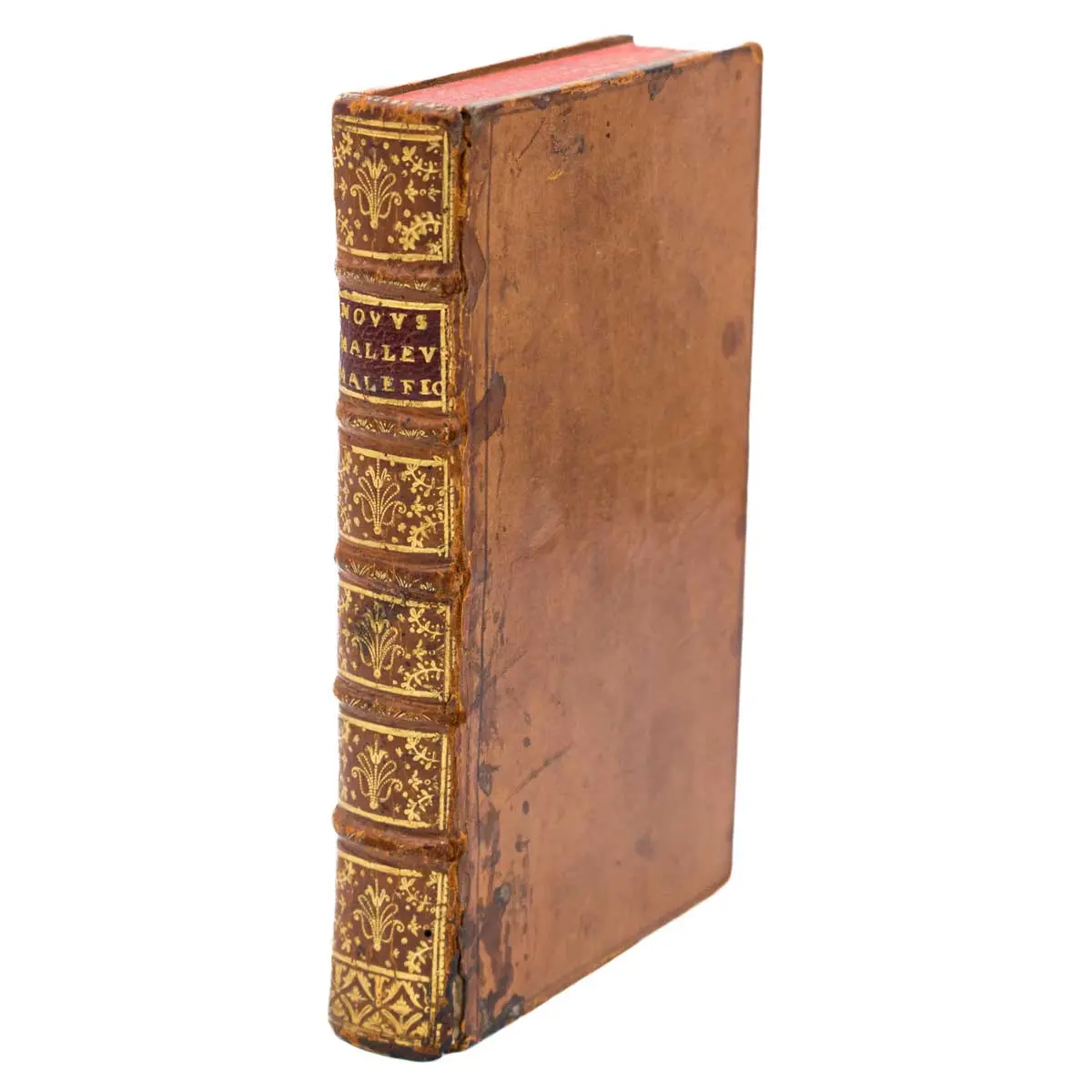
Three Important Tracts on Deomology with the Malleus Maleficarum
FIRST EDITION, pp. [16] 398, printers device to title, ornamental woodcut initials, contemporary calf, spine gilt, red morocco label, a.e.r., marbled endpapers, 8vo, Köln, apud Maternus Cholinus, 1581
£7,500
Bartolomeo della Spina (1475-1546), a papal official and theologian, was a leading defender of the reality of witchcraft in Renaissance Italy. A student of Sylvester Prierias, he studied in Bologna and Padua, eventually being appointed Master of the Sacred Palace in Rome, the chief theologian to the Pope. Under Pope Paul III, he was tasked with tackling the important theological questions raised at the Council of Trent. As a result, della Spina wrote three tracts in 1523, which are included in this work along with the Malleus Maleficarum.
Spina was an extreme supporter of the belief in witchcraft, and an inquisitor during the time of the witch trials at Modena. He quotes at first hand an inquisitor who said in one year at Como he and his ten assistants had burned 1,000 witches. Spina’s major work in this area was his Questio de strigibus, a combination of his three tracts, published in 1523. Written against a background of specifically Italian magic, it upheld the belief in witches, especially their ability to fly by night, have sexual intercourse with demons, and transform into animals. It was written in part as a rebuttal to the sceptic Gianfrancesco Ponzinibio.
Gianfrancesco Ponzinibio, an Italian lawyer, condemned the methods used by the Inquisition to prove the guilt of witches. Writing in 1520, he combined a critique of common people’s credulity with outrage over the injustices of inquisitorial practice, and asserted that civil law had the same authority over witchcraft trials as canon law. Ponzinibio’s major offence was, as a lawyer, to reprove the theologians for improper conduct. Ponzinibio explicitly urged inquisitors to seek the assistance of lawyers throughout witchcraft trials, implying that it would help avoid serious mistakes.
Soon he was answered by Spina, who demanded the burning of Ponzinibio’s treatise. Bartolomeo della Spina argued against the sceptical views by pointing out that, with very few exceptions, those accused by a witch of being at a sabbath ultimately confessed. To this end he advocated spectral evidence, observing that if the confessions of witches sufficed to burn them, their confessions must be accepted as valid evidence against those they named (under torture) as accomplices. Such accomplices all confessed; furthermore, God would not allow truly innocent people to be so defamed. Spina goes on to reason, as evidenced by Ponzinibio’s scepticism and his attack on the Inquisition, Ponzinibio was in fact aiding the witches and ought himself to be prosecuted.
Spina was a very influential demonologist, known for his attempt to discredit the authority of the Canon Episcopi. The Canon Episcopi warned against the Devil’s wiles but characterised them primarily as deceptions. Although it did not mention the Sabbat specifically, Episcopi underscored that, by taking hold of the imagination, the Devil could show humans images of many different events and people, fully persuading them of their reality. This was a core problem for demonologists who wished to argue the reality of magical travel to the sabbat, especially since the Canon Episcopi was later incorporated into canon law via Gratian’s Decretum. The weight of the Episcopi’s stance explains why several witchcraft writers from the first generation display a marked uncertainty on these issues. Spina overcame this by insisting the witches of his time differed so much from those described in the Canon Episcopi that its description of flying women was not relevant to contemporary circumstances.
That a Dominican of such prestige answered the sceptic Ponzinibio indicates the widespread apathy and even resistance to the witch delusion in Italy and elsewhere. An inquisitor such as Spina would naturally see such theories as a serious threat to the teachings of the Church and to its cultural authority in contemporary society. Spina was disturbed by the growth of Aristotelian naturalism and materialism in the Italian intellectual world and tried to use the evidence of witches’ confessions to demonstrate the existence of the soul and spirits, demonic and angelic. Spina’s work placed much weight on the intellectual authority of theologians, which he saw as a principal source of witchcraft belief. The rise of increasingly radical doubts about witchcraft marks an important step in the broader process of secularisation of the debate on metaphysical questions.
In his inquisitorial work, Spina significantly relied on the Malleus Maleficarum. Malleus Maleficarum was, for a long time, the most authoritative and widespread handbook for the prosecution of witchcraft available to judges, lay and ecclesiastical. The fact that Spina’s tracts are published alongside the Malleus Maleficarum is evidence not only of the influential role it has on Spina, but the repute it gives to Spina’s argument against the claim of the Canon Episcopi. Like Bartolomeo della Spina, the Malleus Maleficarum reconciles with the Canon Episcopi by distinguishing between the women described in the Canon Episcopi, and real witches who committed crimes and had made a bargain with the Devil, and by claiming that the delusions of the former did not also apply to the latter.
Although Spina’s work is written in the form of a scholastic treatise employing formal argument, it also contains much anecdotal and folkloristic material, some of it drawn from Spina’s own experience as an inquisitor and persecutor of witches.
[USTC:678744; The Oxford Handbook of Witchcraft in Early Modern Europe and Colonial America, 2013; The Encyclopedia Of Witchcraft And Demonology, Robbins, 1964; The Lancashire Witches: a chronicle of sorcery and death on Pendle Hill, Almond, 2012; Doubting Witchcraft: Theologians, Jurists, Inquisitors during the Fifteenth and Sixteenth Centuries, Duni, 2016]