
 Marshall Rare Books
Observations upon the Marine Barometer, made during the Examination of the Coasts of New Holland and New South Wales, in the Years 1801, 1802 and 1803. By Matthew Flinders, Esq. Commander of his Majesty's Ship Investigator. In a Letter to the Right Hon. Sir Joseph Banks
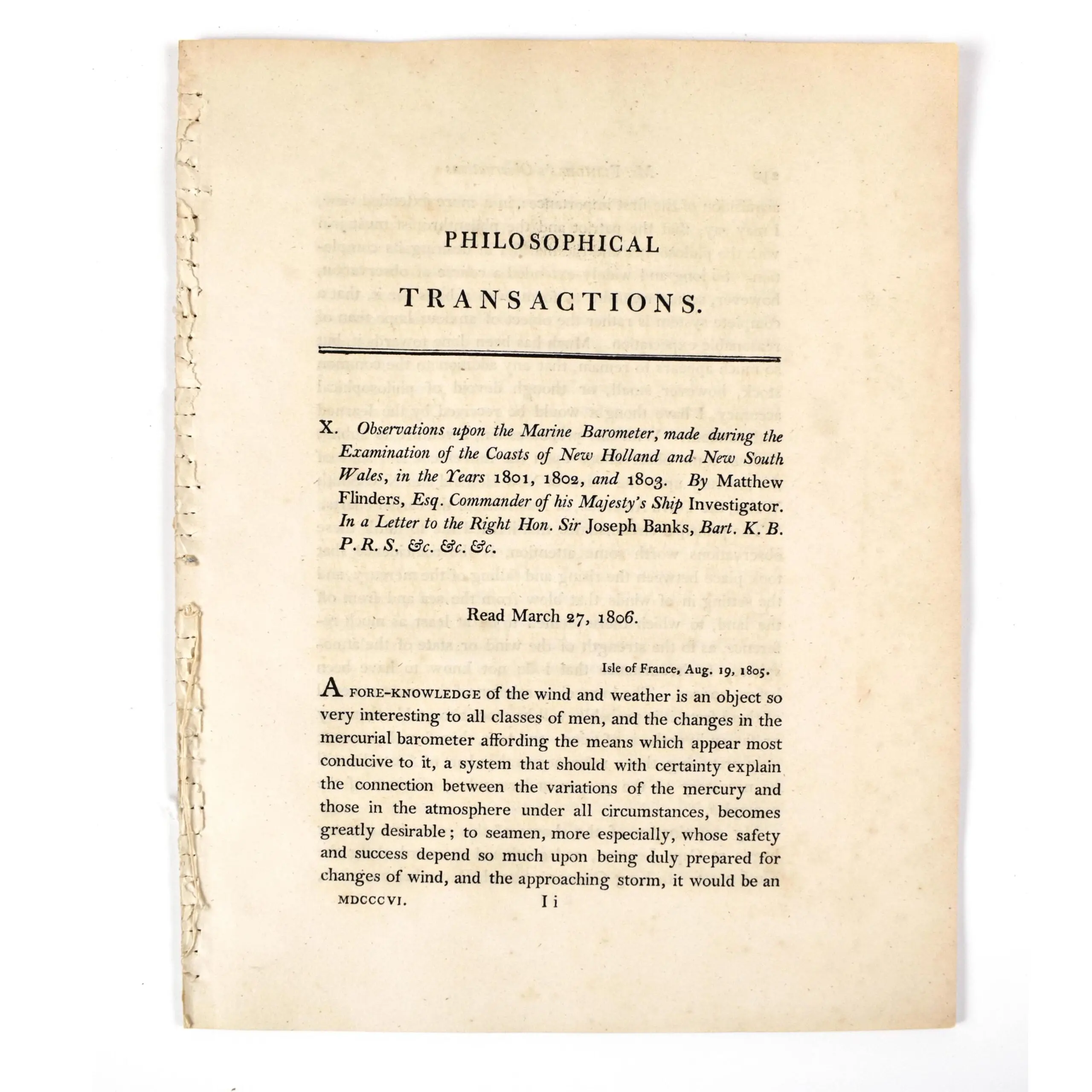
FIRST EDITION, From Philosophical Transactions of the Royal Society of London. For the Year MDCCCVI. Part II, pp. [239]-266, unbound, 4to, 1806.
FIRST EDITION, From Philosophical Transactions of the Royal Society of London. For the Year MDCCCVI. Part II, pp. [239]-266, unbound, 4to, 1806.
Scarce first printing of the important work relating Flinders’ observations on the H.M.S. Investigator, when charting the coast of Australia. Written while imprisoned in Mauritius, it is possibly the first time “Australia” appears in print. Flinders popularised the name Australia and pushed for the name to be formally adopted as early as 1804. Formally known as Terra Australis, he mentions in a footnote “Had I permitted myself any innovation on the original term, it would have been to convert it to Australia; as being more agreeable to the ear, and an assimilation to the names of the other great portions of the earth.”
Mathew Flinders (1774-1814) was a naval officer and hydrographer who charted much of the Australian coast. He first sailed to Australia in 1795, where he explored the southeast coast and circumnavigated the island of Tasmania. In 1801 he returned to Australia, as commander of the Investigator, where he surveyed the entire southern coast, from Cape Leeuwin, in the southwest, to the Bass Strait, which separates mainland Australia from Tasmania. On July 22, 1802, he sailed from Sydney (on Port Jackson) and circumnavigated Australia and again reached Port Jackson on June 9, 1803. In December, on the voyage back to England, the condition of his ship required him to stop at the Île de France (now Mauritius) in the western Indian Ocean. There he was imprisoned by the French authorities and was not allowed to leave for England until 1810.
Despite the hardships of his voyage, he is considered one of the most successful hydrographers of his time. His charts formed the basis of Admiralty charts for most of the nineteenth century.