
 Marshall Rare Books
Of Ghostes and Spirites Walking by Nyght…,
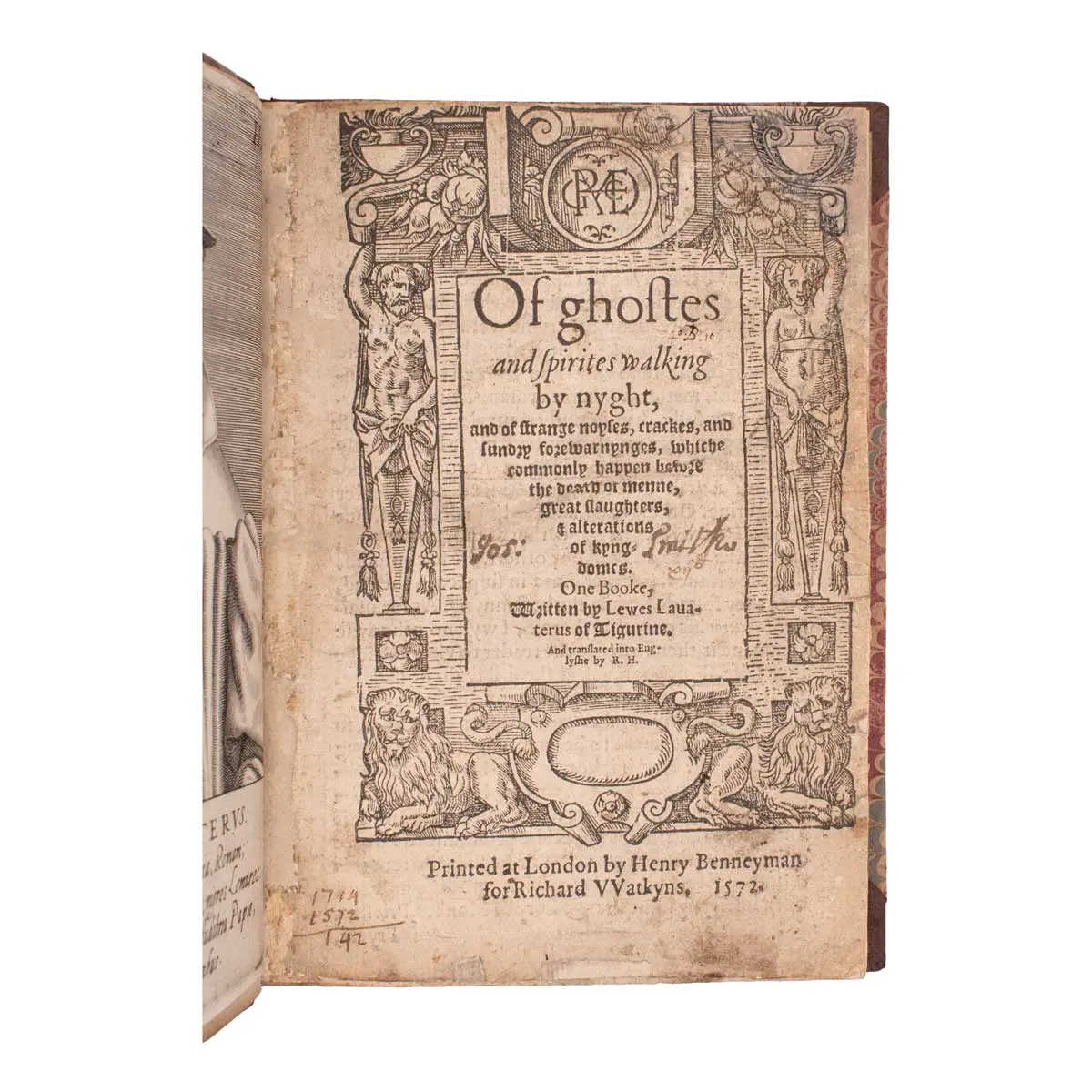
INSPIRATION FOR SHAKESPEARE’S HAMLET
FIRST ENGLISH EDITION, [16],220pp., pages 31, 194-195 and 198-199 respectively misnumbered 13, 198-199 and 194-195, extra illustrated with portrait frontispiece of author, woodcut title boarder, initials and tailpiece, minor repair to the corner of the first 19 leaves not affecting text, later half calf over marbled boards, speckled edges, 4to (185 x 135mm), London, Printed by Henry Benneyman for Richard Watkyns, 1572.
“If it be not a vayne persuasion proceeding through weaknesses of the senses through feare, or some such like cause, or if it be not decyte of men, or some naturall thing… it is either a good or evill Angell, or some other forewarning sent by God.”
One of the most important demonological works of the Reformation era, and credited as a source for Shakespear’s Hamlet.
The Reformation caused a complex cultural and psychological shift, as the Thirty-Nine Articles of 1563 marked the doctrine of Purgatory as a superstition which was ‘repugnant to the world of God’. Given that spiritual visitants could therefore only come from heaven or hell, Protestant ghost-seers were left in the position of having to rule out ghosts of the departed as an explanation. Yet ghosts did not just disappear among Protestants in the absence of a theological place for them. Pre-Reformation pamphlets, sermons and other documents discussing the revenant dead continued to circulate and their stories were told in various settings. Despite not being central to the main theological and ecclesiastical disputes of the Reformation, it did bring forward some key questions that had previously been soothed by the acceptance of familial ghosts; what humans might face after death, and to what extent the natural and supernatural interacted in this world? As such, the preparation of a protestant text which assessed the theological, pastoral, and personal foundations for ideas about the return of the sanctified and unsanctified dead was a pastoral necessity. It was in the context of the refutation of the doctrine of purgatory that reformers began to apply tentative forms of investigation to cases of ghost-seeing, usually with a view to exposing apparitions as the sinister doings of priests and monks. Given that ghost-seeing in sixteenth-century England, or at least the cases considered most worthy of note and dissemination, were explained as the intervention of malevolent spirits, it was inevitable that the issue would become interlinked with demonology and witchcraft.
In 1569, Swiss theologian, Ludwig Lavater (1527-1586) wrote Of Ghostes and Spirites… in order to revise common beliefs about apparitions of demons and human spirits in the post-Reformation world. Lavater expresses here what came to be the dominant view in Protestant theology: what people call ghosts are actually demons or angels. The afflicted may be unable to tell if the apparition is angelic or demonic, but those are the only two options. Although Lavater accepted the existence of ghosts, he dismissed many supposedly supernatural apparitions as the hallucinations of women, like both Johann Weyer and Reginald Scot. As such, Lavater has been seen as providing a clear intellectual and pastoral program for his readers, one that was much more difficult in a pre-Reformation or Catholic Reform world where room for ambiguity remained even in some of the most influential theological texts.
The original edition was first published in the Netherlands in German, but it was soon translated into French, English and Italian and reprinted frequently well into the eighteenth century. It quickly became one of the early modern period’s most popular works on demonology and ghosts. Although written from a distinctly Reformed perspective, Lutheran, Catholic, and Dissenter authors also cited it – and not just to challenge it.
Lavater’s Of Ghostes and Spirites… likely had influence on Shakespeare’s portrayal of the ghost of Hamlet. Lavater says ghosts that are good will confront men in a terrifying way but later will comfort them. In Shakespeare’s Hamlet, during the ghost’s first appearance to the men on guard at night, he frightens them with fear and curiosity. They clamour about the image of the mysterious ghost to Hamlet and bring him outside the castle during the middle of the night. While Hamlet at first was dubious, he was put to ease to see his father again. Though Hamlet ultimately decides to verify the truth of his father’s murder without taking the ghost completely at his word, the question of the apparition’s origin and purpose still haunt the play. Is Hamlet haunted by a demon or by the tormented spirit of his father? Lavater would certainly argue for the former – and his views would go on to influence the likes of Spencer, Milton, and Elizabeth Barrett Browning.
This work is a great rarity with only four copies of the first English Edition for sale since 1921. Over 100 years. The USTC locates fifteen copies in institutions, with three copies held by the Folger.
[ESTC S108369.]