Marshall Rare Books
Original Watercolour Sword-Fencing on the Terrace at Bramshill House, Hampshire, 1873. with The Mansions of England….
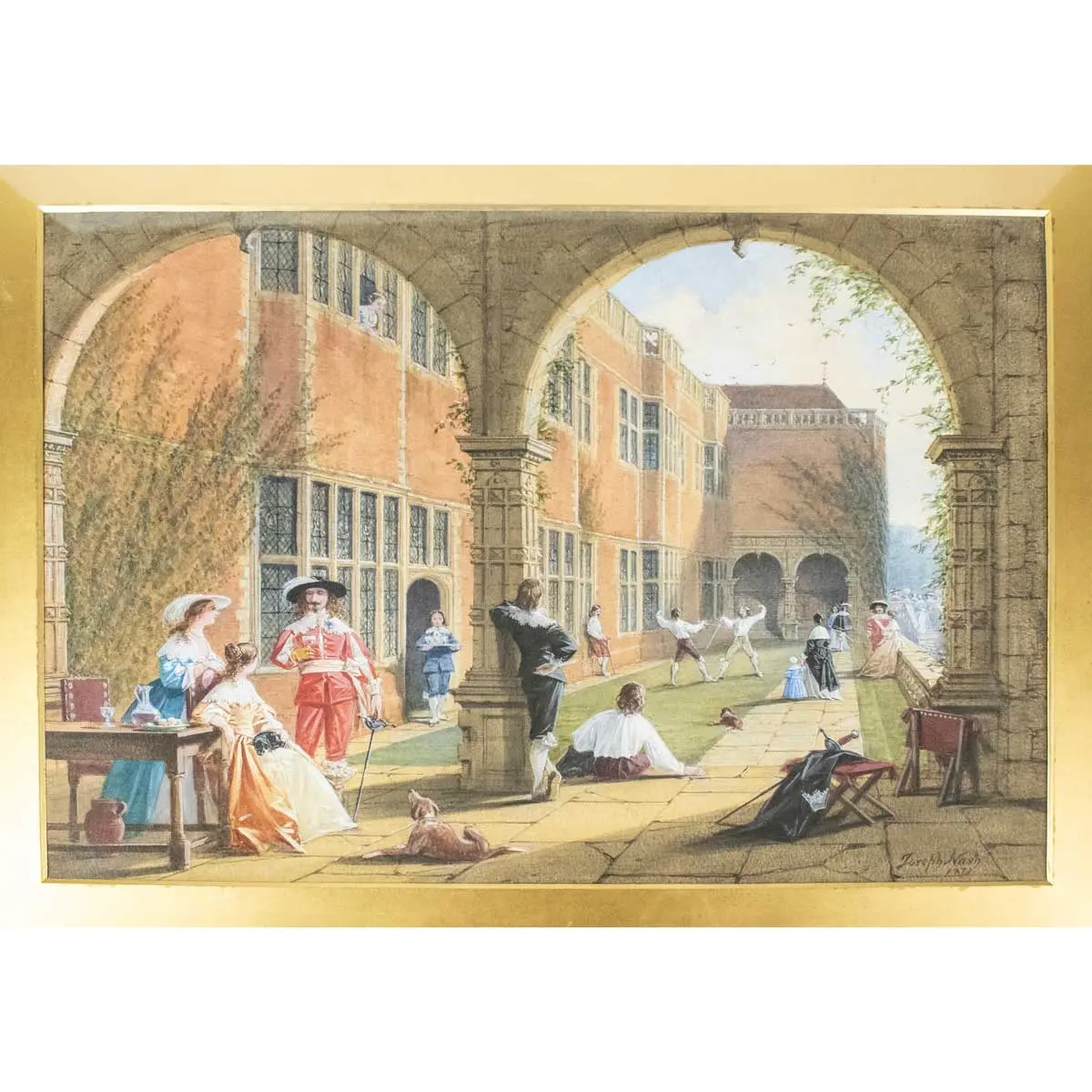
A Highly Accomplished Original (probably) Trial Watercolour by Joseph Nash for ‘The Mansions of England in the Olden Time."
A Highly Accomplished Original (probably) Trial Watercolour by Joseph Nash for ‘The Mansions of England in the Olden Time. Heightened with white bodycolour, signed and dated lower right, 330 x 480 mm, gilt mount, period gilt frame, glazed, with label of J.P. Ballard, Reading Fine Art Gallery, 21 Cross Street, Reading to verso.
With
The Mansions of England in the Olden Time (that includes in volume one a version of the watercolour), 4 volumes, published by Henry Sotheran & Co. 1869-72, additional decorative titles to each volume and 100 llithographic plates, later endpapers, publisher’s red & gilt decorative cloth, folio.
This view can be found in volume one of the accompanying four-volume set. Interestingly,this very attractive and accomplished Watercolour is probably a trial by Joseph Nash that was changed for a watercolour of the gentler game of bowls.
Nash was born in Great Marlow in Buckinghamshire, the oldest son of the Reverend Okey Nash who owned Manor House School in Croydon which Joseph went on to attend. He later studied with the artist and architect Augustus Charles Pugin, with whom he travelled to France to assist and prepare architectural drawings for a book entitled Paris and its Environs, published in 1830.
Having mastered the art of lithography, Nash utilised it in the production of several excellent publications: Architecture of the Middle Ages appeared in 1838, and his four-volume masterpiece, Mansions of England in the Olden Time over a 10-year period from 1839, which involved Nash’s travelling all over the country drawing house interiors and exteriors. He concentrated on the architectural aspects of the buildings, which, using the example of Joseph Strutt, he brought to life with the inclusion of groups of people. The volumes were very popular, with the lithographs circulated widely by newspapers, architects and other artists. The book was so effective it was claimed in Parliament that it was causing an increasing number of people to visit historical buildings