
 Marshall Rare Books
Ornithologiae. Hoc est, de avibus historiae libri XII.
An Early Pirated Edition of Aldrovandi's Famous Work
Frankfurt: Wolfgang Richter and Nicho, 1610. [12], 427, [14] pp.; bound with Ornithologiae. Tomus alter. Frankfurt: Wolfgang Richter, 1610. [6], 373, [14] pp.; bound with Ornithologiae. Tomus tertius et ultimus. Frankfurt: Nikolaus Hoffman and Johann Traudt. [8], 209, [12]. Three volumes in one. Contemporary polished calf with a central gilt crest of Arma Christi to both covers, direct gilt-stamped title,
Occasional discolour and final leaf of index repaired.
Contemporary manuscript annotations correcting the erroneous pagination in gathering C of the third volume. Some worming to the last signature of the last volume.
A very interesting edition of Aldrovandi’s ornithology. Although he began planning his multi-volume encyclopaedia of natural history in the 1570s, the first volume didn’t go to press until 1599, when he was 77 years old. Only four volumes were finished by the time Aldrovandi died in 1605. After his death, his widow, students, and assistants used his extensive collections and notes to bring out nine more volumes of the encyclopaedia. The last volume was published in Bologna in 1668.
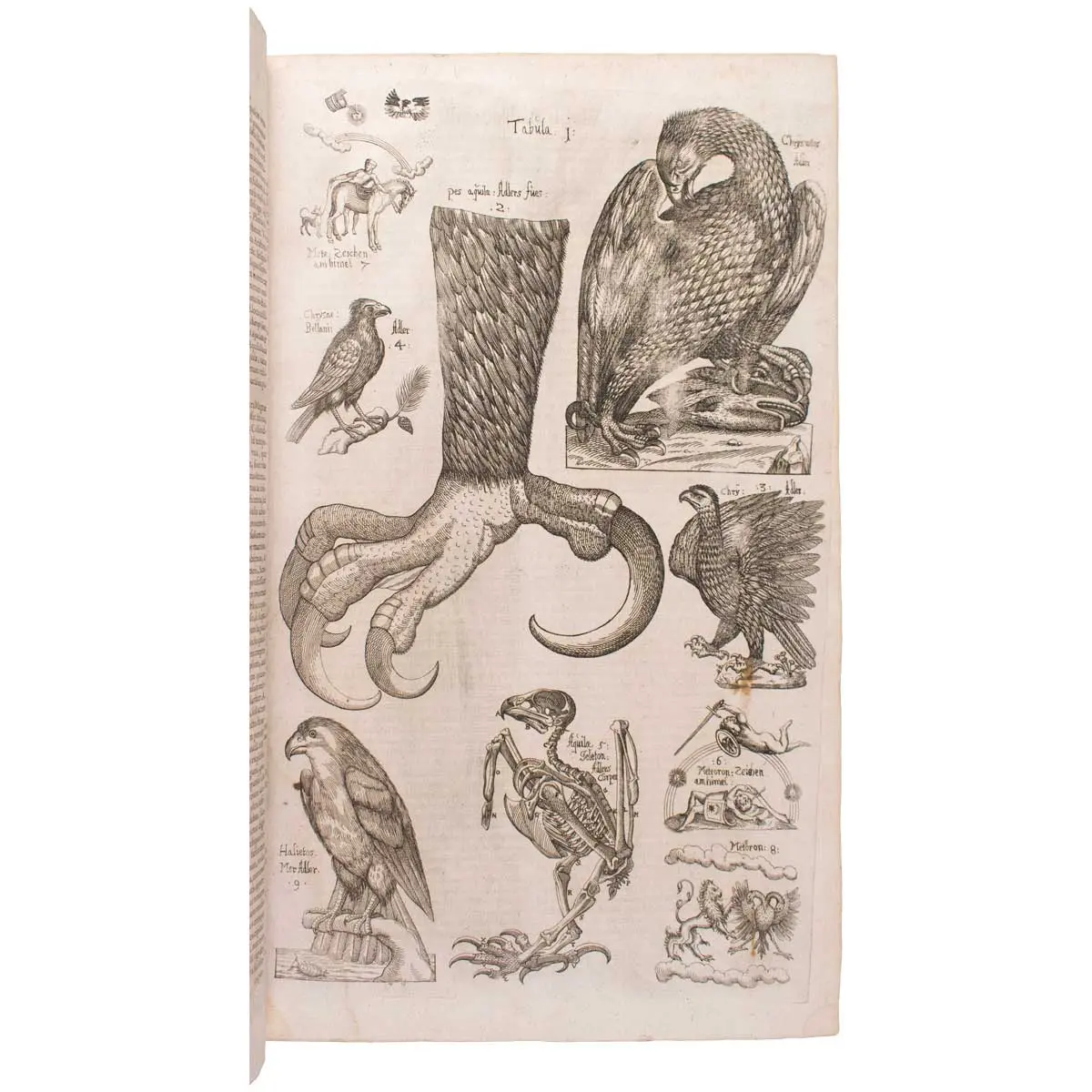
This book was the first volume of a series of pirated reprints done in Frankfurt. In the service of thrift, the Frankfurt editions abandoned the principles of quality in design that Aldrovandi had insisted upon for the Bologna editions. Instead, the piracies were printed in smaller type and laid out in two tight columns. Where the original Bologna editions used woodcut illustrations that could nest easily within the text, allowing for dialogue between word and image, the Frankfurt printers opted to commission copper plates that would combine several of the original illustrations onto one page. The resulting plates are somewhat cramped and chaotic, with a confusing numbering system; often, the engraver has made crude corrections by simply scratching out one number and replacing it on the plate. An interesting example of the way in which the book trade shaped the spread of scientific learning in 17th-century Europe.