
 Marshall Rare Books
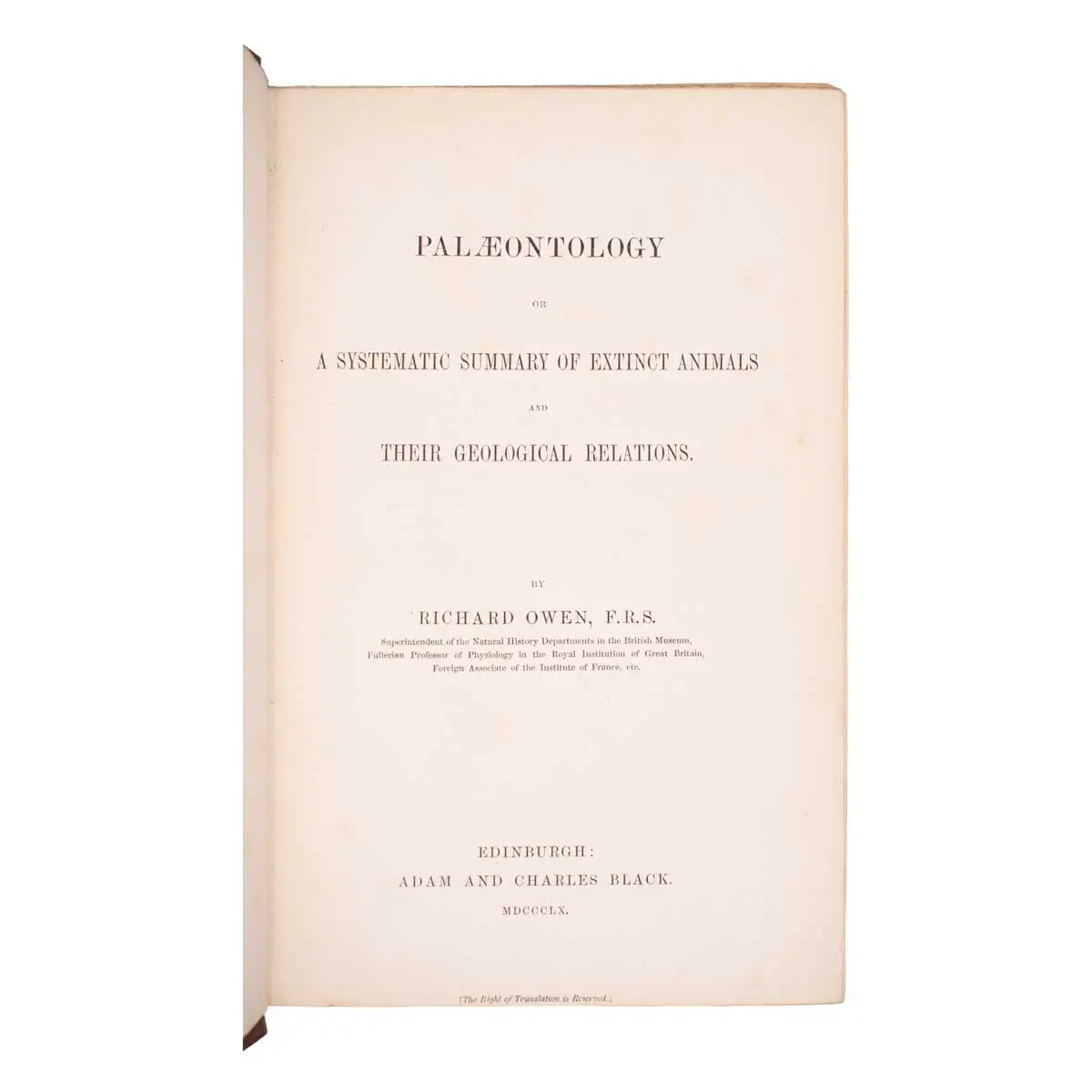
Palæontology or A Systematic Summary of Extinct Animals and Their Geological Relations
Richard Owen was the leading comparative anatomist and palaeontologist of his time, best known for coining the word dinosaur.
FIRST EDITION, folding table of Strata and Order of Animal Life, numerous text illustrations, occasional light foxing to preliminary paes, armorial bookplate and small booksellers label (W.H. Dalton, Charing Cross) to pastedown, publishers brick red cloth, blind stamped, short closed tear to top of spine, 8vo, Edinburgh, Adam and Charles Black, 1860.
Richard Owen was the leading comparative anatomist and palaeontologist of his time, best known for coining the word dinosaur.
Owen was a contemporary of Darwin, and like him, attended the University of Edinburgh medical school but left without completing his training. His career as an outstanding palaeontologist began when he was cataloguing the Hunterian Collection of human and animal anatomical specimens which had passed to the Royal College of Surgeons in London. His public lectures on anatomy were attended by Darwin, and he was entrusted with the classification and description of the fossil vertebrates sent back by Darwin from the Beagle voyage. He was responsible for coining many of the terms now used in anatomy and evolutionary biology, including ‘homoly’ and ‘archetype’.
Owen was an outspoken opponent of Darwin’s Origin of the Species. Although he accepted that evolution occurred, he persistently objected to Darwin’s theory, entering into an academic war of words with Darwin and Thomas Huxley.
Palaeontology defines, describes and classifies all the fossil animal forms then known, and discusses the origin of species, commenting on the theories of Buffon, Lamarck, the then anonymous author of Vestiges of Creation, Wallace and Darwin.