
 Marshall Rare Books
Piscium Serpentum Insectorum aliorumque nonnullorum animalium nec non plantarum quarundam imagines quas Marcus Catesby in posteriore parte splendidi illius operis quo Carolinae Floridae et Bahamensium insularum tradidit historiam naturalem. Eivsqve appendice descripsit Additis Vero Imaginibvs Pisivm Tam Nostrativm Qvam Aliarvm Regionvm avervt Vivisqve Coloibvs Pictas edidervnt Nicolavs Fridiricvs Eisenberger et Georgivs Lichtensteger
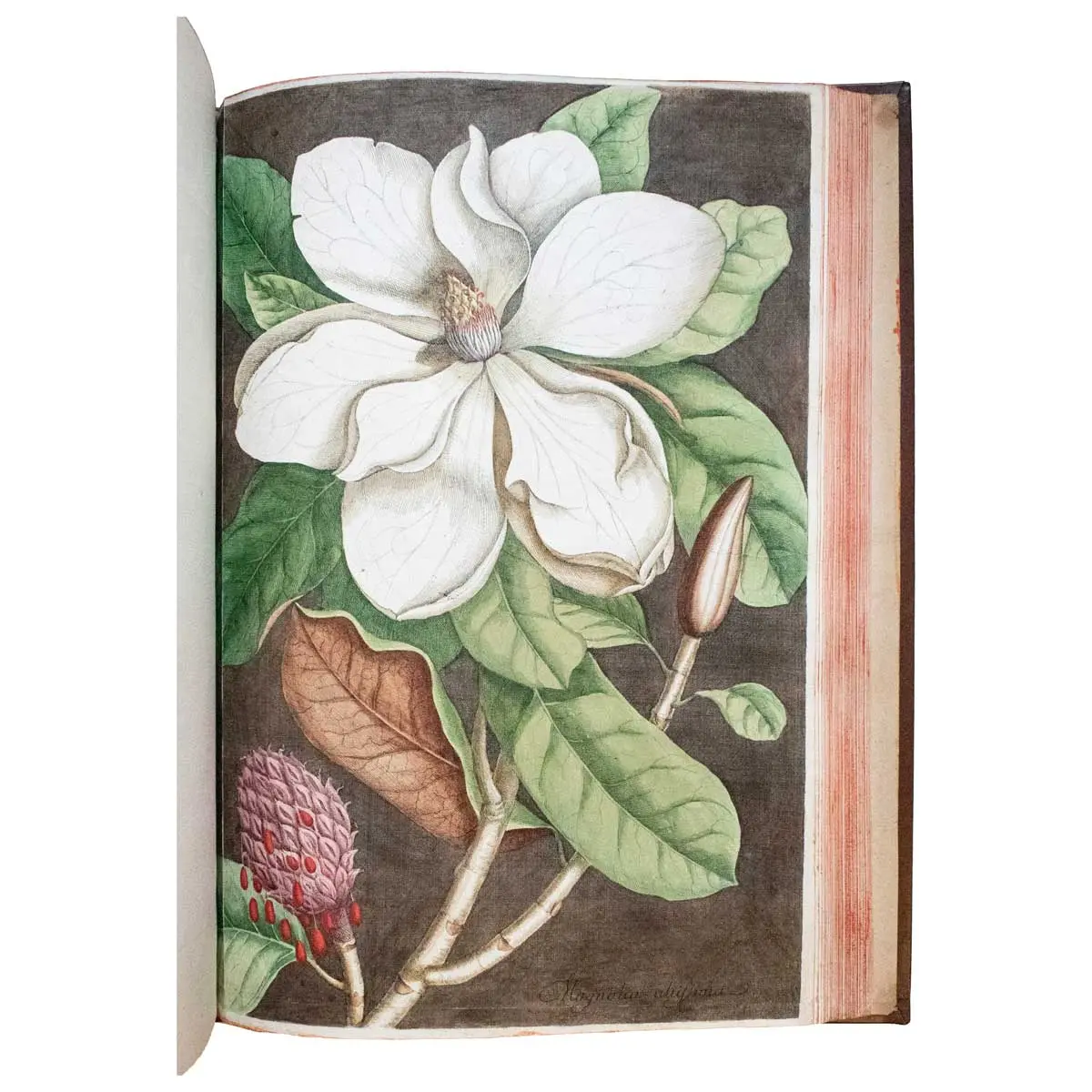
“Catesby’s ‘Natural History’ is the most famous colour-plate book of American plants and animal life” (Hunt 486).
“Catesby’s ‘Natural History’ is the most famous colour-plate book of American plants and animal life” (Hunt 486).
FIRST GERMAN EDITION, Nürnberg, gedruckt bey Joannis Joseph Fleischmann, 1750.Folio (500 x 360mm), Contemporary Calf with elaborately gilt floral borders on both covers, spine with floral urns in compartments, with 100 Hand-Coloured Engraved Plates.
“Catesby’s ‘Natural History’ is the most famous colour-plate book of American plants and animal life” (Hunt 486).
The very rare German first edition of Catesby’s masterpiece with excellent colouring of the plates. The present work describes the fishes, reptiles, insects and some other animals and plants of the New World, which were published in the second volume and the appendix of the first edition of Catesby’s famous work. The first volume of Catesby’s work dealt with birds and a translation in Dutch and German was published separately by Seligmann.
“Mark Catesby, born 24 March 1682, after studying natural science in London, made two sojourns in America, 1712-19 and 1722-26? He resided in Virginia and travelled; sent back seeds; and carried back specimens that impressed Sir Hans Sloane and Dr William Sherard. The second time, he arrived in Charleston in May 1722; travelled in Carolina, Georgia, Florida, and the Bahamas, seeking materials for his projected ‘Natural History’; sent back specimens. Back in London, he devoted himself to the preparation of the book. As he could not afford artists and engravers, and trusted none but himself, he studied etching under Joshua Goupy and did the work himself” (Hunt p. 143).
“Catesby described and illustrated thirty-five different kinds of amphibians and reptiles in his book. Thirty-two of these are recognized to-day as distinct species… Mark Catesby’s ability to distinguish different species of animals was exemplary. He rarely illustrated or gave different names to animals that have not been recognised by later specialists to be valid species? Statistically, this is a far better record than almost every other naturalist who has worked in North America up to the present day. Catesby was indeed a gifted and careful observer of nature” (Kraig Adler. Catesby’s fundamental contributions to Linnaeus’s binomial catalogue of North American animals, published in ‘The Curious Mister Catesby’).
An unusually fresh copy with exquisite colouring of the plates.
Nissen ZBI 846; Nissen ‘Schöne Fischbücher’ 40; Hunt 486 (page 144). See also ‘The Curious Mister Catesby, a truly ingenious naturalist explores new worlds’, edited by C. Nelson & D.J. Elliot.