
 Marshall Rare Books
Planiglobium Coeleste ac Terrestre Argentorati quondam, nunc Opera Jahannis Christophori Sturmii.
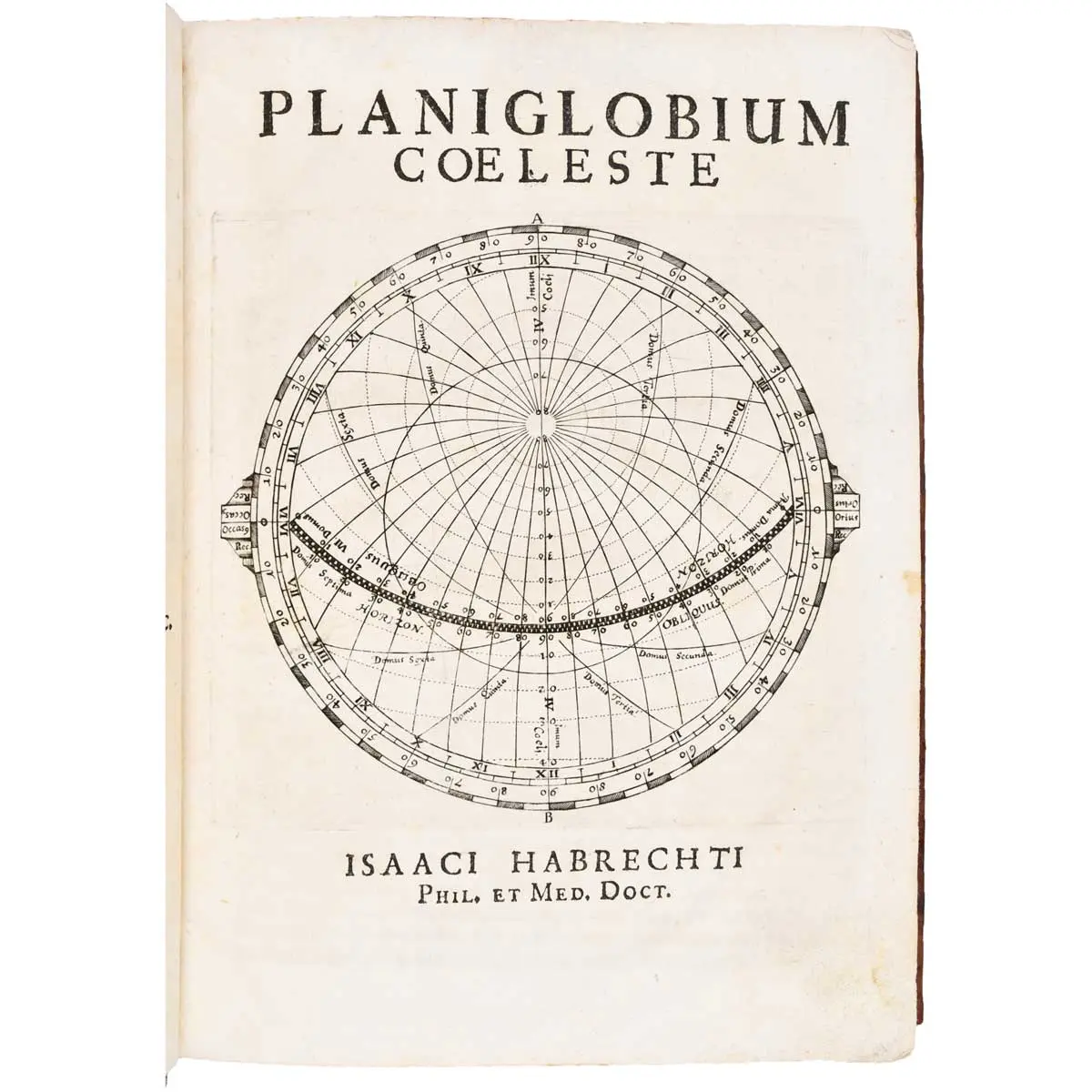
One of the finest Instrument Books Published in the Seventeenth Century
Nuremberg, Fürst, 1666, Enlarged edition by Joseph Sturm, Two Parts in One Volume, 4to, Contemporary panelled calf, gilt border, spine gilt in compartments, a little rubbed, with 14 folding engraved plates. Engraved titles to each part, numerous engravings throughout the text.
First enlarged edition of Sturm’s text with the rare folding plates of Habrecht’s treatise on the construction of celestial and terrestrial globes and planispheres.
One of the finest Instrument Books Published in the Seventeenth Century
Isaac Habrecht II (1589-1633) was doctor of medicine and professor of mathematics and astronomy at the University of Strasbourg. He was one of a famous family, Swiss in origin, of clock and astronomical instrument makers in Strasbourg; his father, Isaac I, constructed the famous Strasbourg cathedral astronomical clock designed by Conrad Dasypodius and completed in 1574. Isaac II designed a famous celestial globe in 1625, which so impressed Jacob Bartsch, Kepler’s son-in-law and coiner of the term ‘planisphere’, that he modelled his own work upon it. This work was accompanied by two planispheres that are rarely present. Of the several copies in Continental libraries, all but one lack the plates. They are, however, present in this work; one is in fact dated 1628.
J. C. Sturm (1635-1703) was Habrecht’s student. He organized the first scientific academy in Germany, the ‘Collegium Curiosum sive Experimentale’ at Altdorf in 1672, and introduced the first course in experimental physics in a German university. In 1662, he undertook the task of augmenting Habrecht’s original text and adding a number of folding plates. The plates include the two Celestial planispheres from the original work, being polar stereographic celestial charts of the northern and southern constellations, printed from the same plates, two handsome polar projections of the world, and ten folded engravings showing the various parts of his ‘planiglobiums’. The plates, superbly executed by Jacob von der Heyden, were probably intended to be mounted and assembled to form several instruments, each with a revolving plate measuring 27 cm in diameter and a movable pointer. Each was to be supported on an approximately 12 cm base. The work is one of the most beautiful instrument books published in the seventeenth century and certainly one of the rarest, particularly with the full complement of plates.
Regarding the two planispheres, Warner writes: ‘Habrecht derived the bulk of the information for this globe from Plancius. The origin of Rhombus – a constellation near the south pole that as reticulum survives today – is unclear. It may perhaps derive from the quadrilateral arrangement of stars seen by Vespucci around the Antarctic pole. In any case, Rhombus as such seems to have made its first appearance on Habrecht’s globe’ (The sky explored p 104).
Houzeau and Lancaster 3039; Zinner 5089; Warner, The Sky Explored, pp 104-5 and 2c