
 Marshall Rare Books
Poems Chosen Out Of The Works Of Samuel Taylor Coleridge.
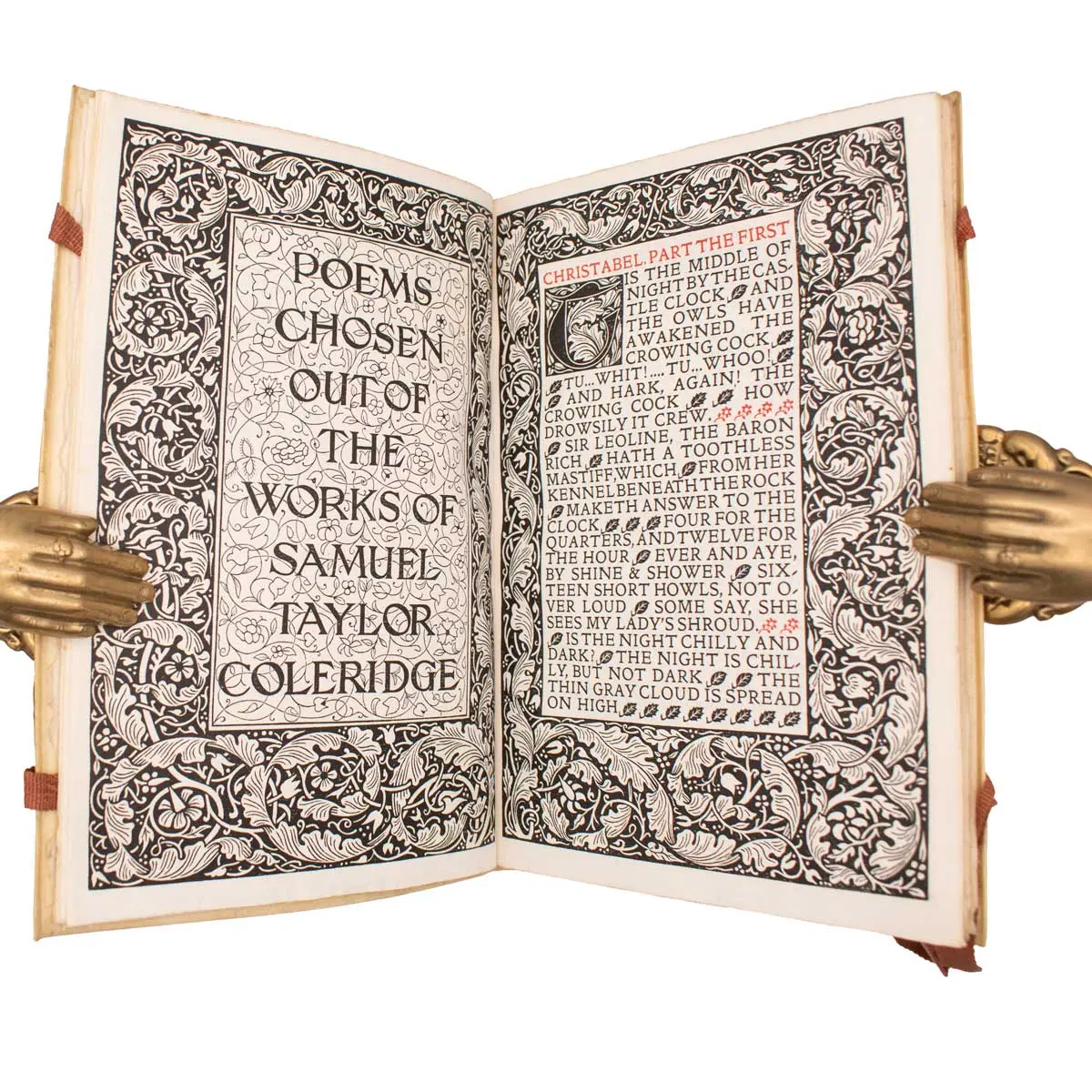
PRESENTATION COPY FROM EDITOR F.S. ELLIS
The Kelmscott Press, Upper Mall, Hammersmith, 1896. one of 300 copies on paper, of a total edition of 308 (8 on vellum). 21.1 x 14.9 x 1.5 cm; pp. [4] + iv + 100. Golden type on Batchelor handmade paper with (the second version of) the Primrose watermark. Two full-pages woodcut borders, three-quarter woodcut borders, and numerous woodcut initials; shoulder-titles, note, side-notes, and a few lines in red. Original full limp vellum, with red silk ties, title gilt on spine.
Samuel Taylor Coleridge is the premier poet-critic of modern English tradition, distinguished for the scope and influence of his thinking about literature as much as for his innovative verse. Active in the wake of the French Revolution as a dissenting pamphleteer and lay preacher, he inspired a brilliant generation of writers and attracted the patronage of progressive men of the rising middle class. As William Wordsworth’s collaborator and constant companion in the formative period of their careers as poets, Coleridge participated in the sea of change in English verse associated with lyrical ballads (1798). His poems of this period, speculative, meditative, and strangely oracular, put off early readers but survived the doubts of Wordsworth and Robert Southey to become recognised classics of the romantic idiom. It is the last of the series to which Tennyson’s Maud, and the poems of Rossetti, Keats, Shelley, and Herrick belong.
Provenance:
Bookplate of Clarence B. Hanson Jr.
Inscription to FFEP, reads “To my dear daughter Phillis Marion Paine in anticipation of her birthday Oct 31. 1899”. Signed F.S. Ellis
Frederick S. Ellis, a bookseller, author and publisher, was a close friend to William Morris, Dante Rossetti, Edward Burne-Jones and John Ruskin – Ruskin called him “Papa Ellis”. As a supporter of the Kelmscott Press, he edited many of the productions, including this work.
In a letter written in response to Ellis on selecting Coleridge’s poems, Morris wrote: “There is absolutely no difficulty in choosing, because the difference between his poetry and his drivel is so striking”.
His daughter, who this book is presented to, conducted the “herculean task” of the initial transcription of the Kelmscott edition of Caxton’s Golden Legend.
[Peterson A38.]