
 Marshall Rare Books
Prodromus Astronomiae, exhibens fundamenta, quae tam ad novum plane & correctiorem stellarum fixarum catalogum construendum.
Danzig, Johann Zacharias Stoll, 1690. Folio [39.2 x 22.9 cm], double page engraved frontispiece displaying an Observatory with a scene of a meeting of Hevelius and other astronomers including Ptolemy, Tycho Brahe, Riccioli, and others, (10) ff. (including general half-title and title), engraved portrait of Hevelius (here bound at front of volume), 142 pp, single-page engraved plate A* bound opposite p. 96 as usual, engraved headpiece and initial, woodcut headpieces, tailpiece and initials, bound without the engraved title to the Firmamentum, Contemporary polished calf gilt, rebacked, replacing the original decorated spine, with gilt swirls and arabesque designs.
Danzig, Johann Zacharias Stoll, 1690. Folio [39.2 x 22.9 cm], double page engraved frontispiece displaying an Observatory with a scene of a meeting of Hevelius and other astronomers including Ptolemy, Tycho Brahe, Riccioli, and others, (10) ff. (including general half-title and title), engraved portrait of Hevelius (here bound at front of volume), 142 pp, single-page engraved plate A* bound opposite p. 96 as usual, engraved headpiece and initial, woodcut headpieces, tailpiece and initials, bound without the engraved title to the Firmamentum, Contemporary polished calf gilt, rebacked, replacing the original decorated spine, with gilt swirls and arabesque designs.
[Bound with:]
____. Catalogus stellarum fixarum ex observationibus multorum annorum. Danzig, Johann Zacharias Stoll, 1687. 143-350 pp., (1) f.
[And with:]
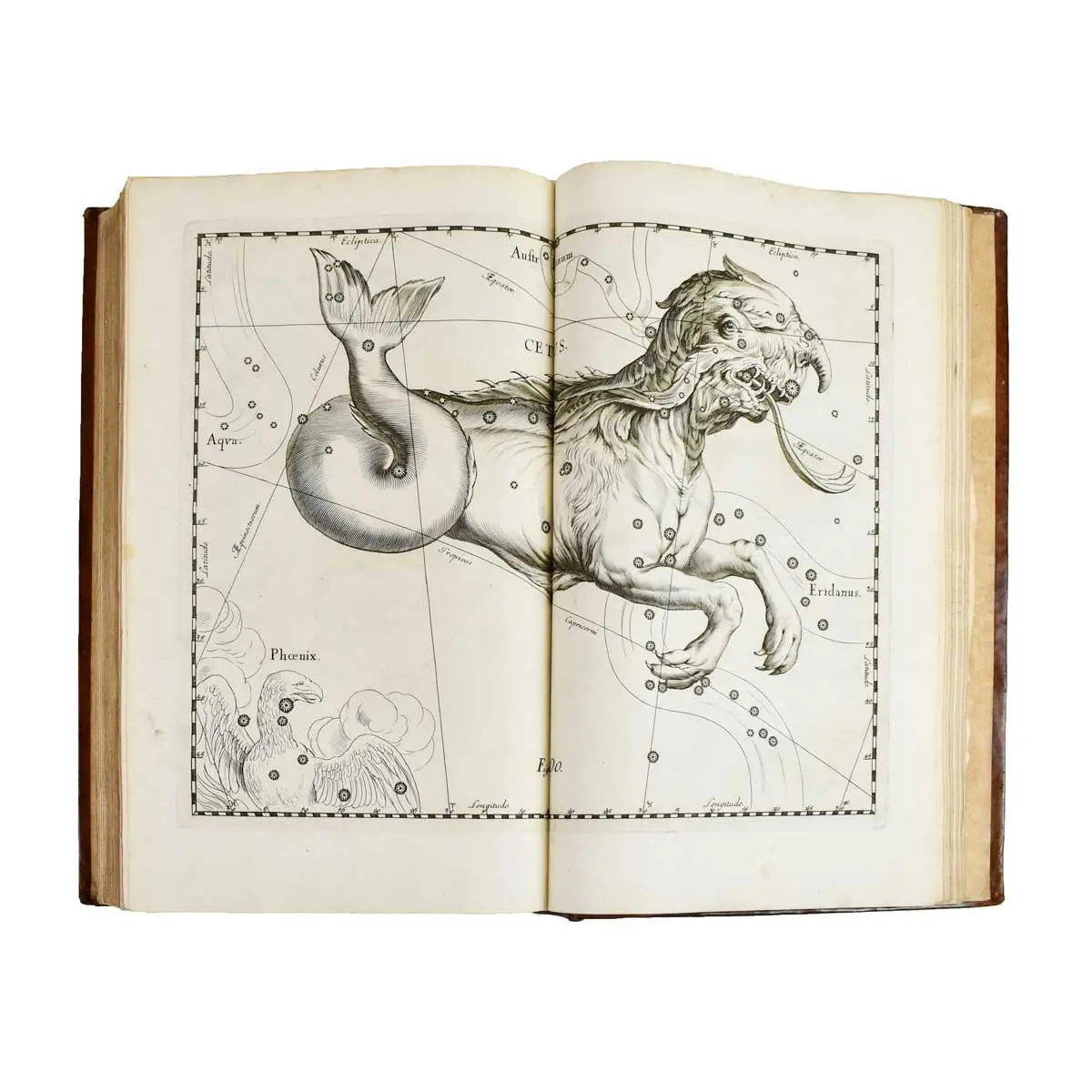
____. Firmamentum Sobiescianum, sive Uranographia, totum coelum stellatum. Danzig, Johann Zacharias Stoll, 1690. (1) f. title, 21 pp., (1) p. circular engraved vignette, with engraved headpiece vignette, (2) oversized folding plates of planispheres & 54 double-page engraved plates of the constellations in excellent fresh impressions.
Rare first edition of Hevelius’ star atlas, along with the Introduction (Prodromus) and the catalogue of stars, together as issued: a fundamental text in the history of astronomy and a spectacular illustrated book. The Firmamentum Sobiescianum is considered the most detailed and influential celestial atlas of its time, both in the formation of subsequent atlases and in the production of celestial globes: “Contemporary globes, such as those by G. C. Einmart, and Gerhard and Leonhard Valk, often acknowledge Hevelius as their source. Later constellation outlines and draftsmanship also owed much to the Uranographia” (North, DSB VI.364).
The star atlas contains 73 constellations, of which 12 are introduced here by Hevelius himself. His discoveries include the Scutum Sobiescianum (the shield of Sobieski, i.e., the shield with which King Jan III of Poland defended Europe against the Turks, and which Hevelius so named to acknowledge the latter’s financial support); the “Lynx”, a grouping of very faint stars named because one needed the sharp eyes of this animal in order to see them; and the “Sextans”, which he called after one of the many astronomical instruments he designed. These names as well as several others coined by Hevelius are still used by astronomers today. The 57 star maps were drawn by the Polish artist Andreas Stech and engraved by Charles de la Haye, though on the basis of his known involvement in making the plates for other works, North has suggested that Hevelius had a hand in these as well.
The publication history for these works is somewhat unclear, as is typical with posthumous publications: Hevelius died in January of 1687, and the work was seen through the press by his widow. Two dates are associated with the Firmamentum: 1687, which appears on the handsome engraved title, and 1690, which appears on the printed title page. The title page of the Catalogus Stellarum is also dated 1687. The printed title page of the Prodromos, however, is dated 1690. This disparity in dates has led some to hypothesize that the star atlas and the Catalogue may have been issued separately for limited distribution in 1687. See the Brigham Young Catalogue, #18, which cites the Harvard copy in its defence: that copy has a frontispiece and plates but does not possess the printed title page nor text leaves. This theory is corroborated by a letter written two months after Hevelius’s death by his assistant Christoph Colbe, indicating that the star atlas was already printed, but publication was delayed until after the Catalogus went to press. It is plausible that all three titles circulated separately as early as 1687. By 1690, however, they were joined (reference is made to “the book”). Most often the three parts circulate together.
* Johannes Hevelius and his Catalogue of Stars, 55-58; J.D. North in DSB VI.360-64; Kenney, p. 83; Warner, The Sky Explored, p. 113, n. 8.