
 Marshall Rare Books
Relacion del viajé par orden de Su. Magd. y Acverdo del Real Consejo de Indias... al descubrimiento del Estrecho nuevo de S. Vicente. y reconosimio. del de Magallanes.
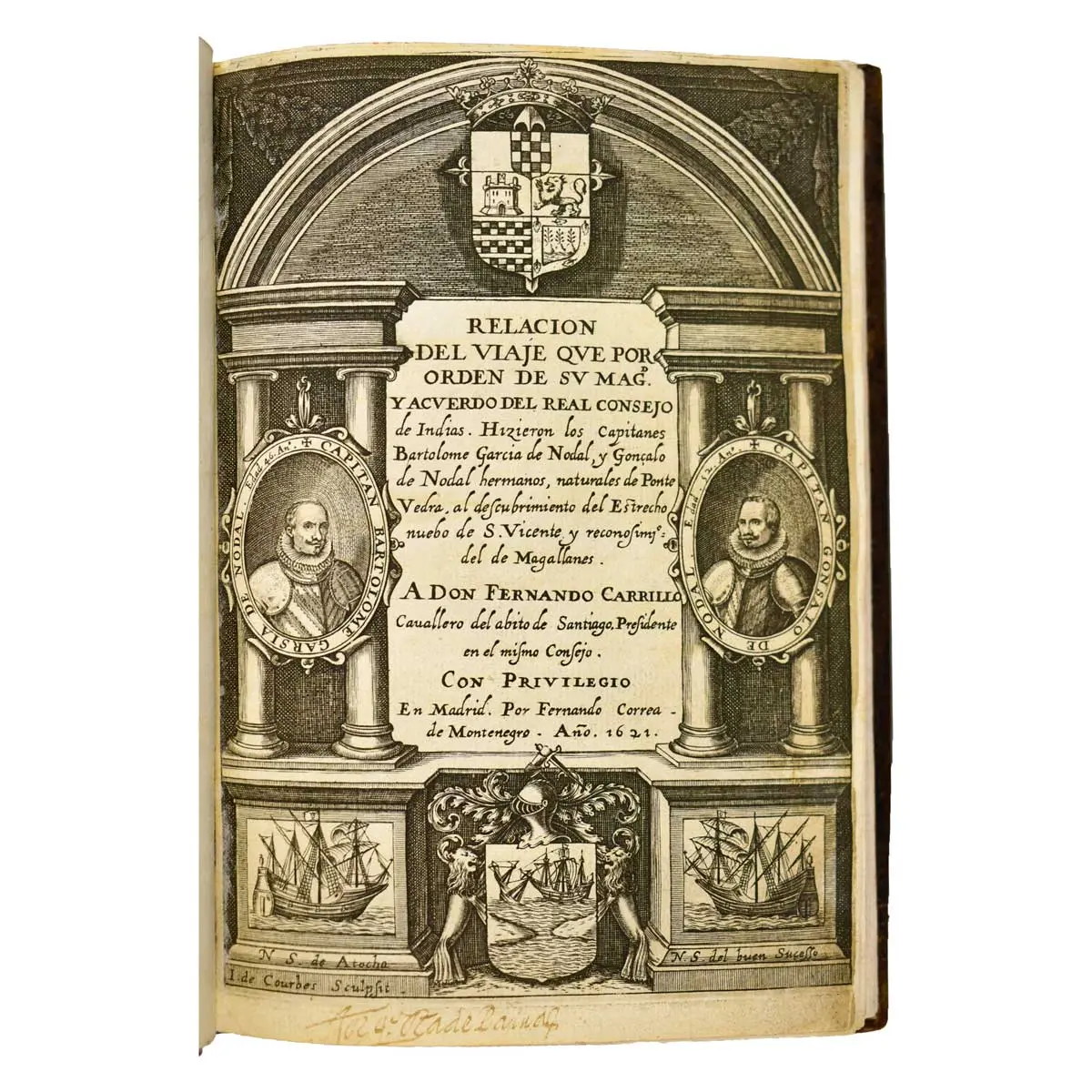
A FINE COPY OF THE FIRST EDITION of this famously rare work which even in the 1860s was described by Sabin as "one of the rarest books of its class." He goes on to note that the map "is almost always wanting." Borba de Moraes comments that "This first edition, particularly with the map, is very rare and in fact is considered one of the rarest travel books of the seventeenth century. Copies containing the map are so rare that it is believed to have been withdrawn [in accordance with the official Spanish policy of secrecy] ... [the book] is of great value as a work of navigation." This copy bound with the map from the second edition.
Madrid: Fernando Correa de Montenegro, 1621, (190 x 140 mm). 18th calf gilt, rebacked, gilt device of a Lyre on upper and lower covers, Engraved title, woodcut engravings on three pages, bound with the engraved map from the second edition.
A FINE COPY OF THE FIRST EDITION of this famously rare work which even in the 1860s was described by Sabin as “one of the rarest books of its class.” He goes on to note that the map “is almost always wanting.” Borba de Moraes comments that “This first edition, particularly with the map, is very rare and in fact is considered one of the rarest travel books of the seventeenth century. Copies containing the map are so rare that it is believed to have been withdrawn [in accordance with the official Spanish policy of secrecy] … [the book] is of great value as a work of navigation.”
This copy bound with the map from the second edition.
This landmark voyage included the first circumnavigation of Tierra del Fuego and was undertaken by the Nodal brothers aboard two specially built caravals. They were dispatched by the Spanish authorities who had become alarmed by the news of the discoveries made by Le Maire and Schouten during their voyage of 1616 in search of the Southern Continent. After a remarkably quick and trouble-free voyage the Nodals returned with accurate observations of the tides in the Straits of Magellan and precise sailing instructions for the area.
The Nodal expedition was a reconnaissance mission sponsored by King Philip III of Spain in 1619. The purpose was to confirm the recent discoveries of Jacob Le Maire and Willem Schouten of a passage from the Atlantic to the Pacific to the south of Tierra del Fuego.
The expedition was led by the brothers Bartolome and Gonzalo Garcia de Nodal, who were accompanied by cosmographer Diego Ramirez de Arrellano, who served as the chief navigator. The expedition departed from Lisbon on September 27, 1618 and by January 22, 1619 the two ships entered the strait discovered by Schouten and Le Maire between Tierra del Fuego and Staten Island. The expedition named the Strait “San Vicente.” The pair reconnoitered the region to the south of Tierra del Fuego including the Drake Passage, before returning to Spain on July 7, 1619.
Le Maire and Schouten, sponsored by independent Dutch merchants, had circumnavigated via the new-found strait from 1615 to 1617. The importance of their find lay in the fact that Spain preferred to operate a closed sea policy in the Pacific; they claimed that their ships were the only vessels allowed to ply Pacific waters. Other nations did not agree with this policy, but the difficulty and distance in passing via the Straits of Magellan prevented many from attempting to enter the Pacific.
Additionally, the Straits were claimed as proprietary territory of the Dutch East India Company, which gave them a veritable monopoly over the passage and prevented non-company ships from passing through, even though the waters were seldom if ever patrolled. The new strait provided a legal avenue for ships of all nations to enter the Pacific, a situation feared by the Spanish whose ports on the western side of South America, already proven vulnerable to sacking by the likes of Francis Drake, were again at risk.
The Nodal expedition was meant to provide the Spanish with vital geographic information about the crucial, yet little known, area around the Straits of Magellan. The brothers established the navigability of the passage and found the Diego Ramirez Islands, which remained the most southerly point visited by Europeans until Captain James Cook sailed in the area in 1775.
Alden & Landis 621/90; Borba de Moraes II:616; Church 386; Hill 1231; JCB (3) II:156; Palau 99485; Sabin 55394.