
 Marshall Rare Books
Sensuyuent les fleurs des histoires de la terre Dorient: copillees par frere Haycon seigneur du Cort: cousin germain du roy Darmienie par le comademet du pape: et sous diuisees en v. pties. La premiere ptye cotiet la situation des royaulmes Dorient. La ii. Ple des seigneurs q'en Orient ont regne depuis lincarnation de nostre seigneur. La.iii. ptie ple des tartaris La.iiii.ple des Sarrazis & des Turez depuis le premier iusqs aux presens q'ont coqueste Rhodes hongrye et dernieremet assailli Autriche. La.v. parle de Sophy roy de Perse Et du prince Tanburlan..
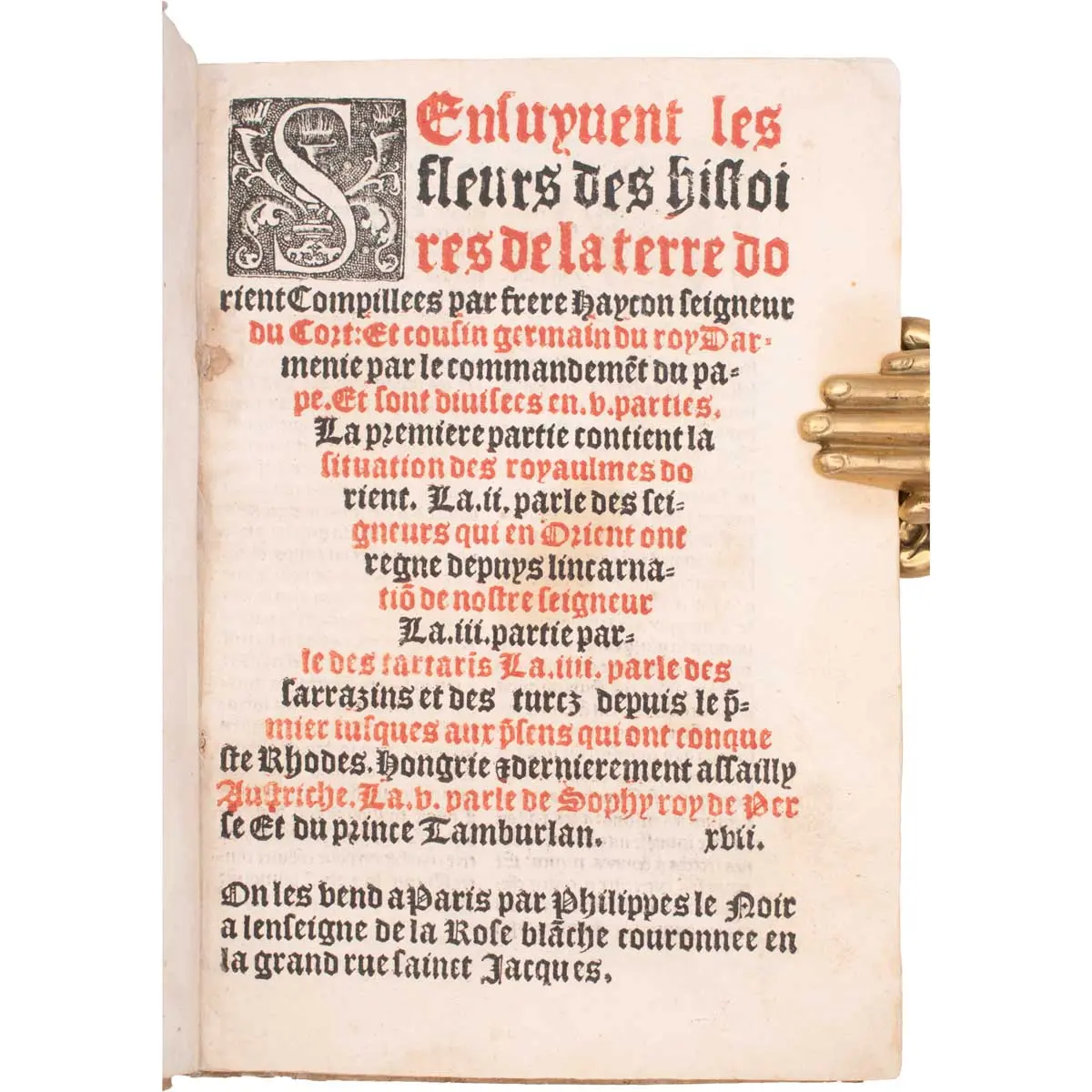
A Mirror To Marco Polo’s Travels, and Profoundly Influenced European Fascination with the East
Paris, Philippe le Noir, [c. 1517], title in red and black, lxx ll, with 12 woodcuts, including one full page,numerous decorated woodcut initials, large printer’s device on verso of final leaf, Contemporary limp vellum, remains of ties.
VERY RARE. Hetoum (or Aitone), an Armenian of princely family, was a monk of the Praemonstrandan abbey of Bella Paise. This work was written around 1305 at Poiders. Much of Mandeville’s material, particularly in Asiatic geography and history, is taken from Hetoum’s work.
Sensuyuent les fleurs de histoires first appeared in 1307 in the city of Poitiers. Dictated in French by the Cilician Armenian statesman and general, Het’um, and then translated into Latin the same year by his secretary, Nicholas Falcon, the work is contained in four books.
Book I is a geographical survey of fourteen countries of the Far East, Central Asia, the Caucasus, Asia Minor, and parts of the Near East. Book II is a brief account of Muslim military history, including the rise of the Saljuqs and Khwarazmians. Book III, the longest, describes the early history of the Mongols, information on the Great Khans, the Il-Khans of Iran, and Mongol warfare in the Middle East, India, Central Asia and the Caucasus to ca. 1304. Book IV contains Het’um’s suggestions to Pope Clement V (1305-14) on initiating a crusade to retake Jerusalem and parts of Cilician Armenia, Lebanon and Syria from Muslim powers, using the combined forces of the Europeans, Cilician Armenians and Mongols. Some scholars have suggested that Book IV was not part of the original French composition, but was added to the Latin translation and then translated into French and appended to the French text. Without Book IV, Het’um’swork is an interesting account of Asian, Middle Eastern, and Mongol history and geography, to be categorized with accounts of 13th & 14th century European visitors to the East.
With Book IV, Het’um’s History enters the ranks of Crusader literature, but with the difference that its author, rather than being a pious and limited cleric, was instead a successful and influential general and tactician who had participated with his troops in numerous Mongol campaigns against the Mamluks and others.
Het’um, born sometime in the mid 1240s, was a son of prince Oshin, lord of Korikos in Cilician Armenia. Though biographical details of his early life are lacking, his family clearly enjoyed great influence in Cilicia. His father, Oshin, was the younger brother of King Het’um I (1226-69).
Prior to the appearance of Het’um’s History in 1307, western Europeans knew about the Mongols primarily from the accounts of clerical travellers to the Far East. Among this determined group were John of Plano Carpini and Brother Benedict the Pole (1245-47), Ascelin and Andrew of Longjumeau (1247-48), William of Rubruck (1253-55), and John of Monte Corvino (1289-1328). As papal envoys, their observations on the daily life of the Mongols and the details of their own harrowing journeys are priceless. However, their often ill-prepared travels were viewed with great suspicion by the Mongols, who found their stated aims puzzling. In any case, with the possible exception of John of Plano Carpini, the envoys’ focus was primarily religious, a circumstance which led to many shocking and painful encounters with the shamanist reality of the Mongols, and to much unintended (and unappreciated) humour. A noteworthy exception was Marco Polo’s Travels (1298). Written by an observant and energetic merchant who spent twenty years in the Orient, Polo’s work was intended to inform and to entertain, which it continues to do. Intertwined with invaluable ethnographic and historical information is a considerable amount of fantasy, including Amazons, dog-headed men, fantastic plants and other marvels.
If Polo’s aim was to write an entertaining best-seller, Het’um’s aim was to start a war. There is no fantasy in Het’um’s History. In the geographical section he describes the countries’ borders, major cities, rivers, mountains, agriculture, exports, religions, and military capabilities. The historical portions (Books II and III) which are remarkable for their breadth, are generally accurate, though Het’um occasionally conflates similar battles fought in the same area, or similar legends (such as the two icons of Edessa), and occasionally, though rarely, is off a year or two in dating events. His shrewd and detailed battle plans in Book IV contain estimates of required troops and materiel; while the preconditions for starting any war, which he lays out in chapter 49, are still valid today. As Het’um had fought Muslim powers diplomatically and on the battlefield for most of his adult life, his work is characterized by a hatred and denigration of Islam and shows a concomitant tendency to emphasize (or overemphasize) Christian currents among the Mongols. This latter, perhaps, was a deliberate exaggeration to further interest or influence Pope Clement V, at whose request the work was written.
The images that appear in this edition of Het’um’s Sensuyuent les fleurs des hystoires de la terre dorient (Paris, ca. 1530) are among the earliest printed representations associated with Tamerlane.
Het’um cannot, of course, have been responsible for the fifth part of the work, dealing with the life of Tamerlane, that appears in this printed edition of ca. 1530.Concerning Tamerlane, of relevance are two small woodcuts in part five, the first illustrating a monarch supervising building work (sig. Qii r), and the second with a monarch in an outdoor setting standing in judgment in front of three men (sig. Rii v). It should be noted at the outset that both woodcuts also occur elsewhere in the book; in other words, these images were not designed specifically for inclusion in part five of Les fleurs, and the monarch seen in the woodcuts cannot be considered an attempt to represent the figure of Tamerlane himself. Nevertheless, it is worth noting that the illustrations occur in the chapters dealing with the Mongols (in part three of the text) and with Tamerlane.
Regarding India, Tamerlane’s Mongol campaigns into India were decisively shaped by the region’s climate. The nomads who supplied the manpower and logistic support for the Mongol cavalry armies depended on pastoral animals adapted to cold and temperate conditions adjusted by migration in Inner Asia. Northwestern India provided suitable conditions in winter, but not in summer. Juvaini remarks on the withdrawal of Chinggis Khan’s Punjab garrison as the summer heat set in, and Ibn Battuta discusses the high mortality of steppe horses exported by the Golden Horde to India. The Mongols could campaign in India only in winter.
Because of this constraint on sustained operations, the purposes of the Mongol invasions appear to have been limited. The attacks at least yielded booty, and the accompanying devastation of the frontier zone kept Delhi’s forces away from Mongol Afghanistan. They may also have enabled use of the frontier lowlands by the Mongol nomads as winter pastures, qishlaqs. Finally, the Mongols probably hoped that enough pressure would compel the Delhi Sultanate, like the Seljuk Sultanate and Armenian Kingdom in the Middle East, to accept vassal status.
But the force applied by the Mongols was insufficient to cow the Delhi Sultanate. The sources claim invasions by hundreds of thousands of Mongols, numbers approximating (and probably based on) the size of the entire cavalry armies of the Mongol realms of Central Asia or the Middle East: about 150,000 men. A count of the Mongol commanders named in the sources as participating in the various invasions might give a better indication of the numbers involves, as these commanders probably led tumens, units nominally of 10,000 men. The small numbers of named commanders mentioned in J. L. Mehta’s work, and the fact that most of these were only generals, not the rulers of the adjacent Mongol realms, seems to suggest that the attacks involved at most a few tens of thousands.
The climatic constraint on sustained operations explains the Mongols’ failure to consolidate their occasional gains in India: Lahore, for instance was repeatedly taken and then abandoned. The hypothesis of small Mongol forces would account for their frequent defeats by the Delhi armies. The 30,000-man cavalry army of Balban (reg. 1266-86) would have been as large as, or larger than, most of the invading Mongol contingents. And finally, the Delhi cavalry was probably better mounted than the Mongols, probably better armed, and possibly better trained. The few horses to survive the climate of Delhi had to be carefully tended and well fed, and consequently could grow larger than the Mongols’ steppe-grazed ponies. And the cream of the Delhi army were slave-soldiers, whom we know from other cases (the mamluks of the Abbasids and of Egypt) could be trained to extraordinary skills with arms.
It can therefore be assumed that the compilers of the text wanted these images to complement the issues dealt with in those parts of the text, and to function as a means for readers to visualize peoples of Central Asian origin. The woodcut of the monarch standing in judgment is the lessassured of the two images. The dress and hairstyles of the figures are consistent with the fashions of early-sixteenth-century Europe, while the full beard of the king and the shape of his crown only confirm his European origin. The other woodcut certainly contains numerous European features, including the style of the architecture and the costumes of the workmen, but the ruler is given some unusual details in his overall appearance. He is bearded but lacks a moustache, and most of his facial hair seems to grow below his chin. His headgear is not the conventional crown but rather what seems to be a combination of a turban (or perhaps a raised cap) and a diadem,while his topcoat is tied by a cord or sash that hangs down on his right side. Another significant feature is the “pearled” border running around his cuffs and the hem of his topcoat.
Brunet 28256