
 Marshall Rare Books
The British Herbal: An history of plants and trees, natives of Britain, cultivated for use, or raised for beauty.
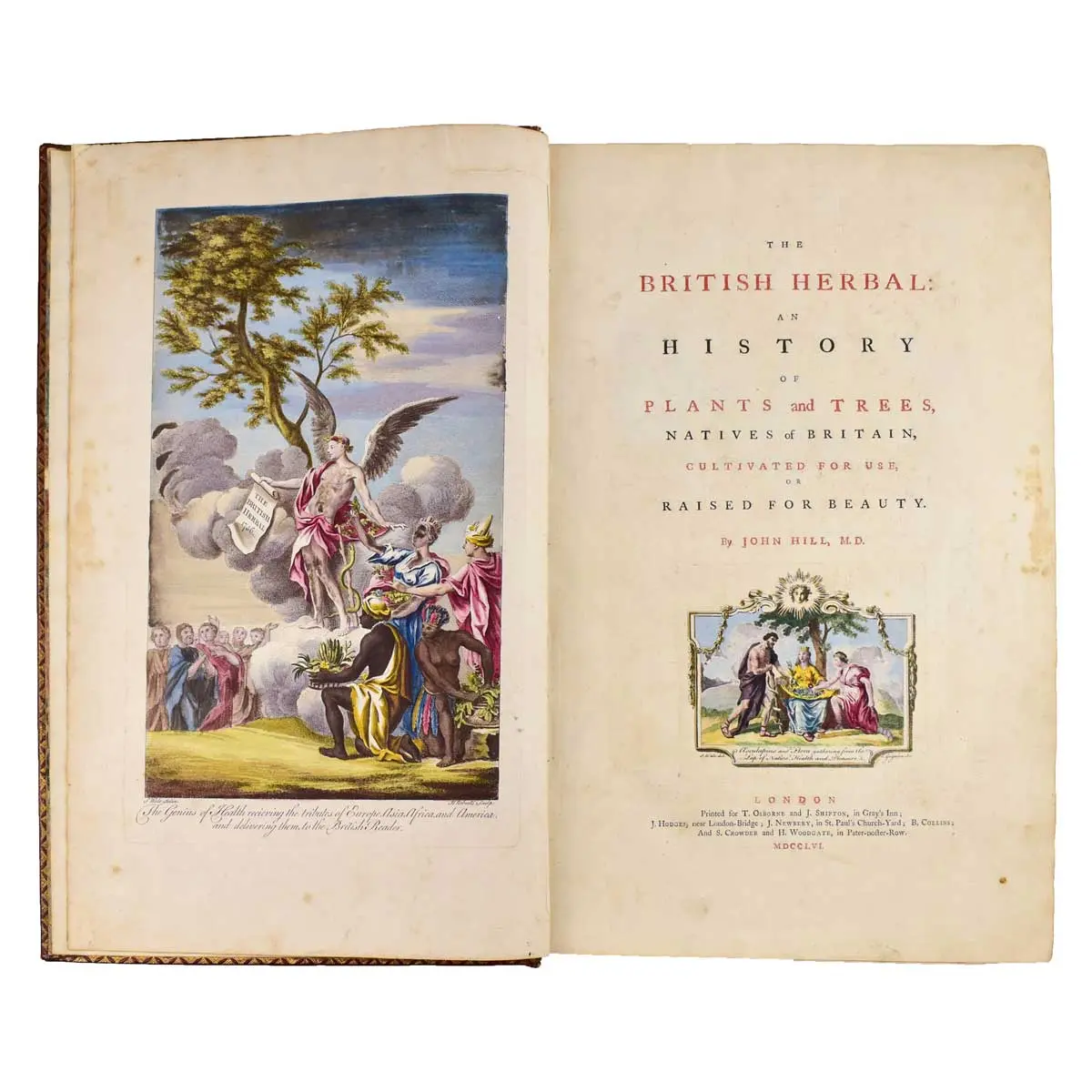
London: T. Osborne and J. Shipton, 1756, Folio (460 x 280mm.), engraved allegorical frontispiece, title vignette, title printed in red and black, dedication with engraved arms, 75 engraved plates, all coloured by a contemporary hand, contemporary straight-grained red morocco gilt with gilt spray on covers, plate 63 mounted.
London: T. Osborne and J. Shipton, 1756, Folio (460 x 280mm.), engraved allegorical frontispiece, title vignette, title printed in red and black, dedication with engraved arms, 75 engraved plates, all coloured by a contemporary hand, contemporary straight-grained red morocco gilt with gilt spray on covers, plate 63 mounted.
A Splendid Special Royal Paper Copy of Hill’s Important Herbal in a Full Contemporary Red Morocco Binding.
FIRST EDITION. “The genera and species are clearly described in The British Herbal, and the work is of importance as being one of the first publications to appear after the Species plantarum of 1753, the year internationally accepted as the starting-point for modern botanical nomenclature… The British Herbal is also of interest for Hill’s criticism of Linnaeus” (Henrey).
His personal and scurrilous writings involved him in many quarrels. Henry Fielding attacked him in The Covent Garden Journal, Christopher Smart wrote a mock-epic, The Hilliad, against him, and David Garrick replied to his strictures against him by two epigrams, one of which runs: “For physics and farces, his equal there scarce is; His farces are physic, his physic a farce is.”
He had other literary passages-at-arms with John Rich, who accused him of plagiarizing his Orpheus, also with Samuel Foote and Henry Woodward. From 1759 to 1775 he was engaged on a huge botanical work–The Vegetable System (26 vols fol.)–adorned by 1600 copper-plate engravings. Hill’s botanical labours were undertaken at the request of his patron, Lord Bute, and he was rewarded by the order of Vasa from the King of Sweden in 1774. He had a medical degree from Edinburgh, and he now practised as a quack doctor, making considerable sums by the preparation of vegetable medicines.
Of the seventy-six separate works with which he is credited in the Dictionary of National Biography, the most valuable are those that deal with botany particularly The British Herbal. He is said to have been the author of the second part of The Oeconomy of Human Life (1751), the first part of which is by Lord Chesterfield, and Hannah Glasse’s famous manual of cookery was generally ascribed to him (see Boswell, ed. Hill, iii. 285). Dr Johnson said of him that he was “an ingenious man, but had no veracity.”
Nissen BBI 881; Henrey 799; Hunt 557; Pritzel 4063