
 Marshall Rare Books
The First Booke of the Historie of the Discoverie and Conquest of the East Indias, Enterprised by the Portingales, in their Daungerous Navigations...
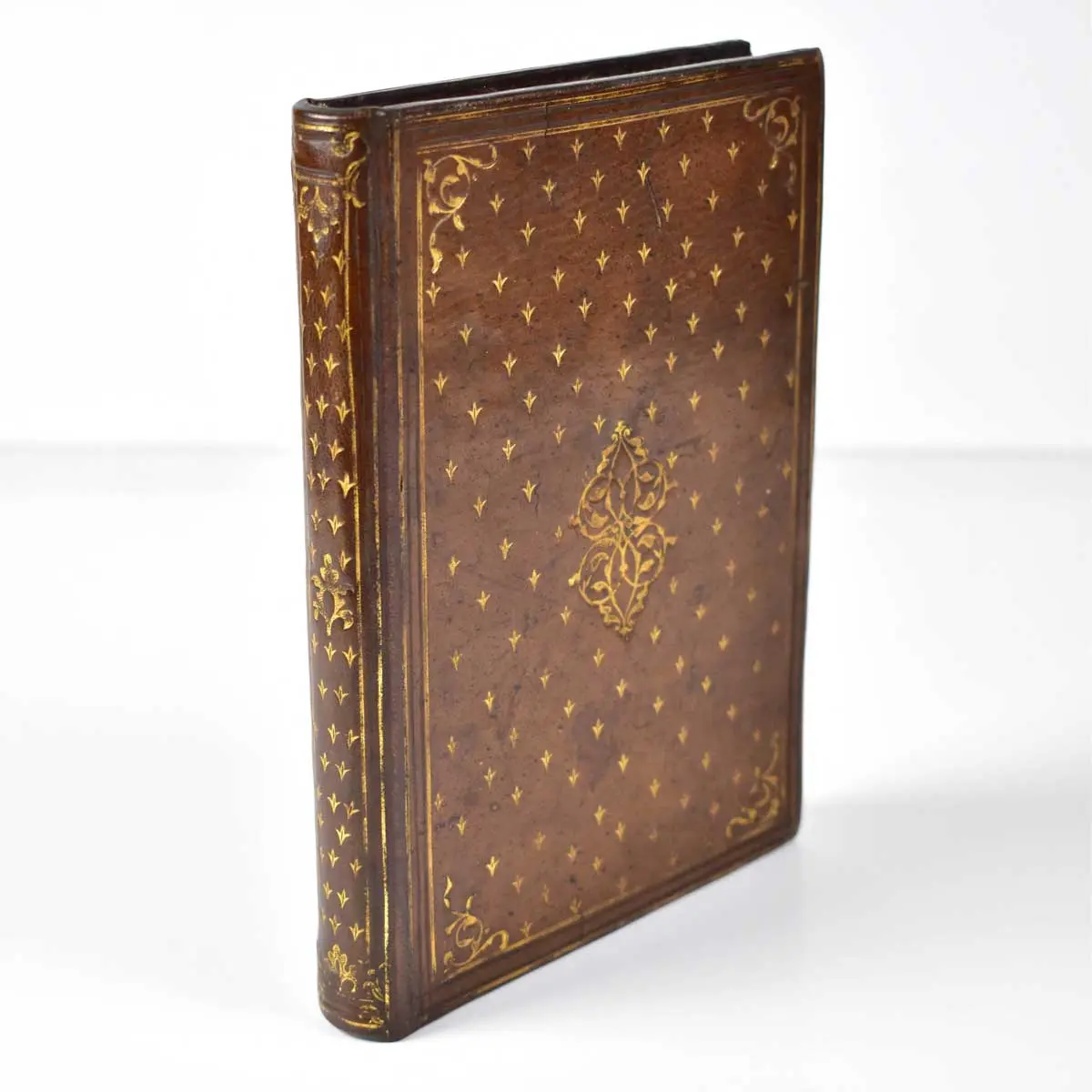
London: Thomas East, 1582, Small quarto (194 x 137 mm). 170 leaves, woodcut border device surrounding title, early ms on verso, woodcut initials throughout, an early but later calf binding with elaborate gilt drops, central gilt device on both covers, a very attractive binding. First English edition of one of the first works in English on World Exploration. Dedicated to Sir Francis Drake. Originally published in Coimbra in 1551, the present text represents one of the most important historical works of the first great age of discovery. Translated by Nicholas Lichfield.
London: Thomas East, 1582, Small quarto (194 x 137 mm). 170 leaves, woodcut border device surrounding title, early ms on verso, woodcut initials throughout, an early but later calf binding with elaborate gilt drops, central gilt device on both covers, a very attractive binding.
First English edition of one of the first works in English on World Exploration.
Dedicated to Sir Francis Drake.
Originally published in Coimbra in 1551, the present text represents one of the most important historical works of the first great age of discovery. Translated by Nicholas Lichfield.
Most of the …Historie… is devoted to the great Portuguese thrust into Asia in the early 16th century, chronicling their epic expansion to India, the East Indies, and China between 1497 and 1525. Castanheda himself spent some two decades in the Portuguese colonies in the East, and so was well equipped to write this account. It is one of the primary sources for the early Portuguese trading empire, a model that the British were beginning to emulate at the time of publication. Penrose says of the author: “…he wrote an impartial book of outspoken sincerity which was the fruit of years of residence in the East.” This work is equally important, however, for its American content, being the first to describe in detail the voyage of Cabral and his discovery of Brazil in 1500, while on his way out to the East Indies. Cabral’s landing is the first recorded there, recounted in Chapters 29-31 of the present work.
Castanheda was the natural son of a royal officer, who held the post of judge in Goa. In 1528, he accompanied his father to Portuguese India and to the Moluccas. There he remained ten years, from 1528 to 1538, during which he gathered as much information as he could about the discovery and conquest of India by the Portuguese, in order to write a book on the subject. In 1538, he returned to Portugal, having collected from written and oral sources material for his great historical work. In serious economic difficulties, he settled in Coimbra, where he held a modest post of bedel in the University of Coimbra.
“This English edition is very rare” (Hill). “A most interesting and rare book” (Sabin). Not in Church. Scarce.
European Americana 582/54; Hill 1035; Borba de Moraes 166-67; Penrose, Travel and Discovery in the Renaissance 274-79; STC 16806; Sabin 11391; Streeter Sale 26