Marshall Rare Books
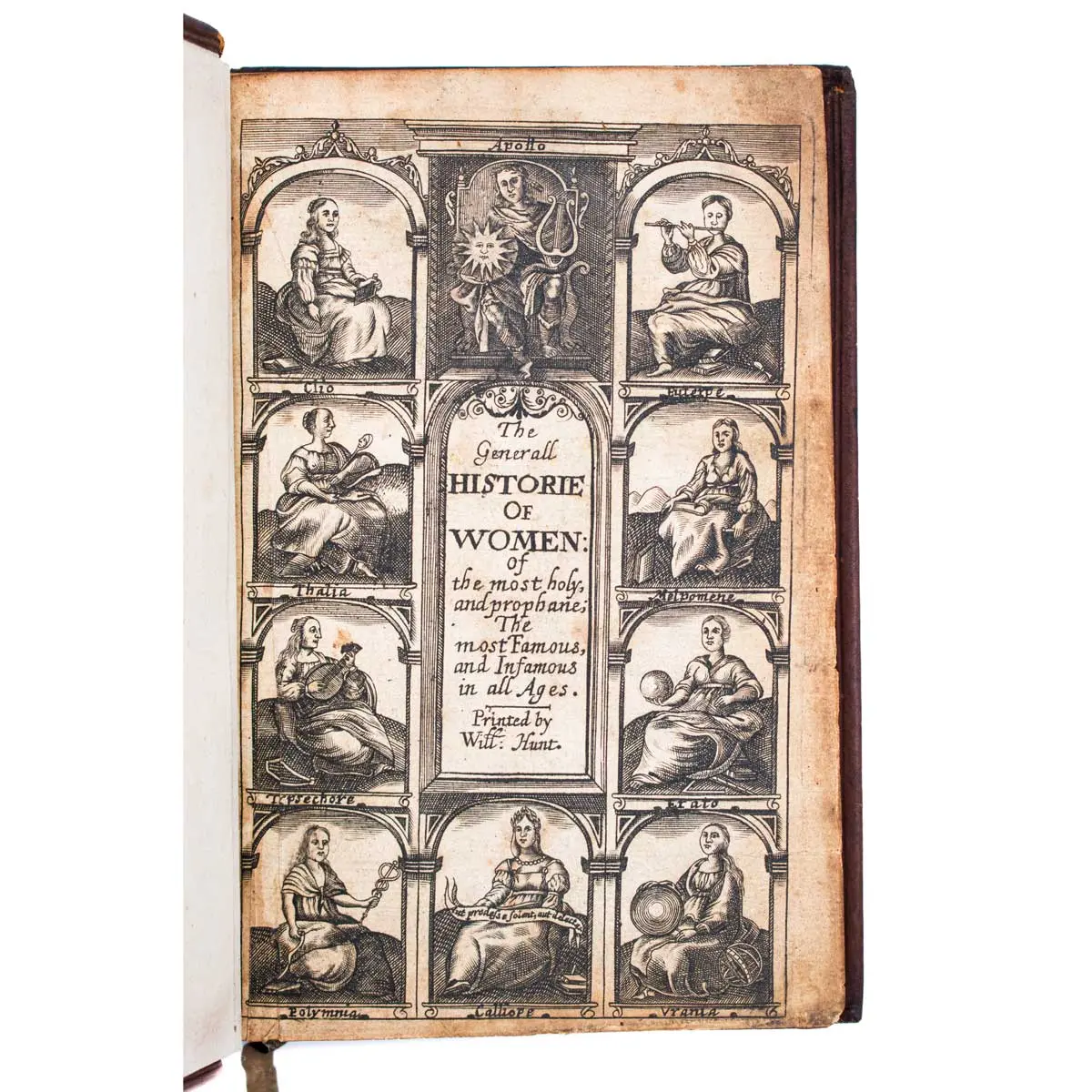
The Generall Historie of Women of the the most holy, most profane; The most Famous and Infamous in all Ages.
A very scarce work on influential women, both admired and maligned.
FIRST EDITION, [16], 193, 192-651, [1], additional engraved title depicting Apollo and the nine muses by William Hunt, woodcut initials, head and tailpieces, a few early ink inscriptions, occasional foxing, later full polished calf, a.e.g., 8vo, London, by W.H. for W. H., 1657.
In the mid-seventeenth century there was a general enthusiasm for encyclopaedic reference works. English playwright Thomas Heywood capitalised on this demand with a work dedicated to the position of women. He offers a large number of exemplary histories of women from classical and modern periods. His treatment of witches is brief, given the size of the work as a whole.
Heywood was known to be cynical on the subject of witchcraft, as evidenced by one of his most famous plays ‘The Late Lancashire Witches’ (1634), which he wrote in collaboration with Richard Brome. Yet in this work he recounts, as fact, all the contemporary myths, superstitions and common beliefs of the capacities of witches; including sections on demon-assisted transportation, shapeshifting and controlling the weather. Heywood comments on the trials and treatises written by famous demonologists like Kramer and Sprenger, Bodin, and Del Rio. He also describes classical witches like Circe and Medea, and the biblical villainy of Jezebel and Delilah.
Written during a time of relatively few witch trials in England, Heywood brought the threat of witches back into the public consciousness, once again exploiting the public interest in the scandalous subject of witchcraft.
[Wing H1784; ESTC R10166; Reading Early Modern Women’s Writing, Salzman, 2006; Riding the Nightmare: Women & Witchcraft, Williams, 1978]