
 Marshall Rare Books
The Mammal-Like Reptiles of South Africa and the Origin of Mammals
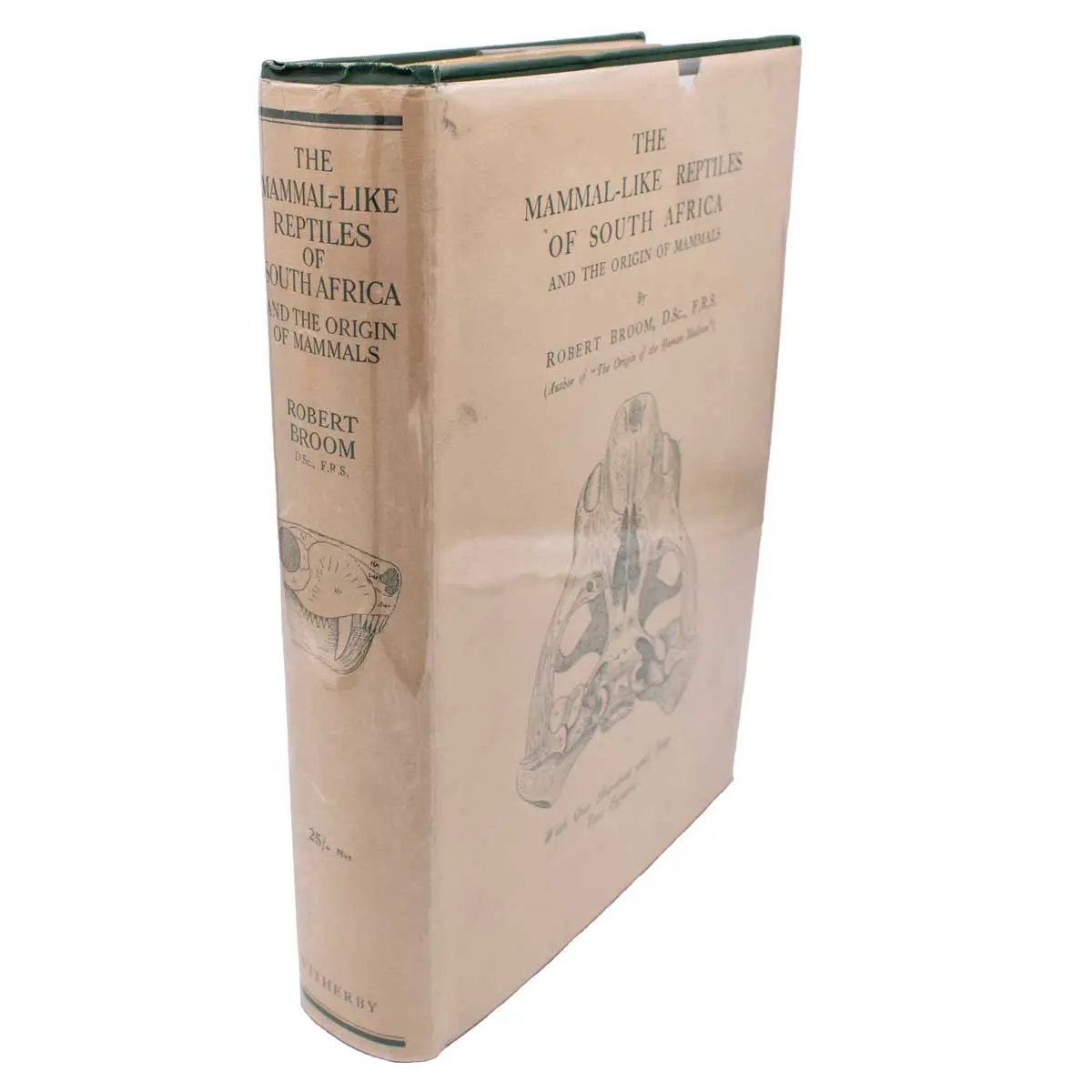
FROM THE LIBRARY OF FAMOUS PALEONTOLOGIST JOSEPH T. GREGORY
FIRST EDITION, xvi,376pp., 111 text illustrations, bookplates and ownership stamp on pastedown of Joseph T. Gregory, publishers green cloth, dust jacket with slight chipping, 4to, London, H. F. & G. Witherby, 1932.
Broom’s early work in South Africa identified hundreds of mammalian holotypes, herein drawn and catalogued.
Robert Broom was first known for his study of the mammal-like reptiles of South Africa. After Raymond Dart’s discovery of the Taung Child, an infant australopithecine, Broom’s interest in paleoanthropology was heightened. In 1936 Broom began collecting fossils from miners, leading to the first discovery of an adult Australopithecus africanus, an early hominin. In the following years, he and John T. Robinson made a series of spectacular finds, including fragments from six hominins in Sterkfontein, which they named Plesianthropus transvaalensis, popularly called Mrs. Ples, but which was later classified as an adult Australopithecus africanus, as well as more discoveries at sites in Kromdraai and Swartkrans. In 1937, Broom made his most famous discovery of Paranthropus robustus. Crews continue to work at Sterkfontein, and the site has been one of the richest sources of information about human evolution, yielding more than 500 fossils.
Robert Broom’s life’s work holds an important place in evolutionary theory, and his name is commemorated in the scientific names of several reptiles.
Provenance:
Joseph T. Gregory, American paleontologist and professor of paleontology at the University of California.