
 Marshall Rare Books
The Natural History of Lancashire, Cheshire, and in the Peak in Derbyshire, with an Account of the British, Phoenician, Armenian, Greek, and Roman Antiquities in those Parts.
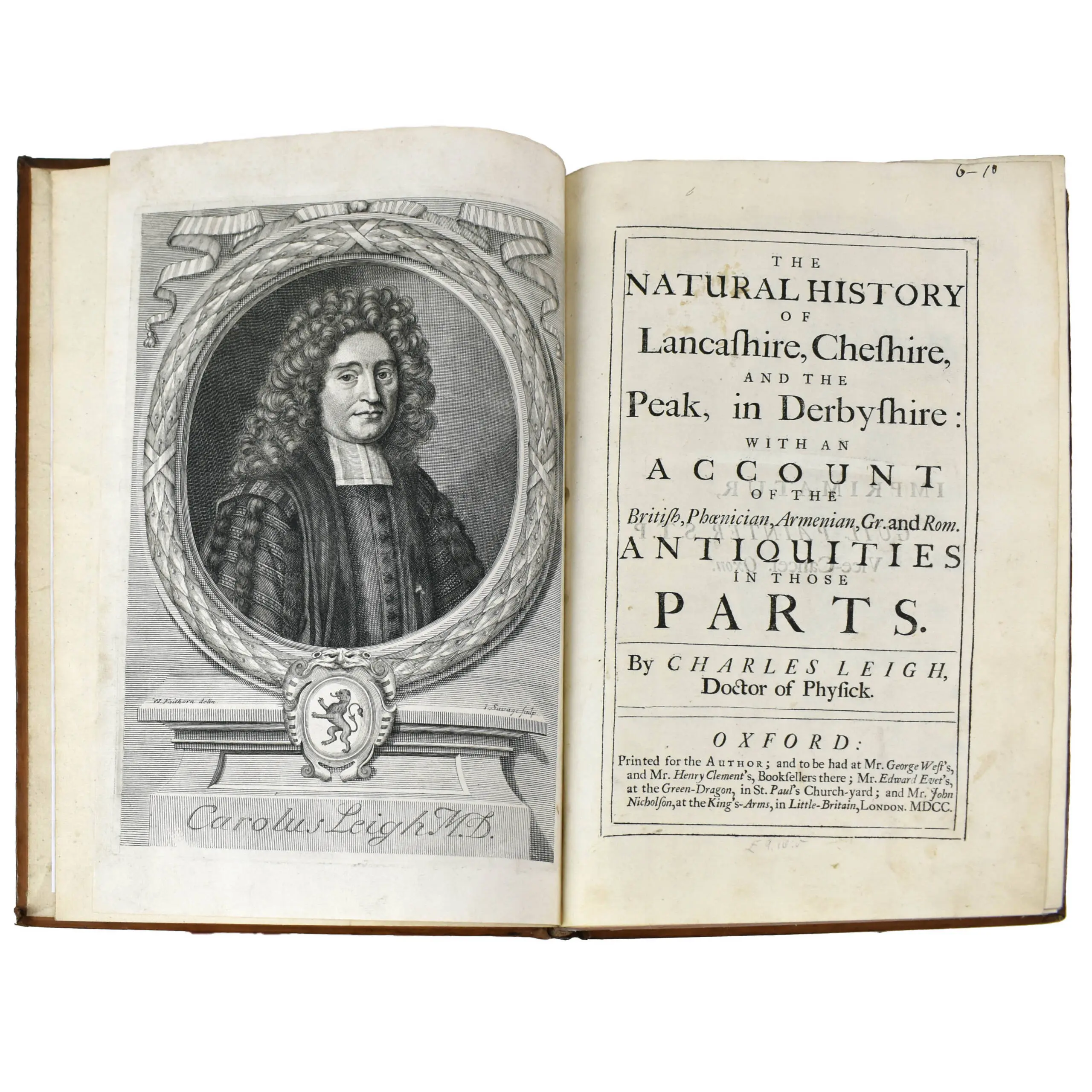
Oxford, 1700.Folio, [20], 4pp list of subscribers, [4], 196, [1]; [2], 97, [1]; 112, [35]pp. Engraved frontis portrait, 23 plates (including two plates of coats-of-arms), and one double-page coloured map.Contemporary tan calf,spine gilt in compartments,a fine copy.
Oxford, 1700.Folio, [20], 4pp list of subscribers, [4], 196, [1]; [2], 97, [1]; 112, [35]pp. Engraved frontis portrait, 23 plates (including two plates of coats-of-arms), and one double-page coloured map.Contemporary tan calf,spine gilt in compartments,a fine copy.
First edition. Leigh, in his preface, explains the structure of his work: “This work is therefore divided into 3 Books, the 1st relating to Natural Philosophy; the 2nd chiefly Physick; and the 3rd, the British, Phoenician, Armenian, Greek and Roman Antiquities of these Counties”.
In the first book, Leigh investigates characteristics of the physical environment (the temperature and pressure of air, the “principles” of mineral waters, soil and coal, minerals and metals) and performs experiments to demonstrate the properties of these various substances and their effects upon humans and animals. There are also descriptive analyses of flora and fauna, with several long passages on trees and plants, and an entire chapter dedicated to marine biology and “Fossile Plants”. In the course of his investigations, Leigh demonstrates the historical reality of the “Universal Deluge” by producing artefacts in Lancashire that were never naturally-occurring and therefore must have been swept to England in the Flood.
‘In Book II, Leigh turns to a discussion of Physick, beginning with a description and comparison of variously textured solid substances, including shells, taken from “a man’s leg, a man’s stool, the bladder of a hog” and other surprising places. The rest of the second book concerns various ‘distempers’ including an account of a “The Pestilential Fever raging in Lancashire, in the years 1693, 94, 95, 96”. Leigh discusses the symptoms of each illness, provides case studies, offers medicinal cures, and posits causes, citing authorities.
This book presents a fascinating, multi-layered investigation of the “Philosophy, Physick, and History” of the Lancashire region. The plates, executed by “the best Artists [Leigh] could meet with” are beautifully and expertly executed and contain the most varied and curious representations: fossil marine animals, a head “of a stag of Canada found under the Moss”, the patella “that lies betwixt the vertebrae of the back of a whale”, the skull of a hippopotamus, a cheshire woman “who had horns”, a full page of various birds, and numerous other subjects. The volume concludes with a suite of engravings depicting ancient artifacts, including coins, inscriptions and statues.
Wing L-975; Freeman, British Natural History Books, 2211. McGill/Wood, p.431; Nissen, ZBI, 2436; Yale/Riply, p.167; Upcott I, pp. 455-7.