
 Marshall Rare Books
The Political State
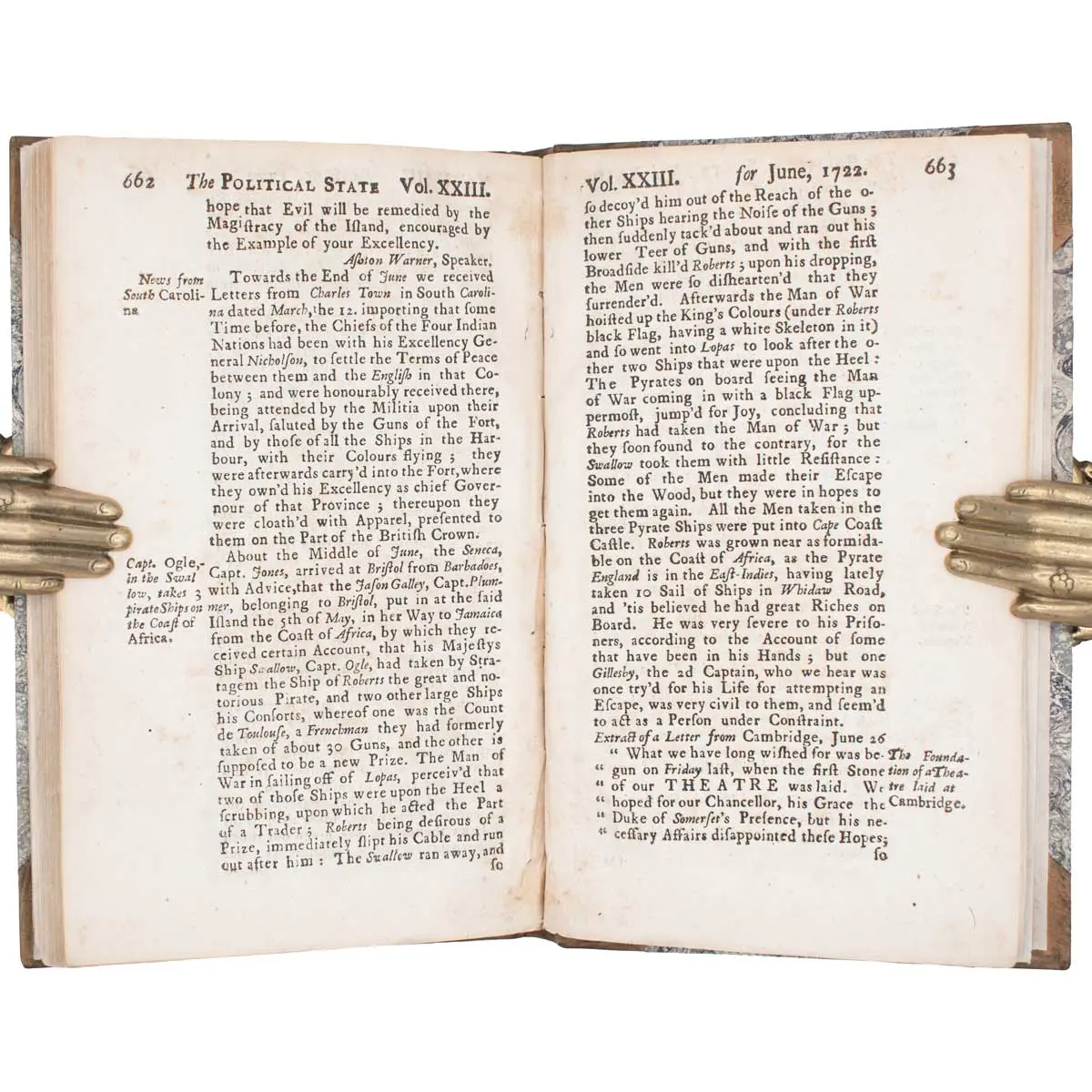
ONE OF THE EARLIEST DESCRIPTIONS OF A JOLLY ROGER PIRATE FLAG
[1], 564-665pp., [7], woodcut headers, printers device at rear, very occasional light foxing, later half calf over marbled boards, rebound, 8vo, [London}, n.p., June 1722.
A rare and very early description of Black Bart (Bartholomew Roberts, 1682-1722) and one of the earliest descriptions of the Jolly Roger pirate flag.
Known as The Great Pyrate in the Golden Age of Piracy, Bartholomew Roberts is considered one of the most fearsome and successful pirates of his time. It is estimated he captured over 400 vessels in his lifetime.
Early in his seafaring life, Roberts was an able navigator and second mate aboard the slave ship Princess. When anchored along the Gold Coast, the ship was captured by pirates led by another Welshman, Howell Davis. Forced to join the pirates, Roberts’s navigational skills were put to use and Davis would take advantage of their mutual Welsh intelligibility. Shortly thereafter, Davis was ambushed and killed by authorities on Principe and within 6 weeks Roberts was elected by the crew as the new captain of the Royal Rover.
After avenging Davis by plundering Principe, Roberts led his crew on a reign of piracy throughout the Caribbean, Brazil, Canada, and West Africa. Reports of his piratical rampage along the African coast reached Admiral Sir Chaloner Ogle, in command of the HMS Swallow. Ogle went looking for Roberts and his pirate crew.
On 5 February he found them at anchor under Cape Lopez, with most of the pirates drunk. Believing HMS Swallow to be a merchantman, one of the pirate ships had given chase and out of sight of the others, was promptly taken. Ogle then returned to Cape Lopez under French colours where he was attacked by Royal Fortune with Roberts on deck: ‛dressed in a rich crimson damask waistcoat and breeches, a red feather in his hat, a gold chain round his neck, with a diamond cross hanging to it, a sword in his hand, and two pairs of pistols slung over his shoulders ‛.
Hauling down his false colours and raising his ensign, Ogle engaged the enemy, delivering a broadside and killing Roberts, whose throat was torn away by grapeshot. Before being boarded, his crew wrapped his body, still armed and dressed in all his finery, into a sail and lowered it into the sea, honouring Robert’s wish to be buried at sea. Of the 272 pirates captured by Ogle: 52 were hanged (18 of the bodies being tarred and put in gibbets), 65 were sold back into slavery, 20 were taken into the service of the Royal African Company and the remainder sent back to prison in London.
The Political State reports the event of Robert’s death: “Capt. Ogle, had taken by Stratagem the Ship of Roberts the great and notorious Pirate, and two other large Ships his Consorts.” This author supports the theory that Ogle appeared to flee in a ruse to lure the pirates: “The Swallow ran away, and so decoy’d him out of the Reach of the other Ships.” The work also describes Robert’s flag “under Roberts black Flag, having a white Skeleton in it”.
The death of ‛Black Bart’ was a sensation. The Great Pyrate captured the public imagination and ‛Black Bart’ was the most important figure in Captain Johnson’s General History of the Pirates (1724), more so even than Blackbeard or Captain Kidd. In the years since, Roberts’ celebrity has only grown, with frequent mentions of his career in popular culture: from Robert Louis Stevenson’s Treasure Island to the film franchise Pirates of the Caribbean.