
 Marshall Rare Books
The Sea-Man's Practice, Containing a Fundamental Problem in Navigation Experimentally Verified; Namely Touching the Compasse of the Earthe and Sea and the Quantity of a Degree in our English Measures.
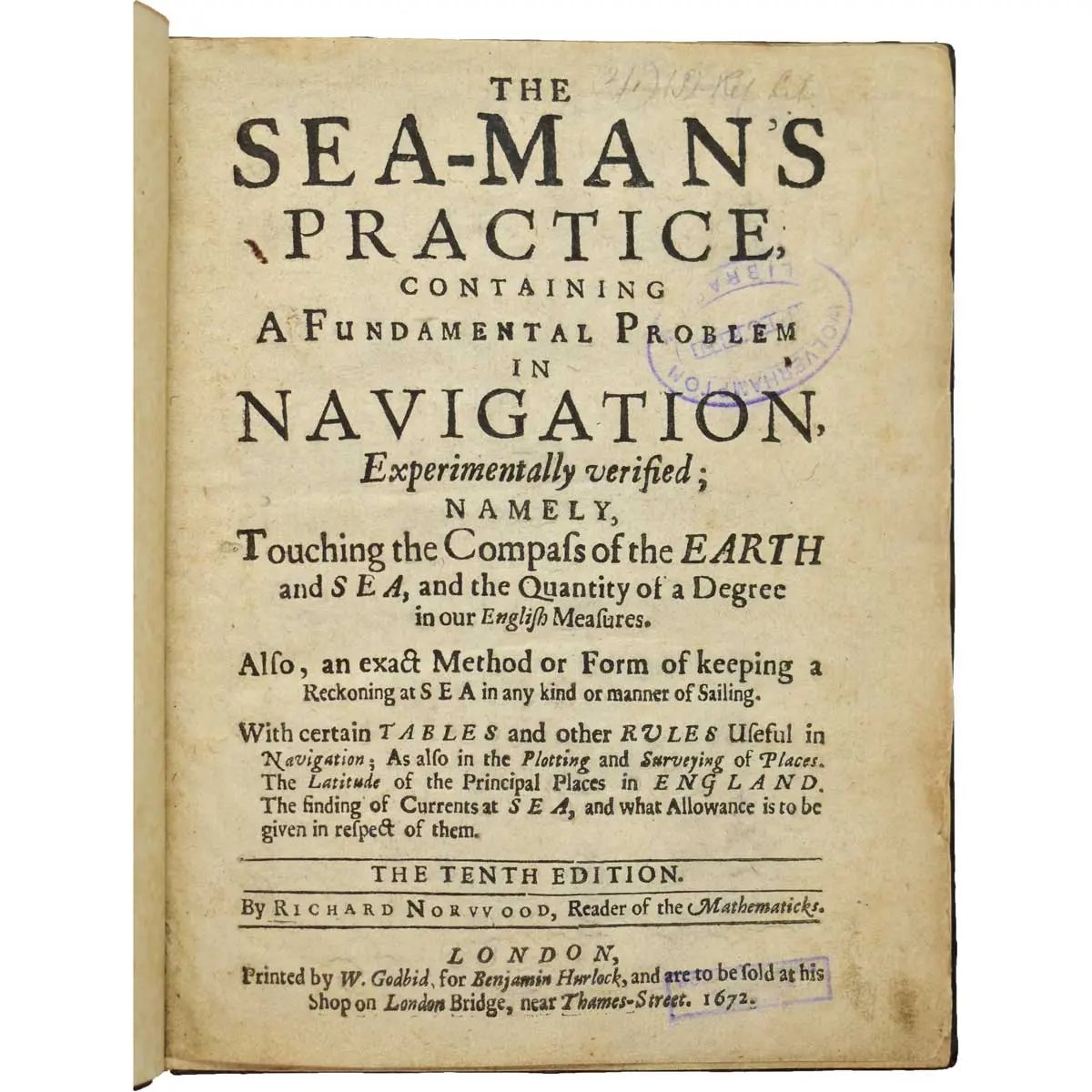
Tenth edition, woodcut initials, decorations, illustrations and tables, occasional ink notes in a contemporary hand to margins, faint stamp to title and foot of 3 or 4 other ff., contemporary panelled calf, gilt, rebacked, small 4to, by W. Godbid, for Benjamin Hurlock, and are to be sold at his shop on London Bridge, near Thames-Street, 1672.
Tenth edition, woodcut initials, decorations, illustrations and tables, occasional ink notes in a contemporary hand to margins, faint stamp to title and foot of 3 or 4 other ff., contemporary panelled calf, gilt, rebacked, small 4to, by W. Godbid, for Benjamin Hurlock, and are to be sold at his shop on London Bridge, near Thames-Street, 1672.
The tenth edition of this important mariner’s guide book first published in 1637, the penultimate before Norwood’s death.
All editions are rare, ESTC lists the BL copy only of this edition.
The Seaman’s Practice found an immediate following as an aid to navigators. It went through seventeen editions and was still in print twenty-five years after Norwood’s death in Bermuda following a frustrating period of habitation on the island from 1638 that was blighted by poor relationships with his neighbours and the hovering threat of witchcraft accusations. The book’s importance reached beyond the sea-faring community and it was to prove an inspiration to, amongst many others, the young Isaac Newton
One of the most influential mathematicians of the second quarter of the seventeenth century. However, it was Richard Norwood’s contact with mariners that inspired him to go to sea although, following severe sea-sickness, he soon became more interested in the mathematics of seamanship than traversing the ocean himself, although he did travel to Bermuda to test (with disappointing results) a diving bell based on Halley’s design. Deprived of a hoped-for fortune from pearls, he accepted an invitation to survey the country.
After returning to London and to teaching, he had been tutor to, amongst others, Henry Mainwaring, Norwood set about seeking to fill holes in navigational knowledge that he had found frustrating throughout his voyages. In the years following 1623 he set about, and succeeded to an unprecedented extent, a series of impressive mathematical research projects. These included establishing the length of a nautical mile and, most impressively, following a painstaking two years of practical trigonometry, the length of one degree of the Earth’s meridian, thereby making it possible to calculate the distance round the whole world. His figure worked out at 110.72 kilometres per degree of arc. He was accurate to within a kilometre.
Wing N1361