Marshall Rare Books
The Tapestry Hangings of the House of Lords: Representing the several engagements between the English and Spanish fleets, in the ever memorable year MDLXXXVIII.
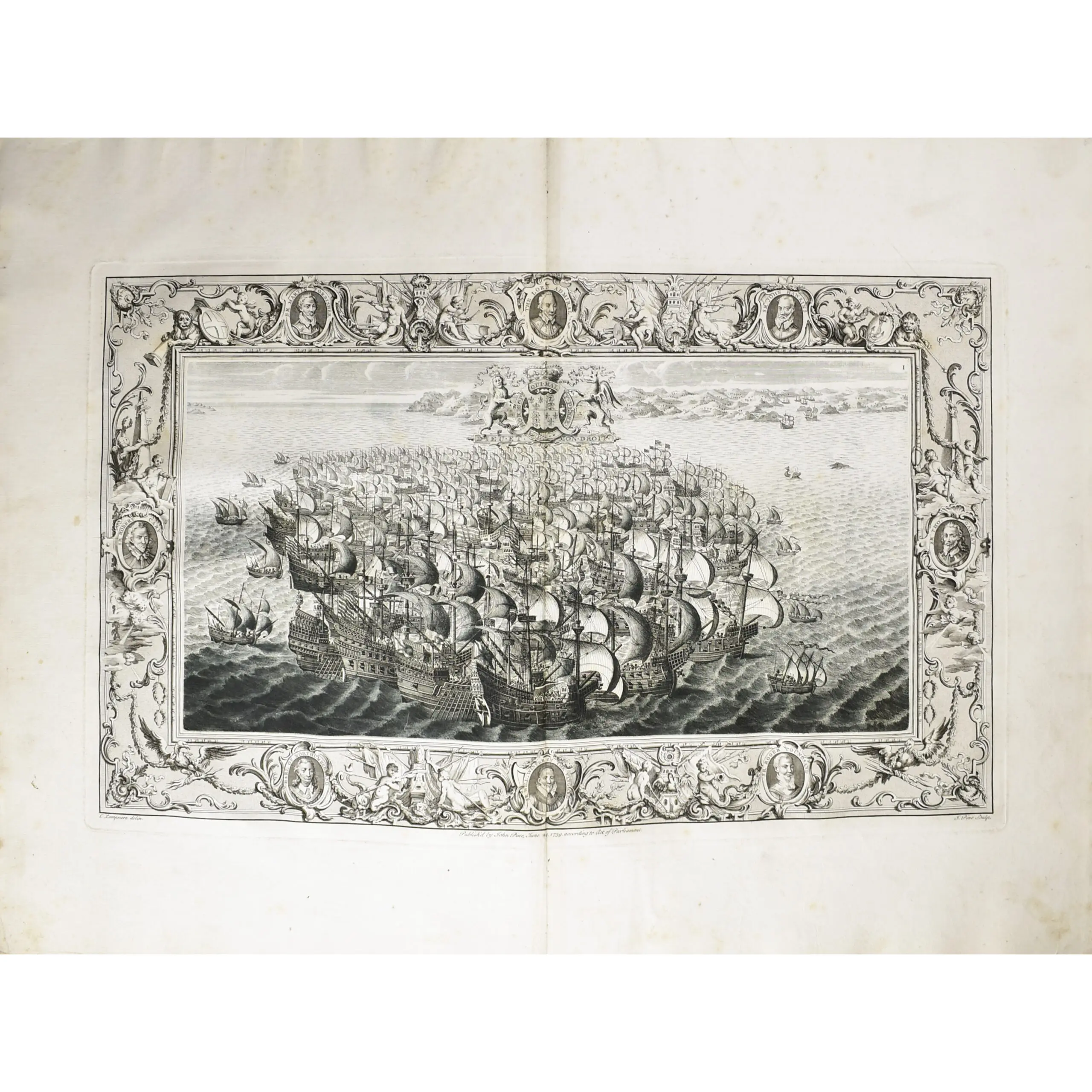
SUBSCRIBER’S COPY OF THE TAPESTRIES ILLUSTRATING THE DEFEAT OF THE ARMADA
A FINE SUBSCRIBER’S COPY OF THE FIRST EDITION.
London: John Pine, 1739, folio (534 x 372 mm.), engraved title, 18 ENGRAVED DOUBLE-PAGE PLATES, including five plates each with two engraved maps, one map of the British Isles showing the route of the Spanish Armada, 10 plates of sea battles printed in dark blue-green ink surrounded by engraved black-and-white borders, and two maps of Cornwall, Devon, and the Thames, Contemporary mottled calf.
One of the major productions of John Pines distinguished career, these magnificent plates reproduce tapestries commissioned in 1591 to commemorate the defeat of the Spanish Armada; in the words of ODNB, they are of the greatest historical value, since the original hangings were destroyed in the 1834 fire that decimated the Medieval parliamentary buildings where they had been displayed. ODNB notes that engraver and publisher Pine (1690-1756) recognized their worth from the beginning of the project, since he used his influence to ensure that the Copyright Act of 1735 gave him the exclusive right to copy the tapestries.
The ten original tapestries were woven from designs by Dutch marine artist Hendrick Vroom (1563-1640) that document the progress of the 1588 naval engagements that would lead to what is generally acknowledged as the greatest naval victory in British history. French artist Clement Lemprière (1683-1746) did the drawings from which these plates were engraved, and the renowned French illustrator Hubert Gravelot (1699-1773) created the elegant borders featuring oval portraits of the battle’s heroes, Sir Francis Drake and Lord Howard among them. The tapestry engravings are printed in dark ink with a blue-green tinge, and the contrast to the black ink of the borders increases the impact of the illustrations.
The maps here are taken from charts produced by Robert Adams, cartographer, engraver, and Queen Elizabeths Surveyor of Buildings. They were first published in the now very 1588-1590 Expeditionis Hispanorum. The original tapestries occupied a special place in the national imagination, symbolic of British power and strength, and depictions appear in the background of several historical works, including James Gillrays Consequences of a Successful French Invasion (1798), which shows French troops desecrating the sacred artifacts. When plans were made for the Palace of Westminster following the 1834 fire, they included a scheme to replace the tapestries with paintings duplicating six of the original scenes. Although this vision did not come to completion until 2010, it would have been altogether impossible without Pines engravings, which were used by the artists involved as the source for their subjects.
Subscriber’ Copy with his engraved bookplate.
Sir Robert Grosvenor, 6th Baronet (7 May 1695 – 1 August 1755) was the youngest surviving son of Sir Thomas Grosvenor, 3rd Baronet. Ancestors of the Dukes of Westminster. In 1730 Sir Robert married Jane Warre of Swell Court and Shepton Beauchamp, Somerset. They had two sons (Richard, later Earl Grosvenor, and Thomas) and four daughters. Initially they lived in Somerset, but when Grosvenor succeeded to the baronetcy, they moved to Eaton Hall in Cheshire. Sir Robert became the MP for Chester in January 1733. When he died in 1755 (still MP) he was succeeded by his elder son, Richard. His second son, Thomas (1734–1795), was MP for Chester from 1755 until his death in 1795.
Berlin Katalog 1677; McMurray, Prints, Politics & Peers: John Pines Tapestry Hangings of the House of Lords”, Royal Museums Greenwich website (Sept. 30, 2019), https://www.rmg.co.uk/stories/blog/library-archive/prints-politics-peers-john-pines-tapestry-hangings-house-lords