
 Marshall Rare Books
The Thanatophidia of India. Being a Description of the Venomous Snakes of the Indian Peninsula with an Account of the Influence of their Poison on Life and a Series of Experiments.
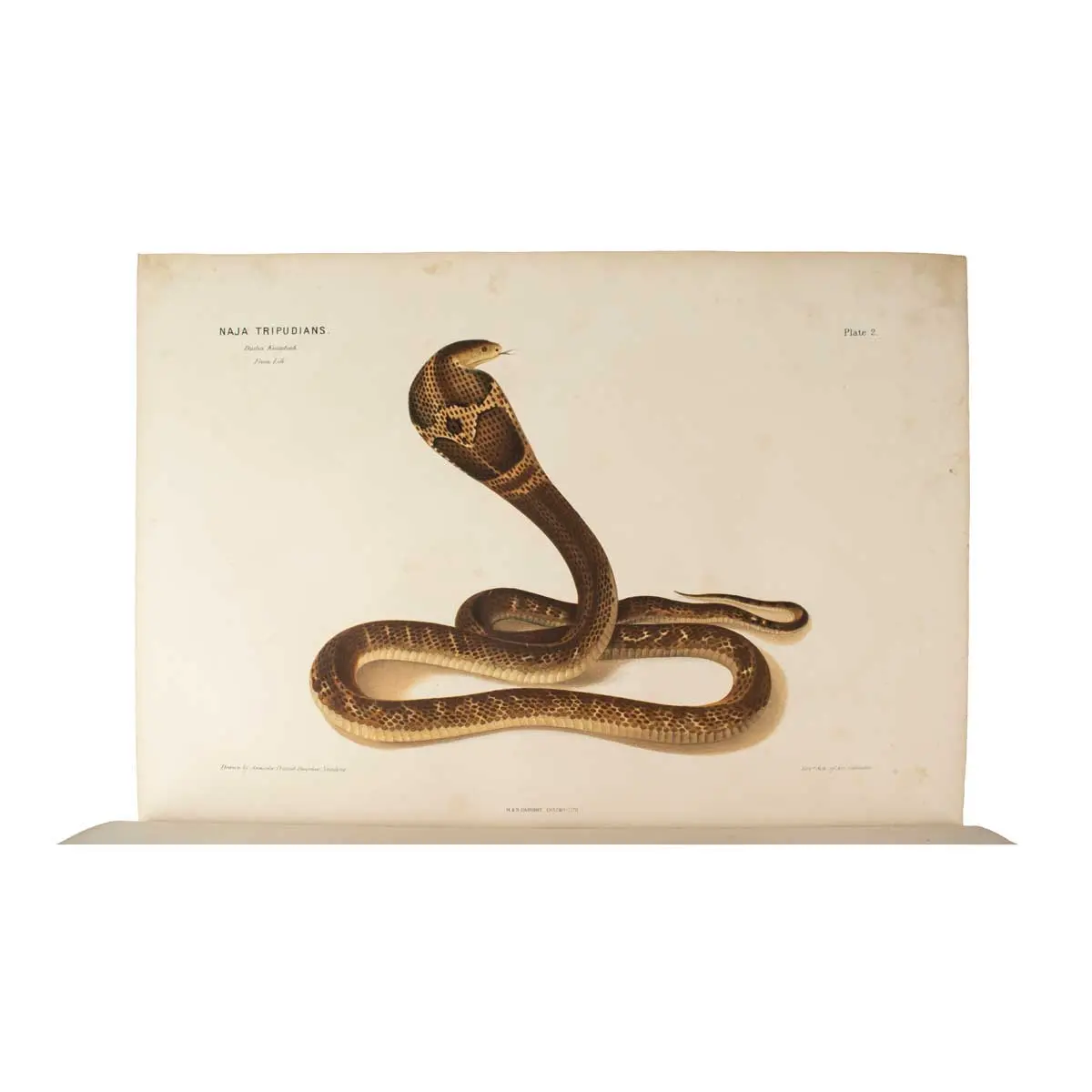
Second and Enlarged Edition.The plates were drawn by students at the Calcutta School of Art, after original sketches by Fayrer.
London: J. and A. Churchill, 1874. Folio (446 x 319 mm),half blue straight- grained Morocco gilt, marbled boards, [xii], List of contents misbound 178 pp. with 28 coloured lithographed and 3 uncoloured lithographed plates, small repair to one plate (no loss). An attractive copy of a scarce book that is difficult to find in nice condition.
Second and Enlarged Edition.The plates were drawn by students at the Calcutta School of Art, after original sketches by Fayrer.
Sir Joseph Fayrer, first baronet (1824–1907), surgeon and physician. In 1843 Fayreraccompanied his father to Bermuda, where an outbreak of yellow fever turned him towards medicine. After entering the Charing Cross Hospital in October 1844, where his fellow pupils included William Guyer Hunter and Thomas Henry Huxley, he was appointed at the end of his second year house surgeon at the Westminster Ophthalmic Hospital. On 29 June 1850 Fayrer left England for Calcutta to become assistant surgeon in Bengal. His connection with the Indian Medical Service (IMS) lasted for forty-five years, half of it in England.
Despite official and professional calls upon his energies, Fayrer was a prolific writer on Indian climatology, the pathology of Indian diseases, sanitation, and above all on venomous snakes. The Thanatophidia of India is a classic contribution to the literature of snakes and snake bites. Printed by the Indian government it was illustrated with admirable coloured plates from life by local members of the Calcutta School of Art. The book embodies all Fayrer Experiments and researches, accounts of which were forwarded from India to Dr F. C. Webb, who put them into literary shape. From Fayrer’s enquiries came the permanganate treatment of venomous snakebites. But his main conclusions were that there then existed no absolute antidote, and that safety was to be attained only when the bite was in such a position as to make the application of a ligature between it and the heart possible, together with the use of cautery. These opinions were somewhat modified after some later experiments by Fayrer, Brunton, and Rogers (PRS, 73B, 1904, 323); it was there
shown that recovery might be expected if a ligature were applied within half a minute or even a longer period after a bite, the site of the injury being then incised and solid permanganate of potassium rubbed in.
“[O]ne of the classics on venomous snakes … The double-page illustration of the king cobra is one of the most imposing drawings of a snake ever published” (Adler II p 97).
Nissen ZBI 1339; BMNH p 560