
 Marshall Rare Books
The Voyages and Adventures of Capt. Barth.Sharp and others, in the South Sea: being a journal of the same. Also Capt. Van Horn and his buccaniers surprizing of la Veracruz..Towhich is added the true relation of Sir Henry Morgan his Expedition against the Spaniards in the West Indies, and his taking Panama….
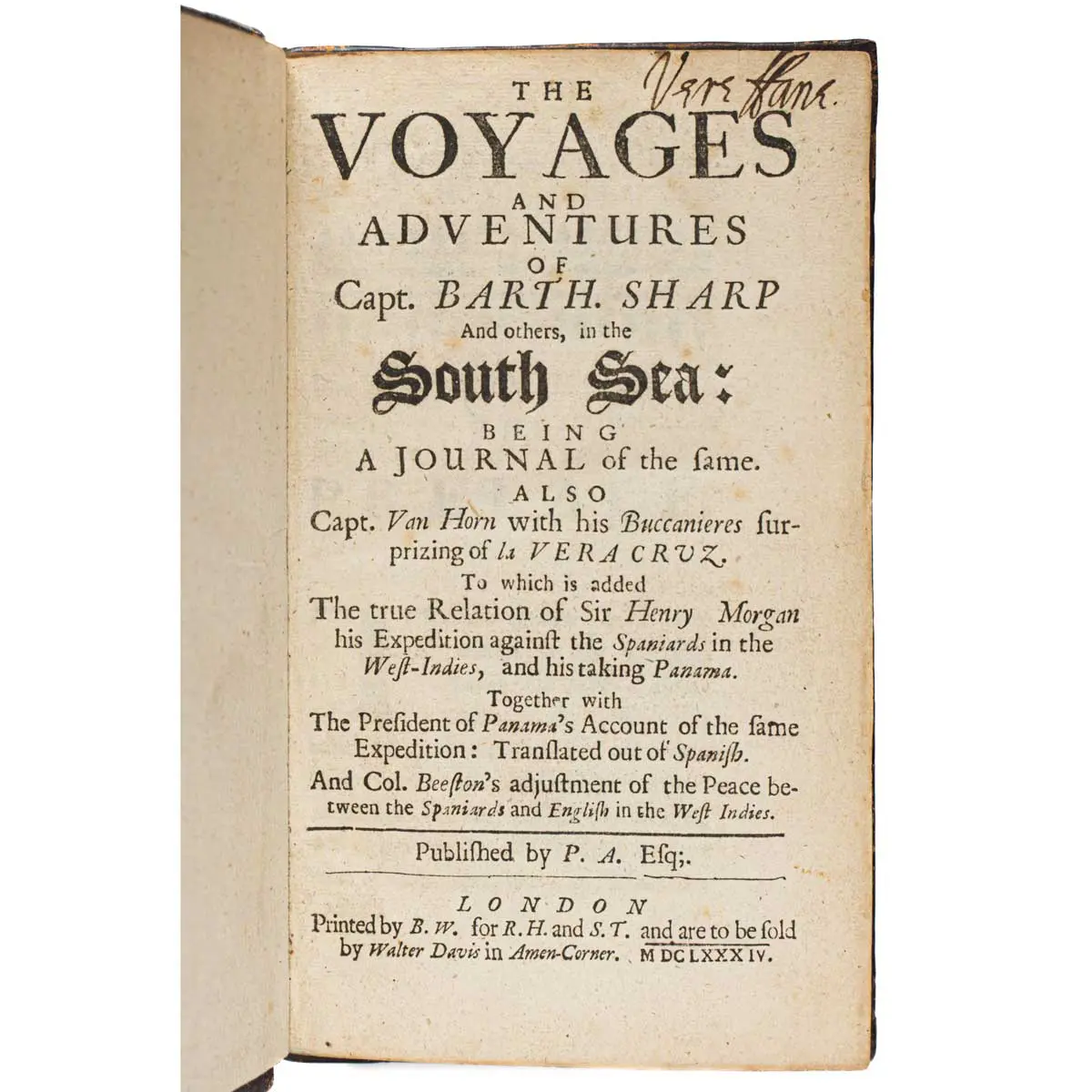
FIRST EDITION, a fine copy in full calf gilt, 8vo [190 x 110mm], London: B.W. for R.H. and S.T.,1684,
A Very Scarce Work.
Sharpe’s voyage began in April 1680, when he gathered a band of buccaneers, including William Dampier, to cross the isthmus of Darien (in present-day Panama) on foot, tracing the path that the notorious Henry Morgan had blazed several years before. Sharpe enlisted the help of the local natives to guide his band overland. “The people for the most part are very handsom,” his diary reads, “especially the female sex, and as they are very beautiful so they are allso very free to dispose of themselves to Englishmen answering them in all respects according to their desire.” After several days with “nothing but the cold earth for our Lodgings, and for our covering the green trees,” Sharpe’s men sacked a Spanish town and finally “beheld the faire South Sea.”
Sailing in ships they had commandeered from the Spanish, Sharpe and his band proceeded south along the west coast of Central and South America, seeking their fortune with violent abandon. After attacking a Chilean town ironically named La Serena, Sharpe boasted of the prowess of his vastly outnumbered band. “I agreed with the Spaniards for the redemption of this city,” the diary reads. “They were to pay me the sum of 80,000 Pieces of Eight—but instead of that they rallied 4 or 500 hors[es] to take us all prisoners. But I marched out with my men & fought them & beat them to their heart’s content, after which I set the city on fire & burnt it & came away by the light of it.”
If Sharpe was a ruthless thief and murderer, he was also an accomplished navigator. He was the first English sailor to make the treacherous voyage around Cape Horn from the west, guiding his fleet through horrendous weather conditions and his men through severe privation—”nothing but dowboys & tallow for dinner & supper.” They had saved a hog to kill for Christmas dinner, but after many difficult months the crew was ready to mutiny if they didn’t reach the Caribbean islands soon. Sharpe promised to eat the ship’s dog if they didn’t see land within three days—and he made it, finally arriving in Barbados and giving the ship to those pirates who had already gambled away their booty.
Sharpe returned to England and because England and Spain were not at war, the Spaniards demanded Sharp’s prosecution for piracy. Sharp, however, presented the authorities with a book of maps taken from the Spanish ship El Santo Rosario in July 1681; their value to English seafarers was such that Sharp received a full pardon from Charles II. This ‘ Derrotero’ was copied by William Hacke, a friend of Sharp and numerous other buccaneers. Among his other companions were William Dampier, Lionel Wafer and William Funnel,
Hill 40. Sabin 79781; Wing A-4315