
 Marshall Rare Books
The Works of Edmund Gunter: Containing the Description and the Use of the Sector, Cross-Staff , Bow, Quadrant, and other Instruments.
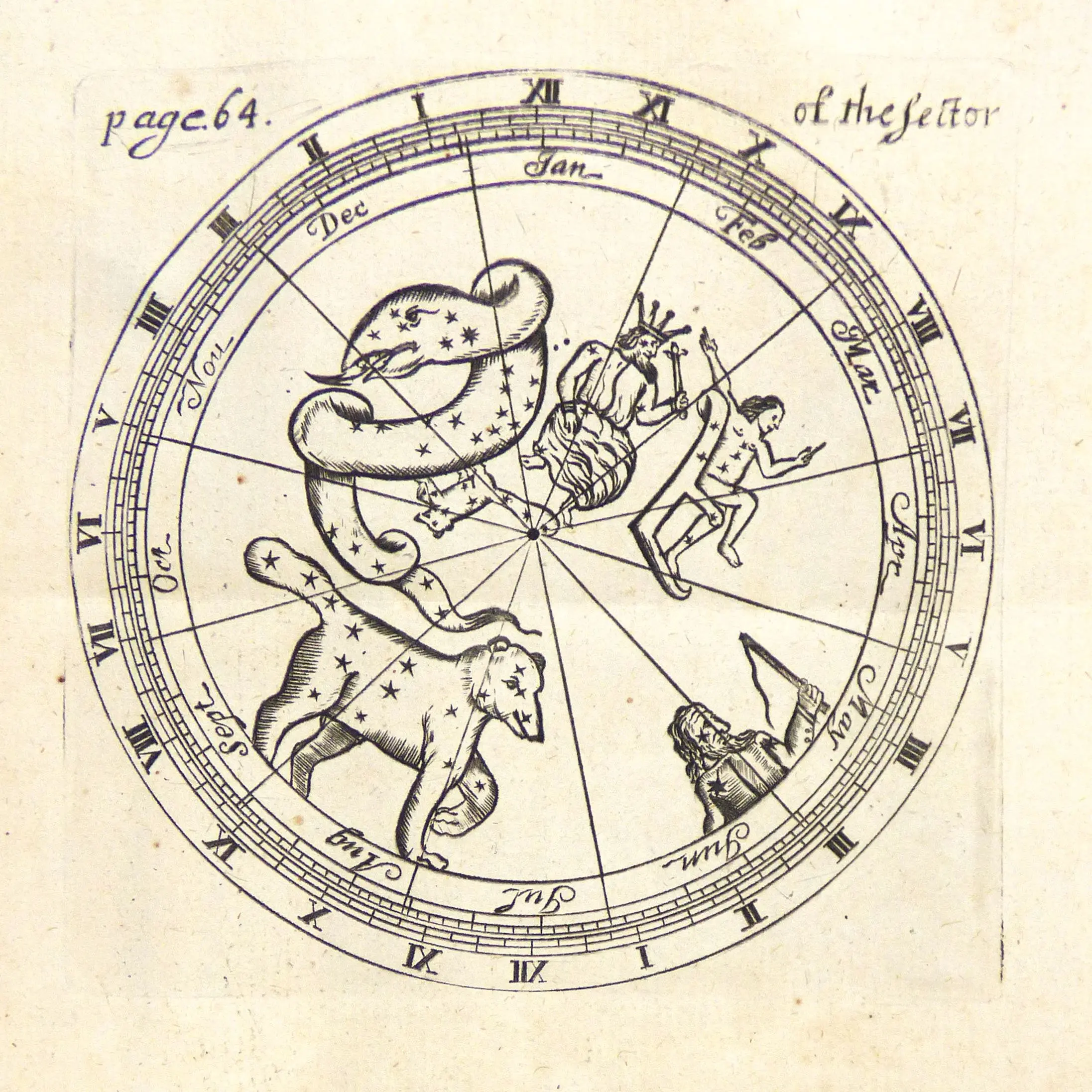
The Works of Edmund Gunter: Containing the Description and the Use of the Sector, Cross-Staff , Bow, Quadrant, and other Instruments. With a Canon of Artificial Sines and Tangents to a Radius...The uses whereof are illustrated in the Practice of Arithmetic, Geometry, Astronomy, Navigation, Dialling and Fortification.And some Questions in Navigation...Corrected by William Leybourn. London: A.C. for Francis Eglesfield, 1673, 4to (198 x 154mm.), half-title, engraved additional title and 3 folding plates (one, at p.64, being a volvelle), woodcut diagrams and illustrations, 5Y1-2 bound between 2S1 and 2), contemporary panelled calf.
With a Canon of Artificial Sines and Tangents to a Radius…The uses whereof are illustrated in the Practice of Arithmetic, Geometry, Astronomy, Navigation, Dialling and Fortification.And some Questions in Navigation…Corrected by William Leybourn.
London: A.C. for Francis Eglesfield, 1673, 4to (198 x 154mm.), half-title, engraved additional title and 3 folding plates (one, at p.64, being a volvelle), woodcut diagrams and illustrations, 5Y1-2 bound between 2S1 and 2), contemporary panelled calf.
Edmund Gunter is renowned for inventing numerous practical instruments for the use of Sailors.
In 1624 Gunter published the above collection of his mathematical works. One of the most remarkable things about this book is that it was written, and published, in English not Latin. It was a manual not for cloistered university fellows but for sailors and surveyors in the real world.
There is reason to believe that Gunter was the first to discover (in 1622 or 1625) that the magnetic needle does not retain the same declination in the same place at all times. By desire of James I he published in 1624 The Description and Use of His Majesties Dials in Whitehall Garden, the only one of his works which has not been reprinted. He coined the terms cosine and contangent, and he suggested to Henry Briggs, his friend and colleague, the use of the arithmetical complement (see Briggs Arithmetica Logarithmica, cap. xv.).
Gunter’s quadrant is an instrument made of wood, brass or other substance, containing a kind of stereographic projection of the sphere on the plane of the equinoctial, the eye being supposed to be placed in one of the poles, so that the tropic, ecliptic, and horizon form the arcs of circles, but the hour circles are other curves, drawn by means of several altitudes of the sun for some particular latitude every year. This instrument is used to find the hour of the day, the sun’s azimuth, etc., and other common problems of the sphere or globe, and also to take the altitude of an object in degrees.