
 Marshall Rare Books
Theatrum De Veneficis, Das ist: Von Teuffelsgespenst Zauberern und Gifftbereitern, Schwartzkuenstlern, Hexen und Unholden, vieler fuernemmen Historien und Exempel, bewahrten, glaubwirdigen, Alten und Newen Scribenten, was von solchen… disputiert und gehelten worden, mit sondern fließ… an Tag geben,
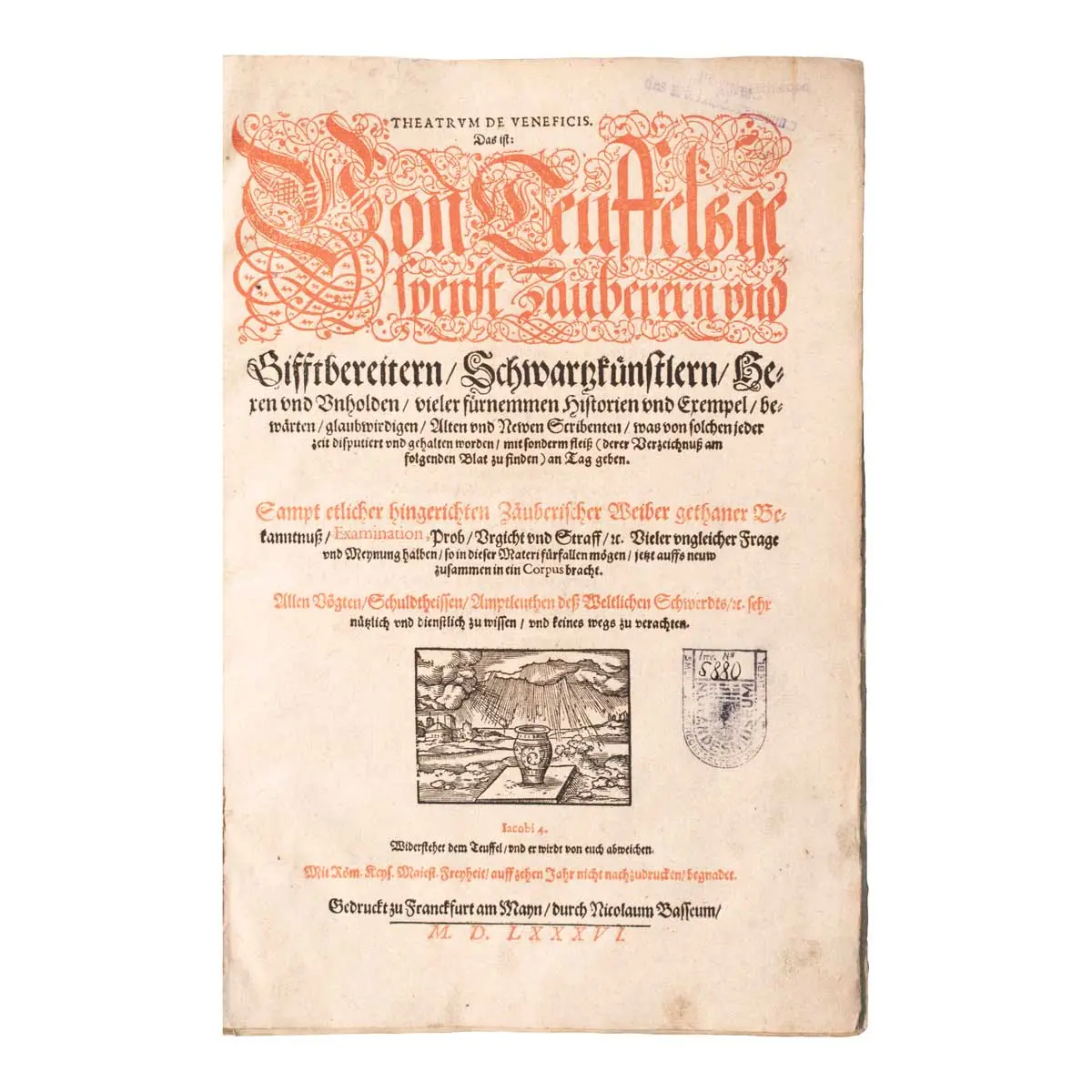
FIRST EDITION OF AN EXTENSIVE WORK WITH CRITICAL AND DIVERSE EXPLANATIONS ON MAGIC, WITCHCRAFT, SUPERSTITION, EXORCISM AND WITCH HUNTS.
FIRST EDITION, [14] , 396 (406), [10], printed in gothic black, half title, title in red and black, woodcut vignette and woodcut printer’s device at end, folio, (316 x 200mm), Frankfurt, Nicolaus Basse, 1586
FIRST EDITION OF AN EXTENSIVE WORK WITH CRITICAL AND DIVERSE EXPLANATIONS ON MAGIC, WITCHCRAFT, SUPERSTITION, EXORCISM AND WITCH HUNTS.
The First Edition of the ‘Theatrum de Veneficis” (Theatre of the Witches”), edited by Marbung attorney Abraham Saur, is an important compendium of demonological tracts which represented a wide variety of early modern views on witchcraft.
The editor, Abraham Saur, was born in Frankenberg in Hesse on February 12, 1545. Presumably encouraged by Professor Hermann Lersner, who he was close to, he studied law first in Witternberg in 1565, then in Marbung. Saur was a prolific and skilful writer, producing numerous legal handbooks which he compiled for his own use, to teach others and published on request. These were well received, many being printed several times after Saur’s death.
Saur’s “Theatrum de Veneficis” was compiled in Frankfurt in 1586 when the witch hunt craze was in full swing. Despite Saur’s own belief that it is the God-given duty of the magistrates to eradicate the practise of witchcraft and to punish its practitioners, “Theatrum de Veneficis” covered the whole spectrum of reactions to the witch phenomenon. This includes Johann Weyer’s sceptical preface about witchcraft, where he considers the idea of diabolic illusion, and how melancholy women were particularly prone to fall into delusions about the Devil. Later he would conclude that most of those accused of witchcraft were innocent.
Saur also included severe condemnation as championed by the Genevan pastor Lambert Daneau in “Dialogus de veneficis”, 1564, and pastor Jacob Vallick in “Von Zauberern Hexen und Unholden”. Even with the important role the Catholic church played in the evolution of demonologies, the onset of the Reformation did not significantly change the witch debate. Martin Luther’s convictions and teachings about the reality of evil in the form of Satan, and his demons, formed the basis of Protestant demonology. In “Von Zauberey Teuffelsgespenst Und Hexerey Campsionibus und Wechselkindern” he specifically and vigorously condemned the witches’ apostasy as the most serious crime against God and the Christian faith.
Writers who doubted the witches ability to commit the acts with which they had been charged are also represented. This conviction was expressed by Hermann Witekind in Bedencken von Zauberey woher und wie vielfaltig sie sey, 1585. Witekind was sceptical about the reality of flight and was fascinated by how an individual could come to confess things which could not be taken as literally true. Despite his doubt, Witekind’s tract contains a lengthy passage on flight, much of which was later pillaged by Faust. He also doubted whether intercourse with the Devil really happened, while insisting that the pact with the Devil itself could be real.
Ulrich Molitor, a jurist from Constance, wrote a tract in opposition to the Malleus Maleficarum. Molitor argued against the reality of demonic power attributed to women, calling them an illusion. According to Molitor in ‘Von Hexen und Unholden’, it was only by permission of God that witches were able to make weather, inflict illness or impotence, fly to the Sabbath, etc., as only God could bestow whatever power Satan falsely claimed as his own.
Towards the end of the sixteenth century, the ordeal by water was widely discussed among demonologists, specifically jurists and physicians. Both sides of the debate about the efficacy of the trial by water for the purpose of identifying witches are represented. In 1583, Wilhelm Adolph Schreiber (Scribonius) published ‘De examine et purgatione sagarum per aquam frigidam epistola’, which certified the procedure as legally and theologically sound. A forceful rejection of Scribonius’ thesis was advanced by Herman Neuwalt, professor of medicine at the University of Helmstedt, in his Exegesispurgationis sive examinis sagarum super aquam frigidam – the first tract devoted exclusively to the question of efficacy of trial by water..
Among the authors are Heinrich Bullinger, Ludwig Lavater, Konrad Lautenbach, Reinhard Lutz, Adrian Rheynmann, Leonhard Thurneysser, Johannes Trithemius and many more.
The tracts collected here are often appended with trial records, as witchcraft raised questions of belief. The tales of witches’ doings were never the creation of the demonologists alone, and information about what witches confessed to constantly fed back into the works of demonology, enlarged and exaggerated by their interrogators. These trials were attached to tracts for two reasons; firstly, to set up the pamphlet as a dialogue between theory and evidence. At the same time the vividness of the confession added greatly to the treatises readability. This was a tried and true formula, long exploited by writers, who peddled their learned works with the stories of the horrors of individual witches.
[VD16S 1938. BM STC, German Books S. 854. Witchcraft Coll. S. 539.Coumont T17,1. Hayn-Gotendorf III, 242., Witch Craze Terror and Fantasy in Baroque Germany, Roper, 2004, The Oxford Handbook of Witchcraft in Early Modern Europe and Colonial America, 2013]