
 Marshall Rare Books
Theatrum mundi, et temporis, in quo non solum precipuae horum partes describuntur, & ratio metiendi eas traditur, sed accomodatissimis figuris sub oculos legentium facile ponuntur.
Second Edition of the First Celestial Atlas of the New Copernican Astronomy
Venice, Giovanni Battista Somasco, 1589. 4to, (350 x 180mm),pp. [16], 478, [2] Contemporary vellum, Manuscript title.
Second edition of the first celestial atlas of the new Copernican astronomy. (the first is dated 1588).
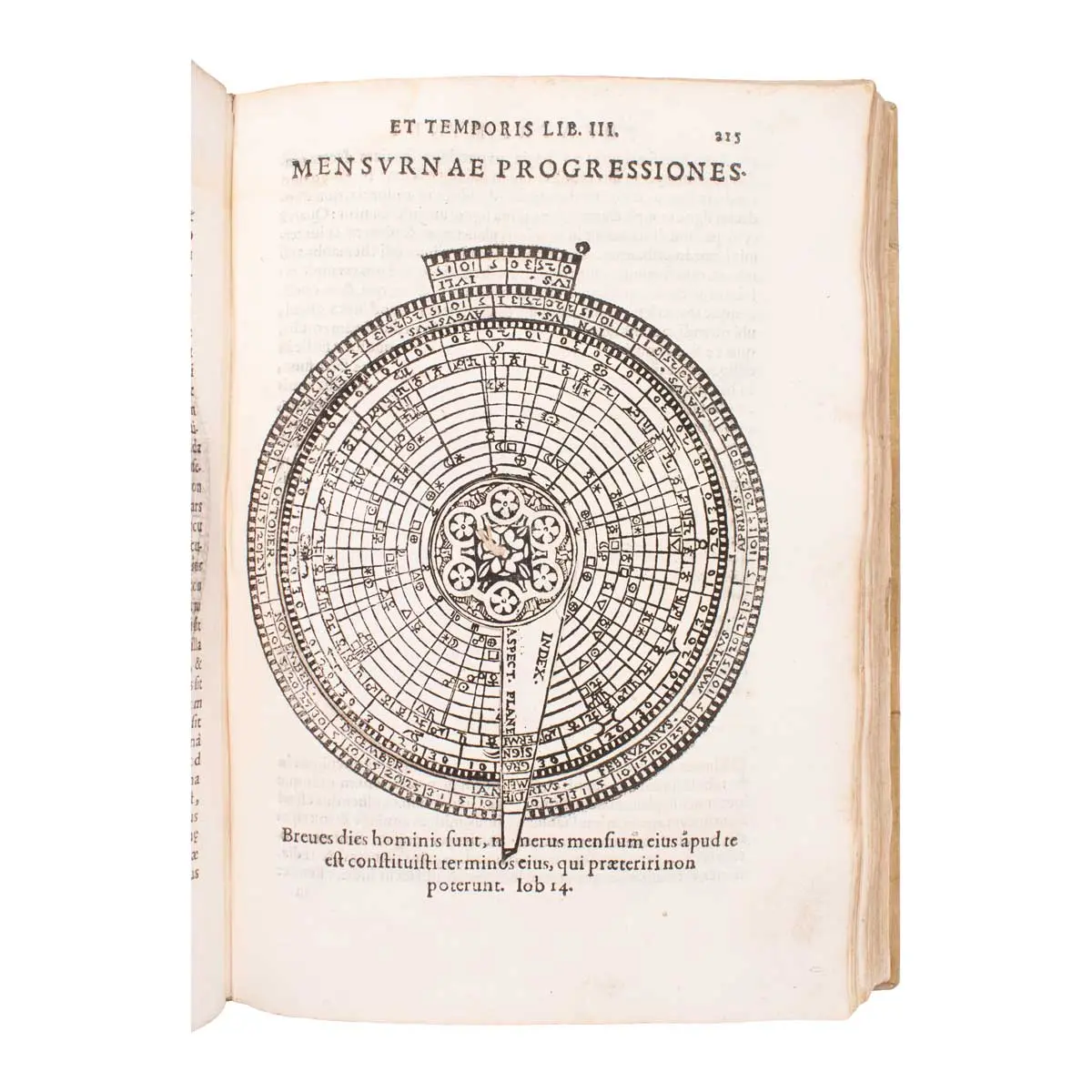
The Theatrum mundi is an encyclopaedia devoted to astronomy, bringing together studies on the movements of the planets, the nature of eclipses and precision calculations. There are 144 full-page woodcuts, one of which depicts the two hemispheres of the terrestrial globe with the American continent. 48 are celestial maps inspired by the Ptolemaic constellations, 50 have 68 moving parts or volvelles.
The notice to the bookbinder indicates that for page 121 (f. Q1), there are 6 possible variations, only one of which must be mounted according to the latitude at which the copy will be used, thus bringing the total number of different moving parts to 73.
Giovanni Paolo Gallucci (1538-ca 1621) was a well-known private teacher to the Venetian nobility and founding member of the Second Venetian Academy. All his life, Gallucci engaged greatly with the Venetian printing industry: he edited a collection of astronomical medical essays including writings of Marsilio Ficino, published many works on astronomical and time-measuring instruments and translated into Italian Peckham’s essay on perspective, Dürer’s treatises on body symmetry and Acosta’s history of the New World.
His most successful work, however, was certainly the Theatrum Mundi, a vast survey on terrestrial and celestial physics. It provides almost 150 maps for measurements, each accompanied by a Biblical quotation. The work is dedicated to Pope Sixtus (1585-1590), who had just banned all astrological literature since 1586. Although Gallucci could not resist to touch on some astrological implications of constellations, he questioned their alleged influence over human health and fate and pioneeringly tried to draw up a pure astronomical treatise.
In his numerous diagrams and maps, Gallucci combined a coordinate system with a trapezoidal system of projection for an accurate determination of the star and zodiacal positions. Alongside the extraordinarily ingenious volvelle illustrations forming the first four books of Theatrum Mundi, there are depictions of Hell and its circles as inner portions of the Earth, the New World hemisphere and the wind rose, as well as calculators for tides and daytime at every longitude and latitude. Book 5 presents 48 maps of the Ptolemaic constellations and the related mythological illustrations. The star positions were taken from Copernicus’s catalogue. ‘Somasco printed blocks for division into small squares of woodcut ornament (a few with grotesque faces) to be pasted on the verso of the leaf over the string by which the separate pieces were attached. He left space for these squares in setting the text.
Mortimer, 206, HL, 2725, Warner, p. 91, Burden, The Mapping of North America, 66, Alden, 589/26, Adams, G-169.