
 Marshall Rare Books
Todten-Tanz / La Danse des Morts
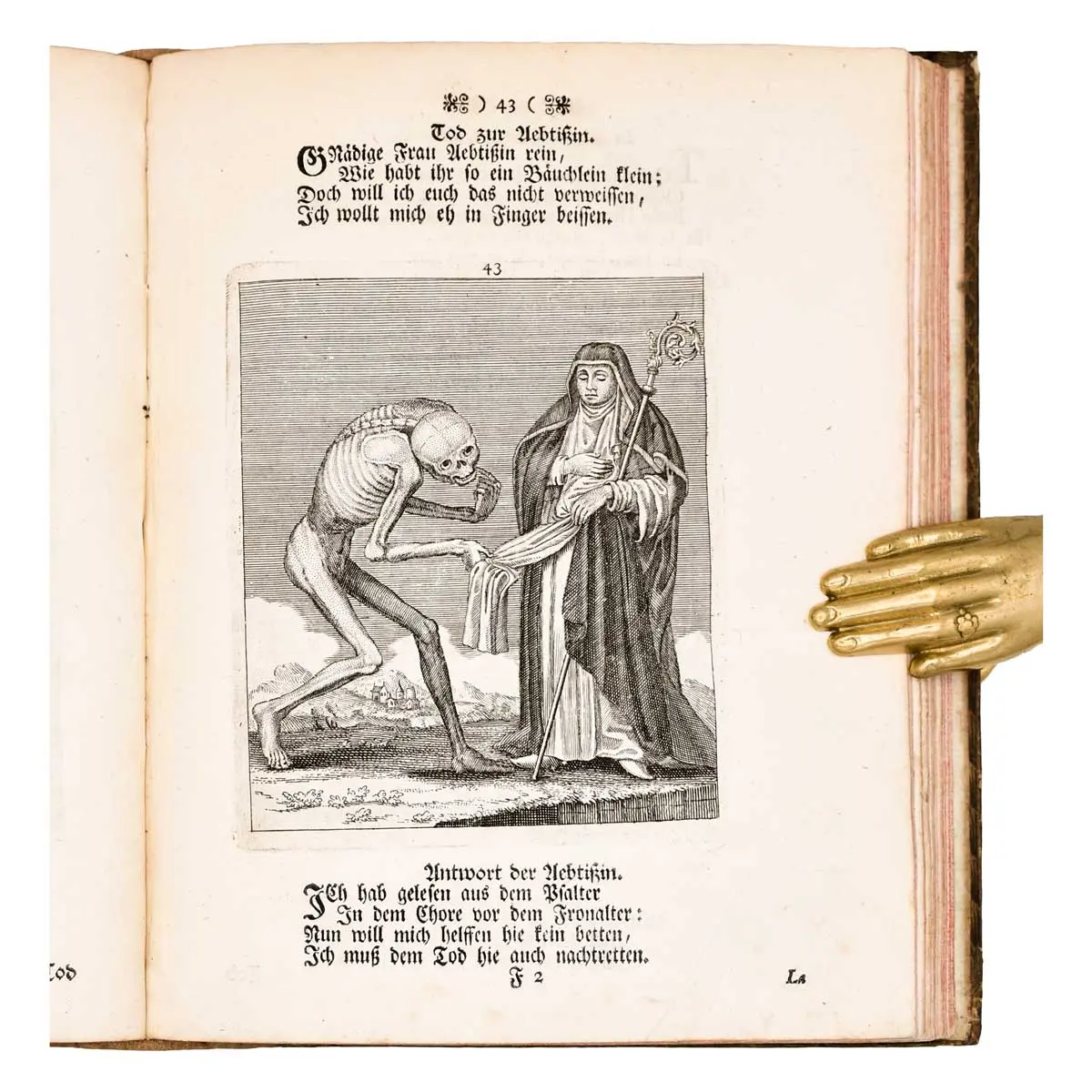
The Bilingual edition, with French text by Jacques Anthony Chauvin. The engraved illustrations were slightly revised by Chauvin from the final state of Matthaeus Merian's own originals. First appearing in 1621, Merian's illustrations were taken from a fresco painted in the 15th century on the walls of the Predigerkirche, in Basel, Switzerland. Merian's engravings made the fresco famous throughout Europe. The frescoes were destroyed (deemed "an eyesore" by the town council) in 1805.
Text in French and German, roman and blackletter type, French letter press title with woodcut vignette, German title engraved, dated 1744, with upper margin trimmed (to remove previous ink ownership inscription, visible offsetting to French title, no loss), woodcut head and tail pieces, 43 engraved illustrations, including 41 for the Dance of Death, one depicting Adam and Eve, and a final engraved plate featuring an anamorphic portrait of a man/death’s head, contemporary brokatpapier boards depicting two allegorical figures representing Spring and Summer within foliate borders, rebacked in modern morocco, three very small abrasions to lower cover, small discrete repairs to lower corners,4to, Basel, Jean Rodolphe Imhof, 1756.
The Bilingual edition, with French text by Jacques Anthony Chauvin. The engraved illustrations were slightly revised by Chauvin from the final state of Matthaeus Merian’s own originals. First appearing in 1621, Merian’s illustrations were taken from a fresco painted in the 15th century on the walls of the Predigerkirche, in Basel, Switzerland. Merian’s engravings made the fresco famous throughout Europe. The frescoes were destroyed (deemed “an eyesore” by the town council) in 1805.
The Dance of Death series displays a very quick and lively skeleton leading someone away in a dance step. The partner’s social station is instantly recognisable, but death is indifferent to rank: the death figure is just as cheerful leading off the Queen or the Pope as the Merchant or the Beggar. While the conventions may have originated in Medieval Pageants, their popularity grew and flourished in the Renaissance and Baroque periods.
Provenance: J Newton (ink ownership inscription front endpaper)
[ Le Blanc III, p 31; Thieme-Becker XXIV, 412., Sander 424.]