
 Marshall Rare Books
Travels to Discover the Source of the Nile, in the years 1768, 1769, 1770, 1771, 1772, and 1773..
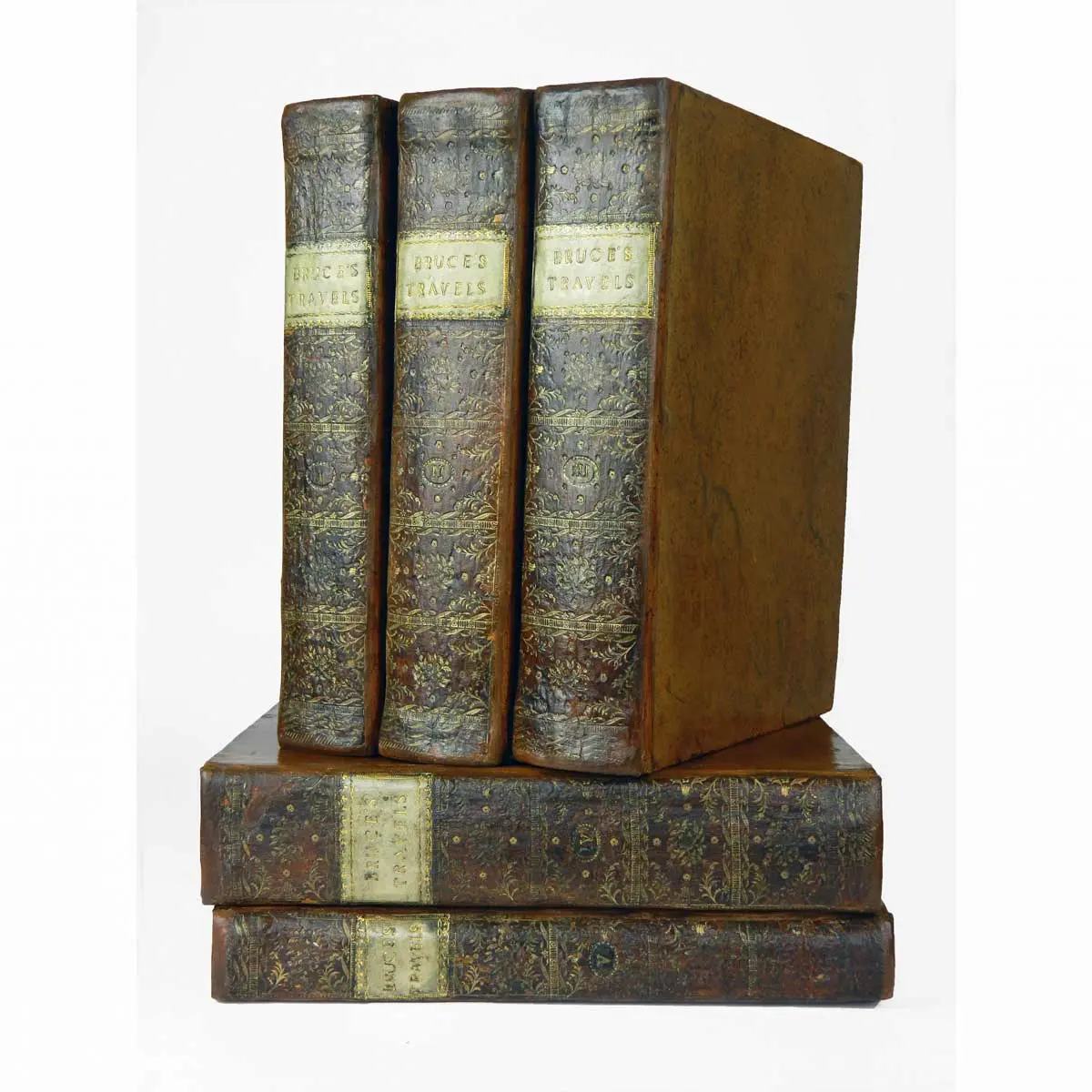
First Edition, Edinburgh: Printed by J. Ruthven for C.G.J. and J. Robinson, 1790. Five volumes. 4to, Contemporary full mottled calf gilt, with engraved vignette title pages, three large engraved folding maps, and 58 engraved plates of scenery, antiquities, battle plans and natural history by James Heath, a very attractive set.
First Edition, Edinburgh: Printed by J. Ruthven for C.G.J. and J. Robinson, 1790. Five volumes. 4to, Contemporary full mottled calf gilt, with engraved vignette title pages, three large engraved folding maps, and 58 engraved plates of scenery, antiquities, battle plans and natural history by James Heath, a very attractive set.
The Scottish explorer James Bruce (1730-1794) introduced Ethiopia to the Western world and confirmed the source of the Blue Nile. He was the first modern explorer of tropical Africa.
James Bruce was born on Dec. 14, 1730, near Larbert in Stirlingshire. His father, the laird of Kinnaird House and a descendant of the prominent Bruce family, sent young James to school in England, partly to keep him away from Jacobite influences.
In 1747 Bruce enrolled at the University of Edinburgh to study law, but after graduating he decided not to practice.
Bruce visited Andalusia in 1757, where he became interested in the history of Moorish Spain and of the Arabs who had created it, and then toured northern Europe. On his father’s death the following year, Bruce became the laird of Kinnaird. In 1760 the pit coal on his land was used by the inventor John Roebuck for a new steelmaking process. Although Bruce, a large, florid, quarrelsome man, argued incessantly with Roebuck, his immediate financial gain was considerable and, with Bruce’s tastes for adventure and travel, liberating.
Bruce obtained the post of consul general in Algiers in 1762, but he took nearly a year to reach the city. He traveled through France and Italy, investigating and sketching Roman ruins and writing essays on classical civilization. As consul general in Algiers to 1765, the ever-querulous Bruce succeeded primarily in alienating both the local rulers and his British associates. However, he acquired a knowledge of Arabic, skill as a horseman, and experience in Oriental society. In 1765 he made two journeys among the Berber peoples of the interior and then traveled through North Africa, the Aegean, and the Levant.
From 1768 to 1772 Bruce was engaged in the adventures on which his fame is noted. Traveling first up the Nile in 1769 and then along the Red Sea, he finally reached Massawa, the main port of what became the Eritrean province of Ethiopia. He spent the major portion of his Ethiopian period in and around Gondar, the imperial capital. This epoch coincided with political upheavals in the empire and the rise of provincial warlords, the chronicle of which is narrated at some length in this work. He also discussed Ethiopia’s history, monuments, art, geography, and natural history.
Bruce gathered detailed and still significant orally derived accounts of the Ethiopian past and made observations on the state of the nation in the late 18th century. During the course of his stay in Ethiopia he also observed the flow of the Blue Nile from its source in Lake Tana. On his way home in 1772 he spent some months in the Funj kingdom of Sennar (now the Sudan), for which his published writings again constitute a valuable record.
Bruce returned to Britain in 1774 and was elected a fellow of the Royal Society.