
 Marshall Rare Books
Vellum Notebook - India
SKETCHBOOK BY A PIONEER IN INDO-SARACENIC ARCHITECTURE, AND A TRIBUTE TO WILLIAM BURGES
Manuscript, 48pp., 26 pages of sketches, most in brown in, many with caption in Gothic script, emulating Burges use of Gothic script, pencil note to head from first leaf, reads ‘W Emerson Vellum Book of Sketches’, original black sheep with onlaid roudel to upper cover, fold over flap and pencil holder, rebacked, 4to (220 x 170mm), c.1865
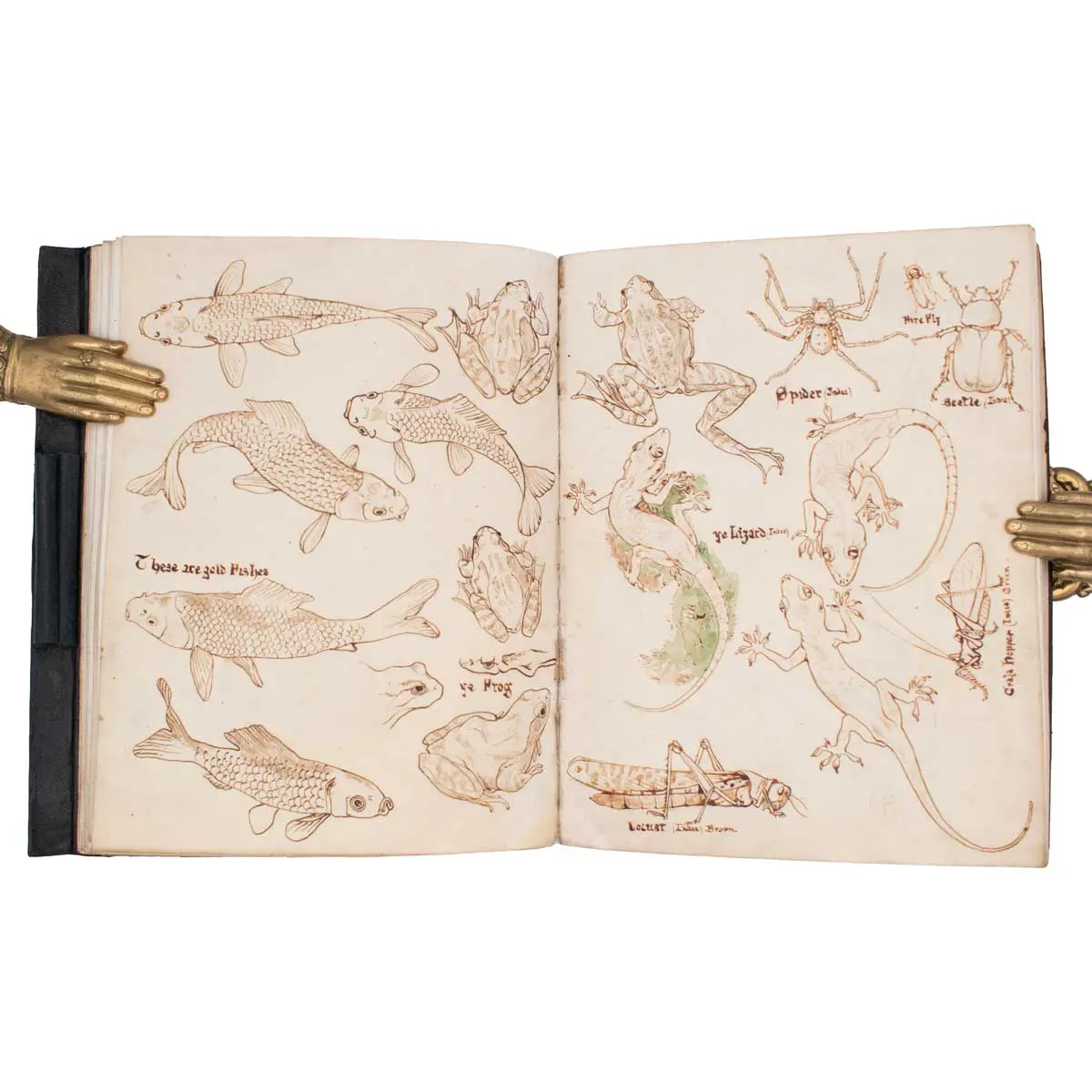
The sketch book begins with three nude male academic figure studies followed by a seated woman and then a series of Indian subjects including a ‘Kattiawar [stone] Mason’ (Kathiawar, Gujarat), a portrait of Mahmoud Ibrahim and a Sepoy. Introduced into these Indian portraits is a very English scene of a group assembled to sing around a grand piano – but in classical dress as if portrayed by Flaxman. A page of sheep and a camel has annotation in pencil that seems to refer to Agra, followed by more camels, an Indian elephant and a sacred cow. There is a strikingly stylish double page spread of insects, gold fish and lizards followed by pages of bats and scorpions and seven pages of stylised flower designs including irises (prefiguring almost the art nouveau) seen from several angles with a drawing of a thistle on paper laid in and another of a kneeling monk also laid in. In the final group of drawings Emerson sticks to Indian subjects including a beautifully realised drawing of piece of jewellery, a ‘Bronze gun at Bijapore’ – presumably the Malik-i-Maidan at Bijapur followed by interior and exterior drawings of the ‘large dome at Bijapore India’ – the Gol Gumgaz.
English architect, William Emerson (1843-1924) and his mentor and employer William Burges travelled to India in 1864 where Emerson supervised the construction of Burges’s design for the Bombay School of Art. Emerson stayed on to practise architecture in Bombay, designing significant buildings, including All Saints Cathedral Allahbad; the Victoria Memorial in Calcutta and Mumbai’s Gothic Crawford Market in what has been described as a ‘translation of Burgesian Gothic into Indian’.
The use of the Indo-Gothic style is seen in this sketchbook, inspired by his mentor, William Burges. Burges created his manuscript in tribute to Wilars de Honecourt’s celebrated collection of drawings of mediaeval architecture and life. Emerson recorded his impressions of India in a reworking of the stripped down visual language established by Burges/De Honecourt. Emerson would go on to complete several major works in India himself and used this vellum notebook to record his impressions of the country – and to pioneer his Indo-Saracenic style, combining his mentor’s Gothic world with stylistic and decorative Indian features.