
 Marshall Rare Books
Viage al Estrecho de Magallanes por el Capitan Pedro Sarmiento de Gamboa en los anos de 1579 y 1580, y Noticia de la Expedicion que despues hizo para poblarle.
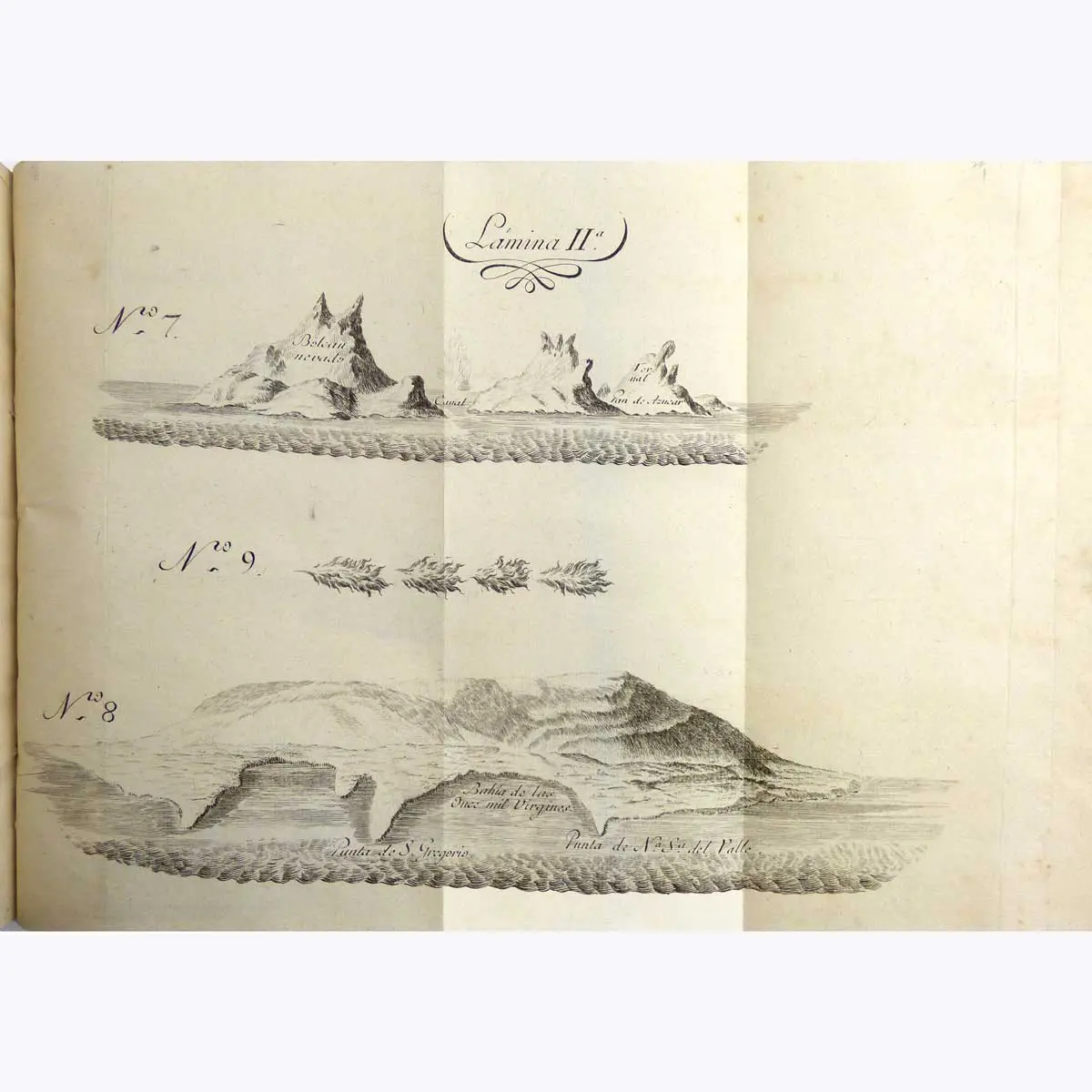
Madrid: En la Imprenta Real de la Gazeta, 1768, 4to (215 x 165 mm), pp. lxxxiv, 402, [2], XXXIII, [1, blank], Contemporary calf gilt, spine restored, with 3 folding engraved plates bound at the end of the book. This is the first printed edition of Gamboa's manuscript journal in the Royal Library at Madrid, and is edited by Don Bernardo de Iriarte.
Madrid: En la Imprenta Real de la Gazeta, 1768, 4to (215 x 165 mm), pp. lxxxiv, 402, [2], XXXIII, [1, blank], Contemporary calf gilt, spine restored, with 3 folding engraved plates bound at the end of the book.
This is the first printed edition of Gamboa’s manuscript journal in the Royal Library at Madrid, and is edited by Don Bernardo de Iriarte.
He then joined Alvaro de Mendana’s expedition through the southern Pacific Ocean to find the Terra Australis Incognito, which, should Mendaña have followed Sarmiento’s indications, had reached New Zealand or Australia; but they discovered the Soloman Islands instead, in 1568. The expedition failed to find gold and attempts at establishing a settlement in the Solomon Islands ended in failure.
In order to take credit of the discoveries for himself Mendaña threw the journals and maps made by Pedro Sarmiento de Gamboa overboard and abandoned him in Mexico. However, a trial was then held in Lima, with the result giving Sarmiento credit for the discoveries.
He became the commander of the naval station in the Pacific in 1578, when Sir Fancis Drake attacked the coasts of Peru and Mexico. Sarmiento de Gamboa sailed out of the port of Callao with eleven vessels in 1579 to capture Drake. He did not find Drake, who had gone westward through the Pacific Ocean, but he explored the southern Pacific Coast of South America, passed the Magellan Strait from west to east for the second time, drawing precious maps of many points of the Strait, and, after an impressive sailing of the Atlantic Ocean from southwest to northeast, he reached Spain in late 1580.
On his reporting the results of his expedition to King Philip II of Spain, the latter resolved to fortify the Strait, and in 1581 sent an expedition of twenty-four vessels with 2,500 men from Cadiz, under the command of Sarmiento de Gamboa and Diego Flores Valdez. The expedition lost eight vessels in a storm, and Flores, on account of rivalry with Sarmiento de Gamboa, abandoned him with twelve vessels in the entry of the Strait and returned to Spain. With only four vessels, Sarmiento de Gamboa continued the voyage, arriving in January 1583 at a favourable point, where he established a fort and colony garrisoned by 300 men which he called Rey Don Felipe. The settlement failed shortly after he left, and when Thomas Cavendish visited the ruins in 1587 he renamed the place Port Famine.
In 1584 Sarmiento de Gamboa sailed for Europe, but he was captured by an English fleet under to Sir Walter Raleigh and carried to England where he was presented to Queen Elizabeth I. They had a conversation in Latin, which was their only common language, and despite Spain’s official policy of keeping all navigational information secret, shared his maps with British cartographers. Queen Elizabeth gave him a “Letter of Peace” to be carried to King Phillip II of Spain. However, on his way back to Spain he was captured by French Huegenots and was kept prisoner until 1588. During that time Spain mounted the Spanish Armada and attacked the English fleet. If Queen Elizabeth’s “Letter of Peace” had been delivered in time to Spain, there might not have been a war. Meanwhile, his colony dissolved and gradually perished of starvation; one of the survivors was rescued by Cavendish’s fleet in 1587, and another by Meriche in 1589. After his liberation, Sarmiento de Gamboa made a representation of his experience and a complaint against Flores to King Philip II; it seems that his complaint was ignored.
On his last naval mission in the service of the king he was made Admiral of an armada of galleons en route to the Indies. He died on board ship, near the coast of Lisbon.