
 Marshall Rare Books
VOYAGE ROUND THE WORLD In the Years MDCCXL, I, II, III, IV.
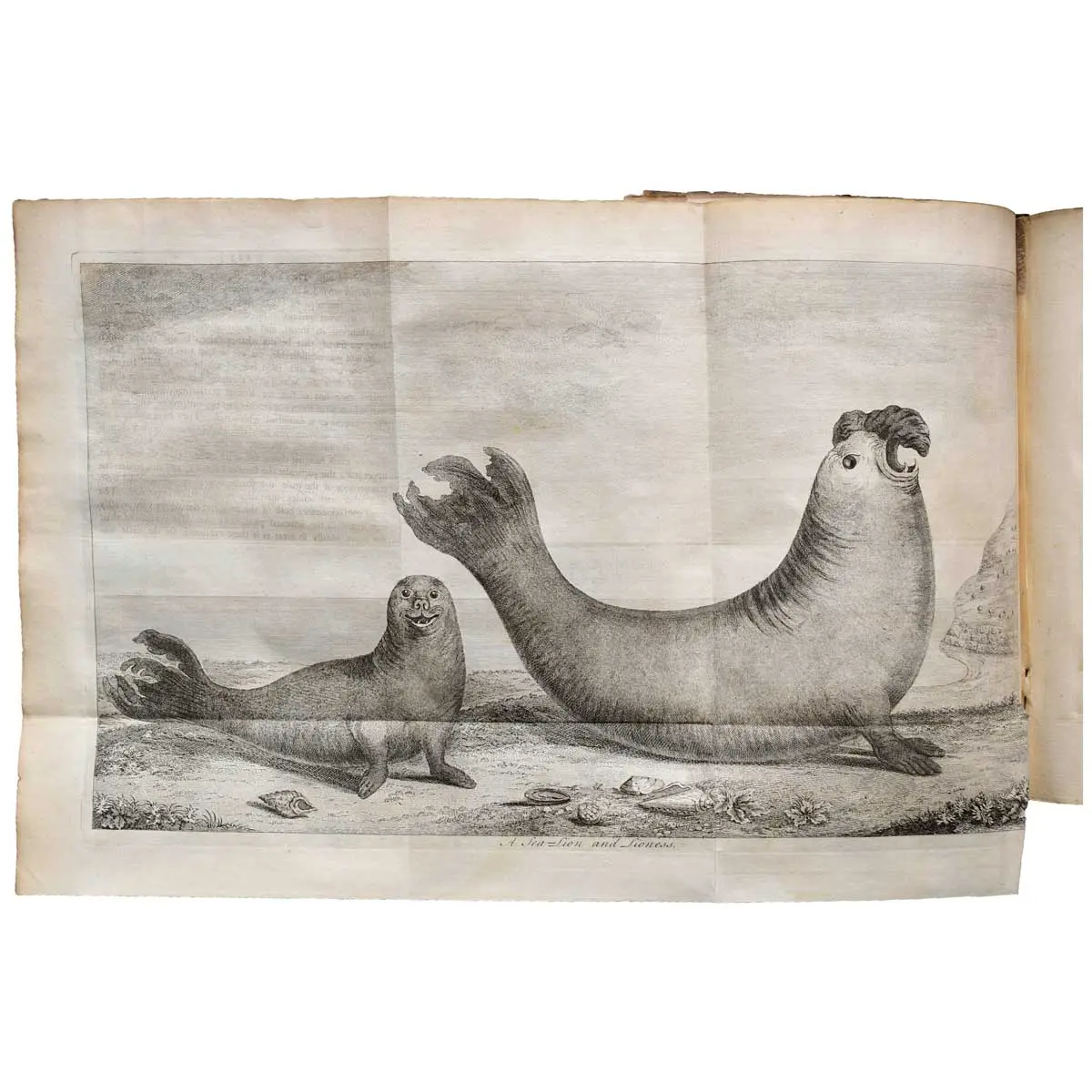
First edition of the most popular book of maritime adventure in the eighteenth century. This can be identified as the first of two issues by a misprinted page number (219 instead of 319) and the fact that the engraved plates are all in an early state before the addition of their identifying numbers. The narrative was based on Anson’s own journal, along with notes by Richard Watler who was chaplain on the ship Centurion.
FIRST EDITION, FIRST ISSUE, [34], 417, [3]p., 42 engraved folding maps and plates, list of subscribers, final leaf of directions to the binder, occasional light foxing and offsetting, pp. 319 misnumbered as 219, contemporary catspaw calf, boards twice ruled in gilt, handsomely rebacked, spine gilt, red morocco label, 4to, London, for the Author by John and Paul Knapton, 1748
A MASTERPIECE OF DESCRIPTIVE TRAVEL – Hill
First edition of the most popular book of maritime adventure in the eighteenth century. This can be identified as the first of two issues by a misprinted page number (219 instead of 319) and the fact that the engraved plates are all in an early state before the addition of their identifying numbers. The narrative was based on Anson’s own journal, along with notes by Richard Watler who was chaplain on the ship Centurion.
George Anson entered the Navy during the War of Spanish Succession and spent the next decade rising through the ranks until 1722 when he was promoted to Commander and given command of the small 8-gun HMS Weazel. Anson’s orders were to suppress smuggling between Britain and Holland, a task he swiftly and effectively performed. In recognition of his efforts he was promoted to the rank of post-captain in February 1723 and given command of the 32-gun HMS Scarborough with orders to escort British merchant convoys from the Carolinas. Between 1728-36 he transferred three times in succession before being promoted to Commodore in 1737. With the 60-gun HMS Centurion, he took command of a squadron sent to attack Spanish possessions in South America at the outset of the War of Jenkins’ Ear.
The work details Anson’s circumnavigation which occurred during the War of Jenkins’ Ear between Britain and Spain. The purpose of the expedition was for Anson’s fleet to intercept Spanish ships and seize their cargo from the New World.
After setting off later than planned, Anson’s squadron encountered successive disasters. Two of his ships failed to round Cape Horn and another was wrecked off the coast of Chile. Anson lost half of his ships and two thirds of his men before reaching the South Pacific Islands. However, he was able to harass and sack the Spanish port of Paita in Peru. The crews were decreased due to scurvy so Anson consolidated the remaining crew in the Centurian. Despite his losses Anson was determined to seize the treasure galleon that made the annual voyage from Acapulco to Manila. Laden with Peruvian silver, she was the “Prize of all the Oceans”. In June 1743 Anson intercepted the Nuestra Señora de Covadonga, and in a 90-minute action forced her surrender. After refitting at Canton he returned home the next year to find himself compared with Drake, and his exploits with the long-remembered feats of arms against the Spain of Philip II. The casualties were forgotten as the public celebrated a rare triumph in a drab and interminable war. The prize money earned from the capture of the galleon made Anson a rich man for life and brought him considerable political influence.
In 1748 the authorised account was published under Richard Walter, and has formed the basis of all accounts of Anson’s Voyage since. The work was a great success; the epitome of adventure for the eighteenth-century reader. It was translated into several European languages and stayed in print through numerous editions for many years.
[ESTC: T89475, Hill pp. 317-8; Sabin 1625]