Marshall Rare Books
Kalendarius Teütsch.
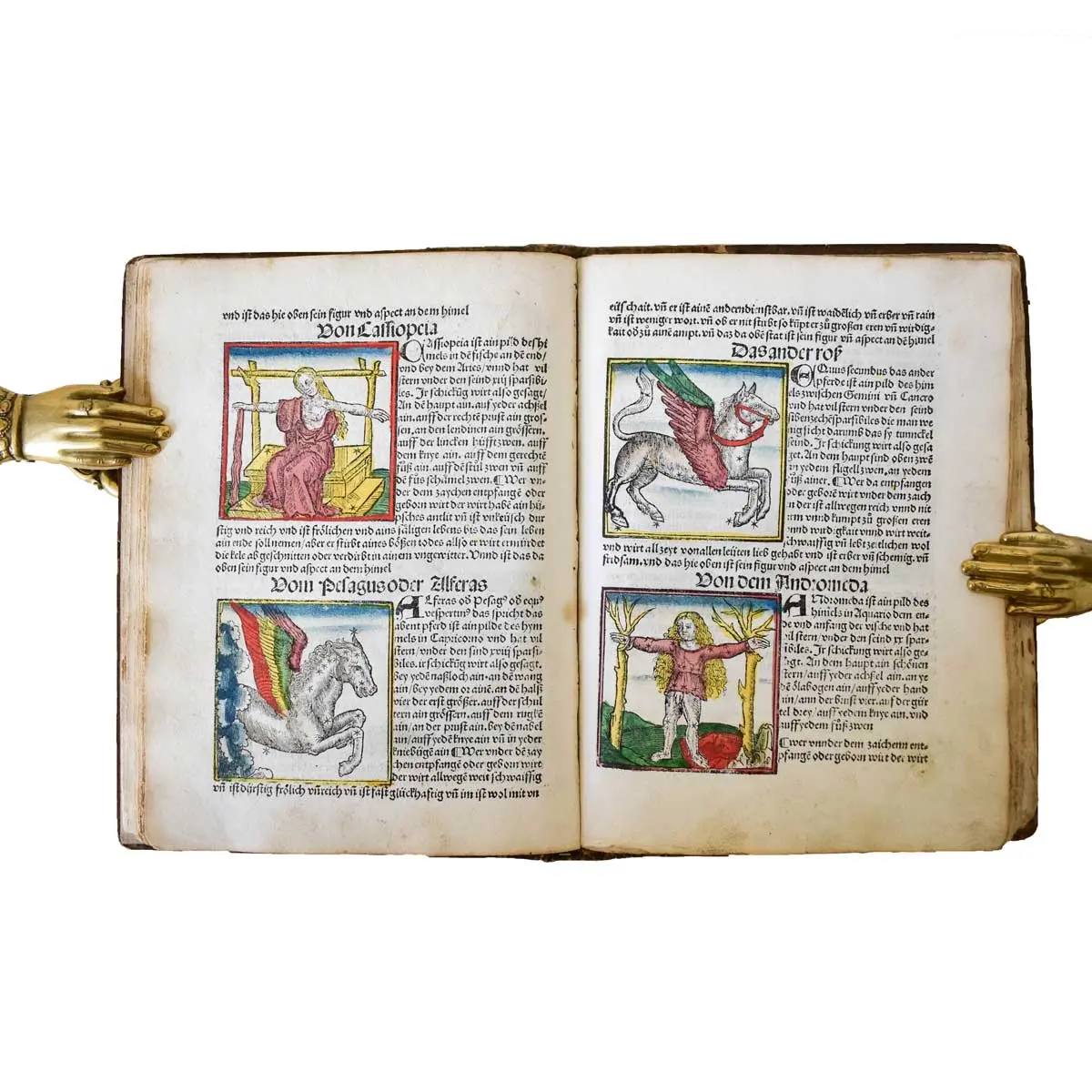
A Rare, Richly Coloured Illustrated Calendar from the Augsburg Renaissance.
Augsburg: [J. Sittich], January 1514. Quarto (210 x 155mm). Title within four-part woodcut border, 87 woodcuts, 10 of these large including 1 full page lunar figure, numerous initials, all in bright contemporary hand-colour, with working volvelles. Contemporary quarter pigskin over wooden boards.
A Rare, Richly Coloured Illustrated Calendar from the Augsburg Renaissance.
Printed calendars and almanacs became extremely popular in the fifteenth century and provided ordinary people with the basic knowledge required to plan their daily routines. The market for calendars was first tapped by Gutenburg, who published a calendar which calculated the times of new and full moons and planetary positions, with readings every two to three days. All earlier calendars, however, were superseded by those of Regiomontanus (1436-1476) whose calculations were far more accurate; he recorded several eclipses of the moon and his interest led him to make the important observation that longitude at sea could be determined by calculating lunar distances. Outstanding also is his observation of a comet in 1472, 210 years before it was “first” seen by Halley.
One of the foremost scholars in mathematics and astronomy during this period, Regiomontanus was professor of astronomy at the University of Vienna before being appointed astronomer to King Matthias Corvinus of Hungary. With funds from his patron and fellow scientist Bernard Walther, he built an observatory in Nuremberg in 1471, and in 1472 erected his own private press in order to publish his discoveries satisfactorily. One of the first to realize the impact printing would have in disseminating scientific knowledge, Regiomontanus’ printing output included the first edition of his Calendar. His press was maintained until 1475 when he was summoned to Rome by Pope Sixtus IV to assist in the reform of the Calendar; his death at the age of 40 a year later brought his work to a premature end, a great loss to the developing science of astronomy.
Provenance: ‘Augsburg Anno 1514’ (inscription on title) – contemporary annotations, including receipts in a 16th century hand in German — ‘Carl Schnizlein gekft 1858’ (Adalbert Carl Friedrich Hellwig Conrad Schnizlein (1814-1868, German botanist and pharmacist; inscription on front pastedown).