Marshall Rare Books
Principles of Geology, Being an Attempt to Explain the Former Changes of the Earth's Surface, by Reference to Causes Now in Operation.
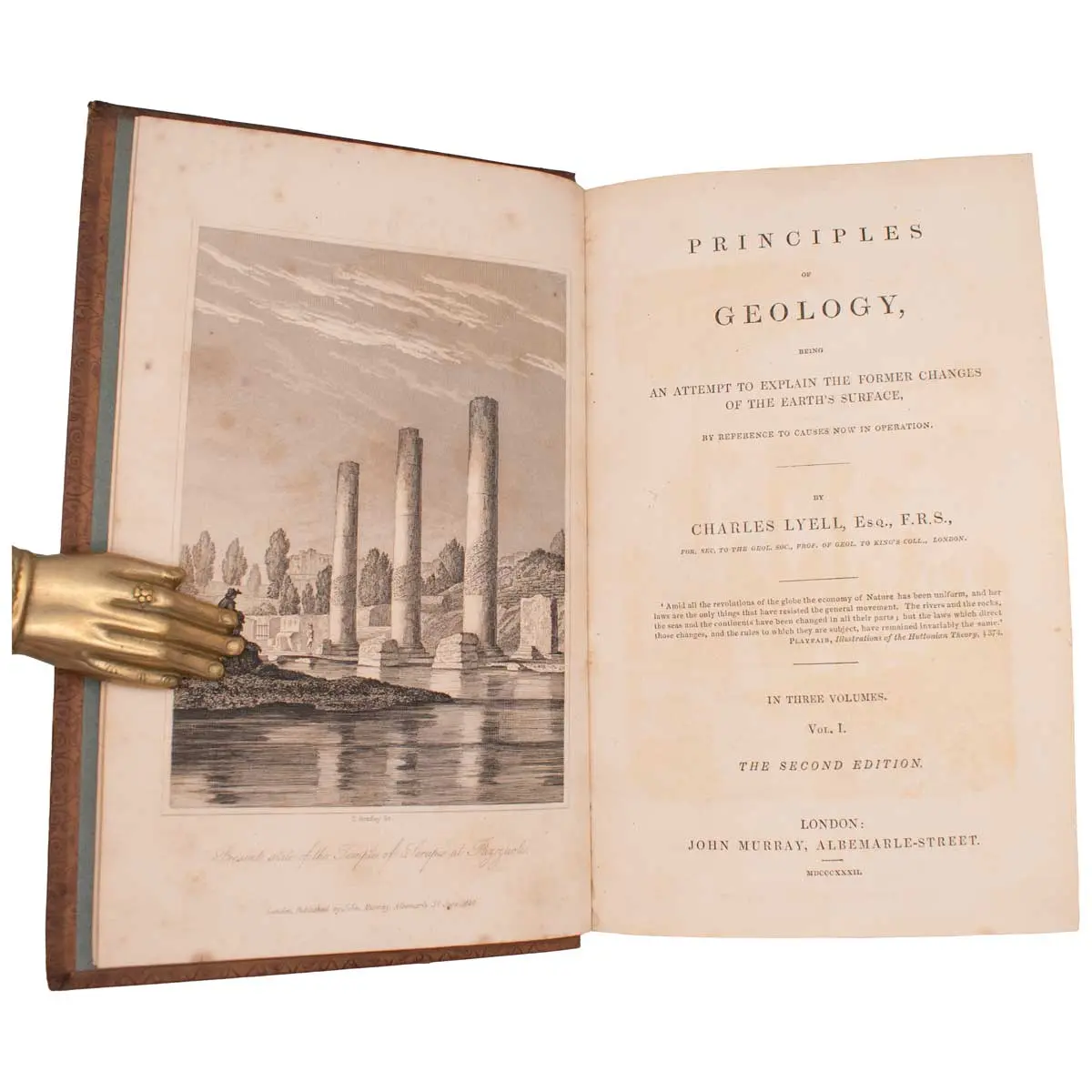
Charles Lyell's Principles of geology (1830-1833) has been described as "perhaps the most important scientific textbook ever written" (Gould 2000a) and was a major influence on Charles Darwin during the voyage of the Beagle.
3 vol., vol 1 & 2 Second Edition, Vol. 3 FIRST EDITION, hand coloured frontispieces, 8 engraved plates (2 folding), numerous wood engraved text illustrations, contemporary diced calf, spines gilt, London, John Murray, 1832-1833-1833
Charles Lyell’s Principles of geology (1830-1833) has been described as “perhaps the most important scientific textbook ever written” (Gould 2000a) and was a major influence on Charles Darwin during the voyage of the Beagle.
Lyell was a Scottish geologist largely responsible for the general acceptance of the view that all features of the Earth’s surface are produced by physical, chemical, and biological processes through long periods of geological time. The concept was called uniformitarianism (initially set forth by James Hutton). Lyell’s achievements laid the foundations for evolutionary biology as well as for an understanding of the Earth’s development.
The central argument in Principles was that “the present is the key to the past”: that geological remains from the distant past could, and should, be explained by reference to geological processes now in operation and thus directly observable.
In 1830 Lyell was already carving out a reputation as an experienced writer and knew exactly for whom his book was intended. He not only wanted to revolutionise geology; he wanted to be considered as the gentleman expert uniquely qualified by his heroic fieldwork to explain his science to the intelligentsia. Publication of the Principles of Geology placed him among the recognised leaders of his field, compelling him to devote more time to scientific affairs. During these years he gained the friendship of men like Darwin and the astronomer Sir John Herschel.
The first edition of Lyell’s book appeared at a critical stage in Darwin’s early career and played a major role in the emergence of his geological and biological theorising. Darwin adopted Lyell’s new terms and referred to the Principles throughout the voyage. In his later career Darwin continued to cite Lyell in his notebooks, publications and correspondence and the second (1845) edition of his Journal of researches is dedicated to Lyell and the Principles. The book is notable for being one of the first to use the term “evolution” in the context of biological speciation.