 Marshall Rare Books

Danzica: Simon Reiniger, 1668.
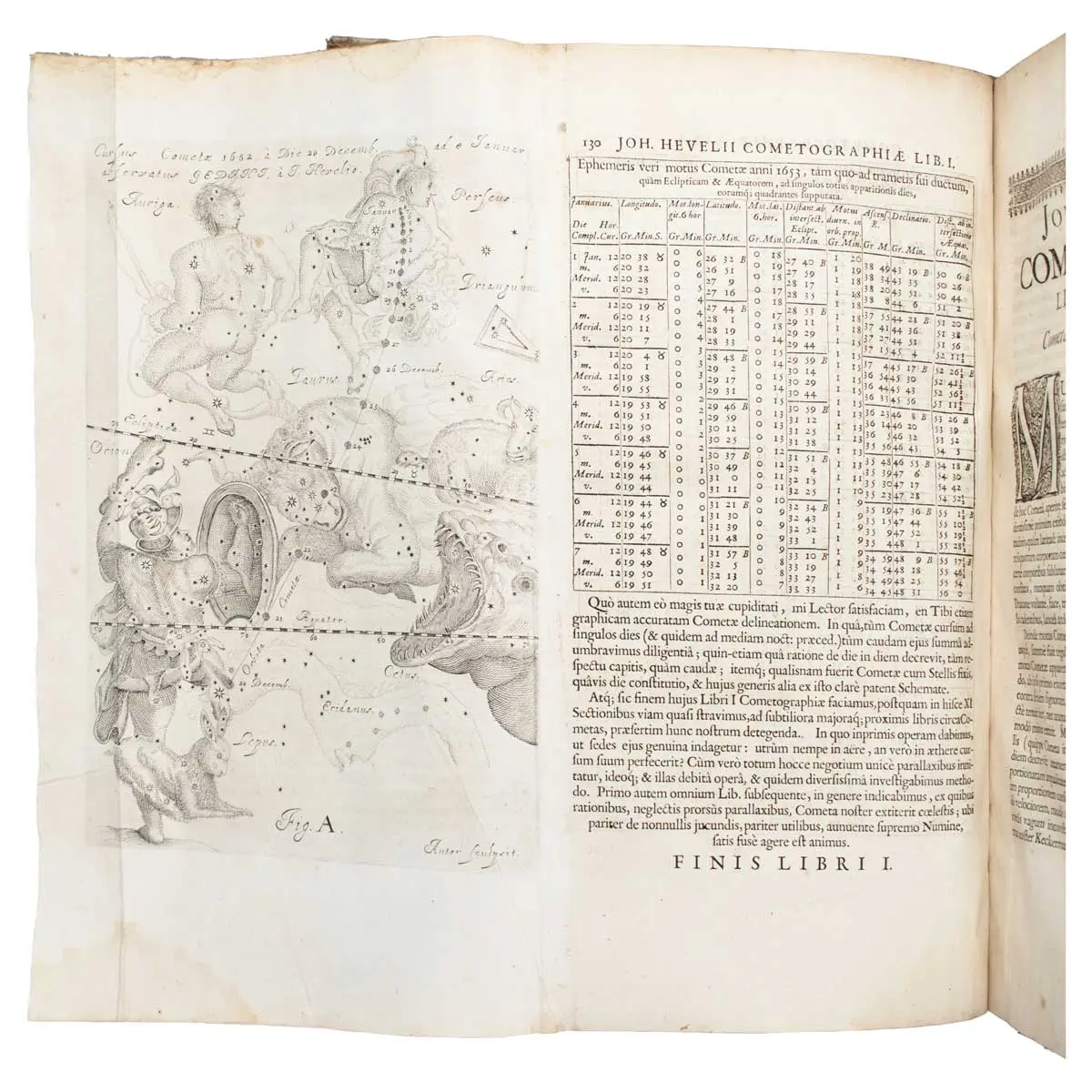
Three Scarce and Important Works by Hevelius entirely dedicated to comets and illustrated by the author.
3 works in one volume, folio (367 x 228mm). Engraved vignettes on titles, half-title and engraved frontispiece in the third work, woodcut headpieces and initials, in the first work and 3 engraved plates, 4 engraved plates in the second , in the third 38 engraved plates attached to the outer margin of the text leaves, engraved illustrations throughout, (without blank a2 in the third work), Contemporary vellum, manuscript author’s name on spine, blue edges, occasional discolour in text, but an excellent copy of a very scarce work with all three titles in one volume.
Three Scarce and Important Works by Hevelius entirely dedicated to comets and illustrated by the author. The first two works are extremely difficult to find and deal, respectively, with the comet observed from 14th December to 28th February 1664 and the comet of April 1665. Both are depicted in detail in their changing appearance over time and their orbits are traced in two celestial maps.
The renowned “Cometographia” follows in Twelve Parts, which begins with the fine frontispiece engraved by L. Visscher (1633-1690) based on a drawing by A. Stech (1635-1697) depicting Hevelius seated at a table with a cometary orbit represented as a conical section combined with a spiral, with the sun at the centre of the first. The figure of Aristotle bears the illustration of some linear and sublunary cometary paths. There is then a wonderful illustration of the house and Hevelius Observation Platform, one of the most advanced of the time (DSB).
“The Danzig brewer and astronomer Johannes Hevelius (1611-1687). in his monumental work Cometographia of 1668, discussed comets thoroughly and brought the various theories that previously existed into a single overall picture … Like Kepler, Hevelius initially adopted a linear motion, but later established that curved paths must be involved, and that comets moved fastest when near the Sun. He took parabolas or hyperbolas as the probable form of orbit. Hevelius supported the view that comets themselves were disc-shaped and lay at right-angles to the Sun. They arose in the atmospheres of Jupiter and Saturn by the transpiration of vapours – a reflection of the then common view that such vapours were to be found on many heavenly bodies: as spots on the Sun, for example. Hevelius chose Jupiter and Saturn on the basis of the colour of comets. The tail was formed from particles ejected from the core of the comet, and which were then swept away from the head by the Sun.” (R. Stoyan, Atlas of Great Comets. Cambridge Univ. Press, 2015, p.28).
“The Cometographia advocated the idea that the motions of comets are fundamentally parabolic. “One of the major works of Hevelius, which had been almost fifteen years in preparation. The first book gives the observational data on the Comet of 1652, the subsequent two books attempt to prove the existence of comets far beyond the atmosphere of the earth. The fourth book gives a detailed account of the actual parallax of the Comet of 1652, while the fifth book deals with the true position of the comet and its distance from the earth. The subsequent books are concerned with the tail of the comet, its size and its structure. A description of the comets of 1661, 1664, and 1665 is followed by a complete listing of about four hundred comets known from ancient times up to 1665” (B.Y.U.).
Provenance: Ex libris Bibliotheca Valentini W..t? 1818 (manuscript ownership inscription on endpaper perhaps Georg Wilhelm von Valentini 1775-1834, Prussian General).
Books you may also like
Historiae coelestis libri duo quorum prior exhibet catalogum stellarum fixarumBritannicum novum & locupletissimum una cum earundem planetarumqueomnium…
Complete set of six untitled celestial charts
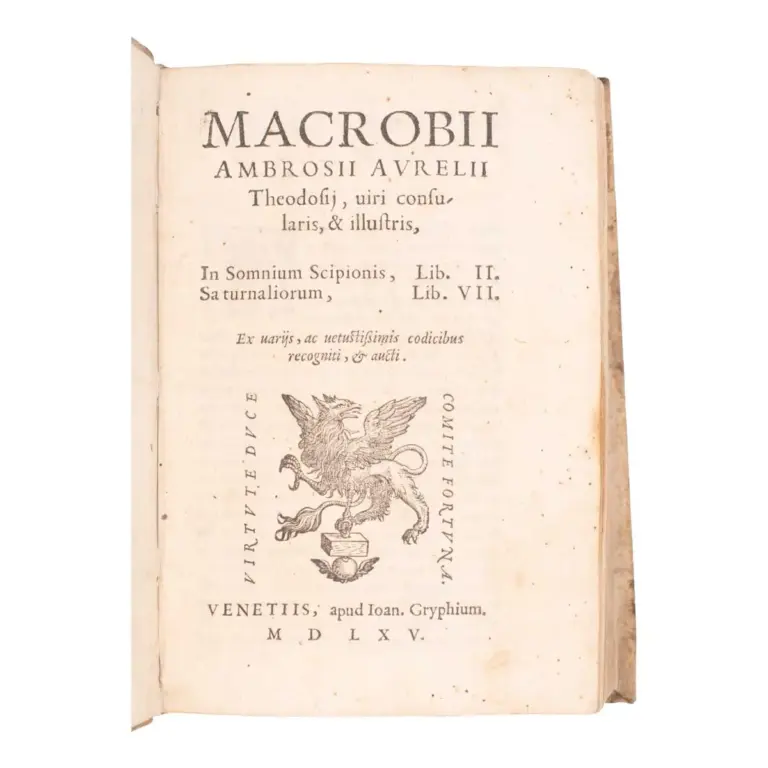
In Somnium Scipionis, Lib. II. Saturnaliorum, Lib. VII. Ex variis, ac vetustissimis codicibus recogniti, & aucti…