 Marshall Rare Books

Vogelbuch. Darin die Art, Natur und Eigenschafft aller Vöglen.
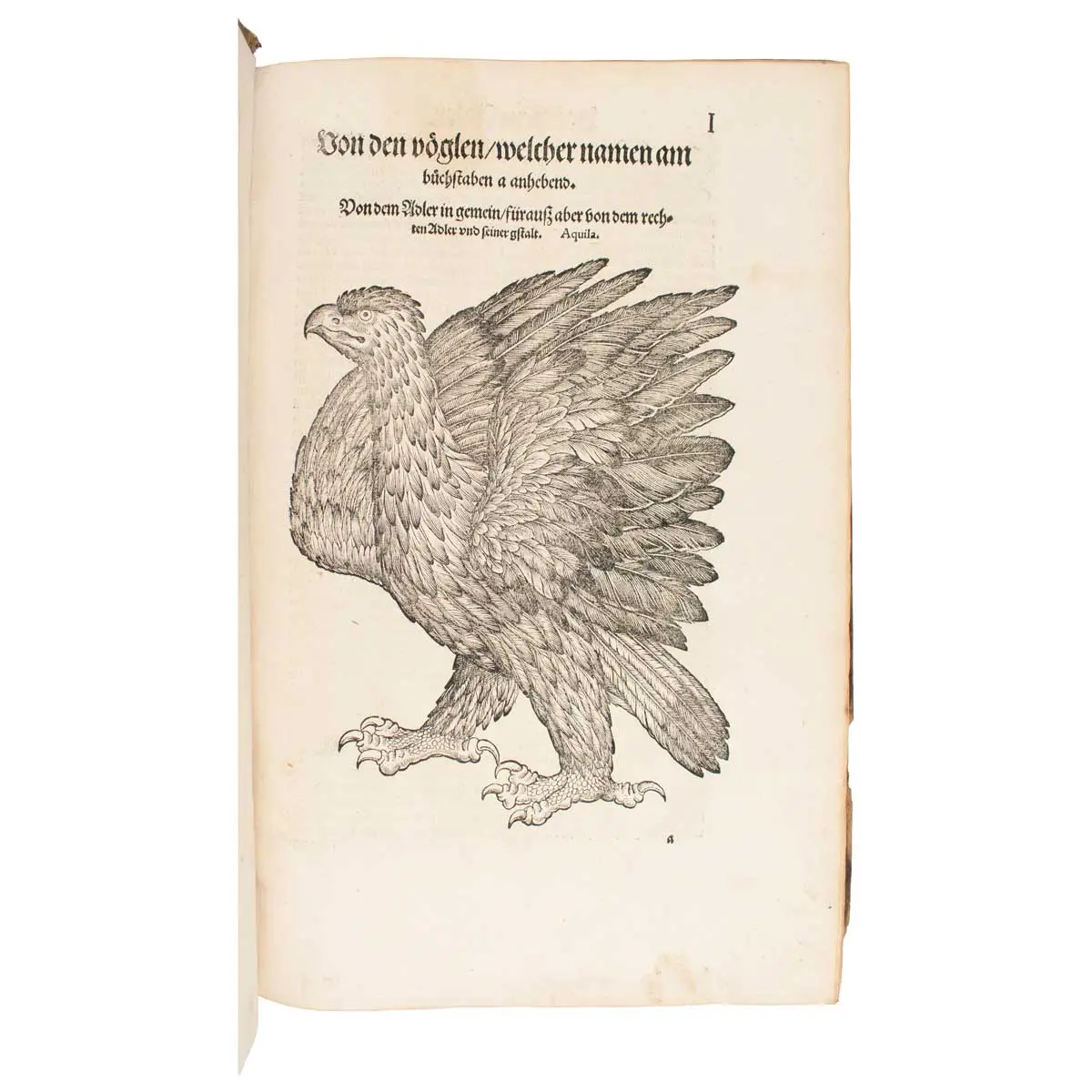
A SPLENDID ANNOTATED COPY OF GESSNER’S GREAT WORK ON BIRDS
Zürich: Christoffel Froschauer, 1557. Folio (380 x 250 mm). (6), cclxiii, (2, blank leaf) with woodcut illustration on title, initials, 219 fine woodcut illustrations of birds. (Sign.: aa6, a-z6, A-X6; cptl.) Finely bound in contemporary half vellum over wooden boards, clasps missing, a fine and clean copy.
A SPLENDID COPY OF GESNER’S GREAT WORK ON BIRDS ANNOTATED BY AN EARLY HAND
The first German edition of the Swiss naturalist and universal scholar Conrad Gessner’s famous bird book, the principal and most extensive source for ornithology in 16th century Europe. Apart from literary quotations, it contains numerous contemporary, precise, original observations and illustrations, most of which are by Gessner himself, but some derive from contemporaries such as William Turner and Pierre Belon. Gessner’s aim with this work and also with his entire Historia Animalium was to create a reference work for an academic readership.
The work is annotated throughout in a neat early hand in the margins with corrections or additional descriptions of the birds.
This encyclopaedic claim is reflected in the mainly alphabetical order of the bird species as a new form of knowledge for early modern times, a specific textual structure and collections of concepts and models into which knowledge is subsumed. As a progressive Renaissance scholar, he made critical statements about traditions and authorities, and he is extremely thorough, carefully describing and illustrating birds in both his text and his plates and also stating his sources, so that the origin of his statements can be checked.
It is clear that Gessner was much more critical than the more linguistically-inclined Aldrovandi. Gessner’s bird book thus differs from other contemporary sources not only by its range and the numerous original observations but also by its high level of accuracy and reliability. It contains an abundance of contemporary information about the occurence and biology of the birds, about their cultural interactions with man, and it is of particular as it documents the status of the Central European bird community during the transitional climatic phase between the medieval climatic optimum and the onset of the little Ice Age. (Katharina Springer) Therefore he is often regarded as “the starting-point of modern zoology” (Anker).
Edited and translated by Rudolf Heusslin (Hüsli; died 1600), priest in Albisrieden, Rafz and Töss, under the guidance of his friend and relative Conrad Gessner, the translation followed closely Gessner’s Latin text and original illustrations (1555), while a later German edition (1669) by Georg Horst is a mere compilation of different books and marks a break with the original content: a significant reduction of the original observations of Gessner. The first German Edition includes two more woodcut illustrations as the Latin edition, taken from Olaus Magnus “Historia de gentbus septentrionalibus” and the Latin text was slightly revised: Ancient quotations and philological accessories are omitted. Heusslin himself writes in the preface regarding the abridgments he has made. He omitted foreign names and left only one to three German names for the birds and he only used the names of those scholars he found credible. Sixty-six sketches for Gessner’s woodcuts came from his scientific correspondents, five were taken from other books, but the majority of the bird illustrations can be traced back to Gessner himself.
The woodcuts were probably cut by the glass painter Jos. Murer (1530 – 1580), Johann Thomann (1525 – 1567) or Hans Asper (1499 – 1571). All herons are drawn in the same way, probably by Gessner himself, as he described many of them very precisely, dissecting them in some cases and probably also preparing them. Gessner drew them himself, including the Lagopus mutus. Errors in the appearance and body posture of the birds leads to the conclusion that the majority of Gessner’s bird illustrations were drawn from stuffed and mounted or mummified specimens.
Gessner was familiar a large number of the birds due to his own observation. He communicated this through statements such as ‘I saw it with my own eyes’, ‘the bird I held in my hands’ and precise descriptions of the bird’s appearance or dissections down to the smallest detail. The culmination of Gessner’s own nature-orientated observations can be seen in some of the pictures he demonstrably made himself. (Rallus aquaticus, Tringa ochropus, pluvialis apicaria, Lagopus mutus, et al.)
Remarks in the animal books make it clear that Gessner supervised the work of artists working for him to ensure that they did not omit any characteristic features of the subject.
Conrad Gesner was one of the great polymaths of the Renaissance … His History of Animals is an encyclopedia of contemporary knowledge, intended to replace not only medieval compilations but even Aristotle’s work of the same title … The work consists of five large volumes … The first four volumes deal with quadrupeds, birds and fishes; the posthumous fifth volume with snakes and, in an appendix, scorpions … Although the Historia animalium does not yet show any recognition of a connexion between different forms of living nature and fails to conform to our modern ideas of biological research, it was a great step forward and remained the most authoritative zoological book between Aristotle and the publication of Ray’s classification of fauna in 1693. (PMM)
Gesner’s encyclopaedic work acquired such prestige and importance that it is often regarded as the starting-point of modern zoology. Its great reputation and wide circulation were largely due to the fact that it was illustrated with so many pictures in the form of woodcuts that it marked a new departure in the field of zoological illustration.
Brunet II, 391-392; Nissen IVB 350; PMM 77; Wood 356.
Books you may also like
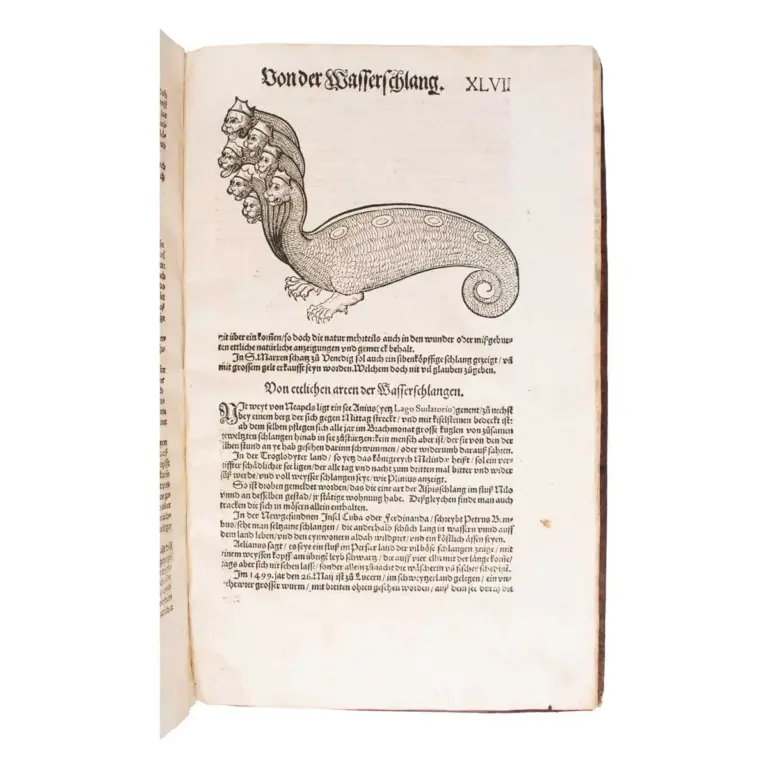
Schlangenbuch. Das ist ein grundtliche und vollkomne Beschreybung aller Schlangen so im Meer, süssen Wassern und auff Erden jr Wohnung haben, sampt der selbigen Conter-factung, erstlich durch den
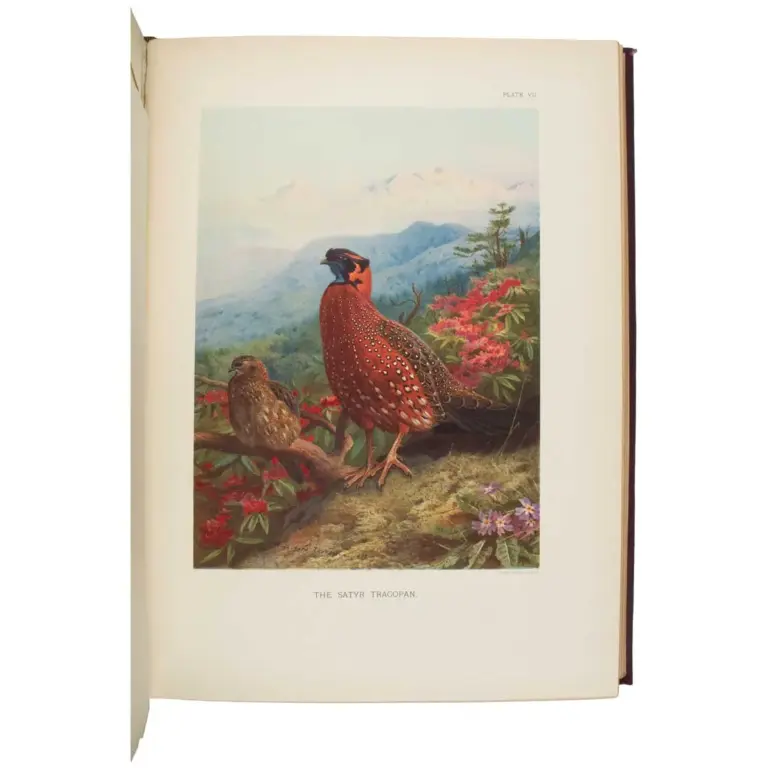
A Monograph of the Pheasants
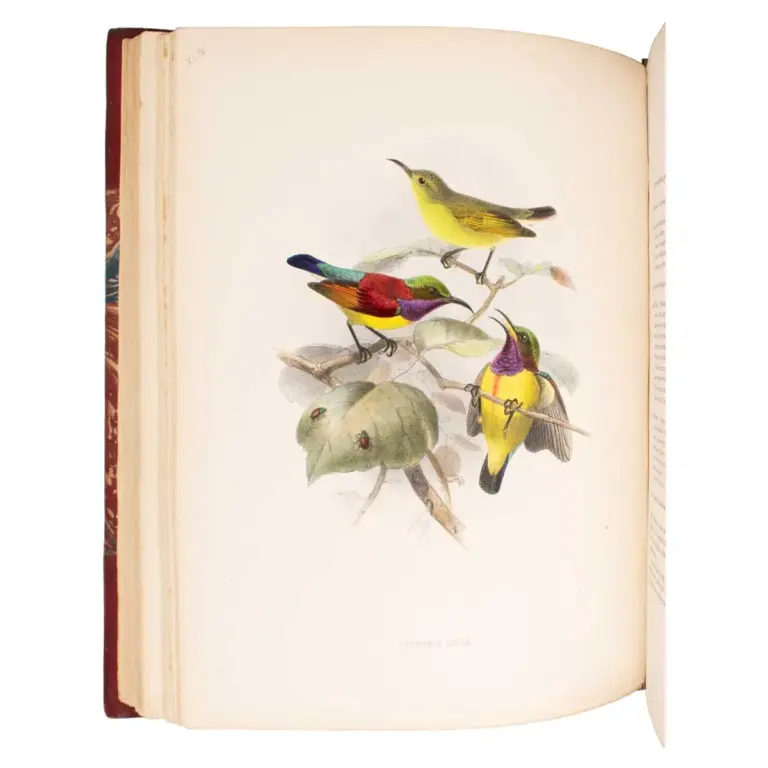
A Monograph of the Nectariniidae, or Family of Sun-Birds.