Marshall Rare Books
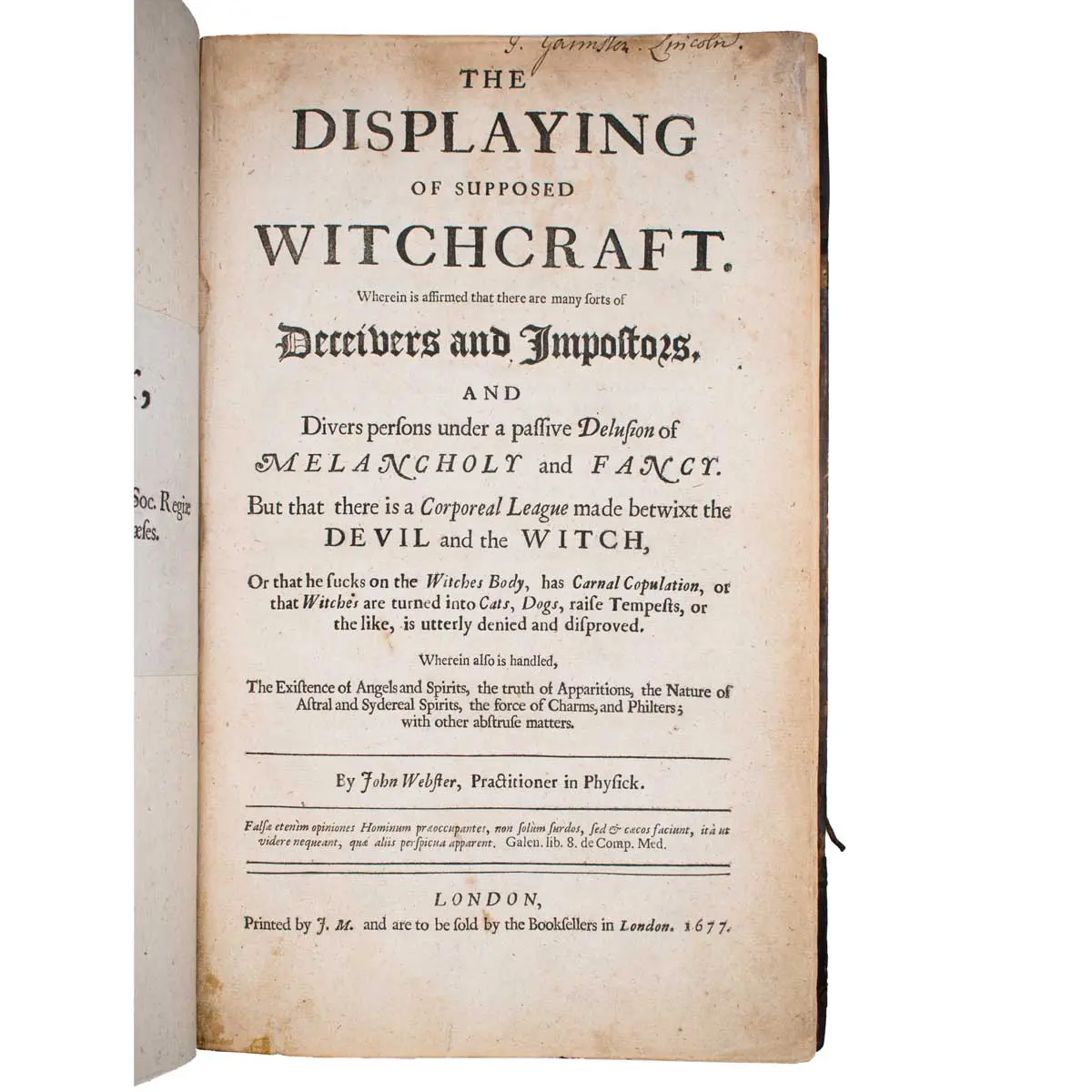
The Displaying of Supposed Witchcraft. Wherein is affirmed that there are many sorts of Deceivers and Imposters. And Divers persons under a passive Delusion of Melancholy and Fancy. But there is a Corporeal League made betwixt the Devil and the Witch, Or that he sucks on the Witch's Body, has Carnal Copulation, or that Witches are turned into Cats, Dogs, raise Tempests, or the like, is utterly denied and disproved, Whereunto is also handled, The Existence of Angels and Spirits, the truth of Apparitions, the Nature of Astral and Sydereal Spirits, the force of Charms, and Philters; with other abstruse matters.
A Unique Copy of an Important Work on Witchcraft
FIRST EDITION, [16], 346, [4], printers notes and errata leaves present, a contemporary manuscript letter bound in, contemporary ownership inscription to title head, contemporary annotations and manicules in margins, occasional light staining to lower margin, original full calf, skilfully rebacked with raised bands, spine gilt with motifs, contemporary marbled endpapers, small folio, London, J.M. [Jonas Moore], 1677.
John Webster (1610 – 1682), a physician and cleric, was known for his controversial works. Webster claimed to be educated at the University of Cambridge, and his writing displays a learned style despite no evidence to back this claim. During the First English Civil War, Webster left his position as a teacher in Clitheroe and became a surgeon and army chaplain in the Parliamentarian forces. In the late 1650s Webster returned to Clitheroe. He gave up the ministry after he was arrested in 1658 and had his papers seized. He practised as a physician in Clitheroe until he died.
His The Displaying of Supposed Witchcraft was a critical and sceptical review of evidence for witchcraft. Webster takes a remarkably similar outlook to Johann Weyer, the best known sixteenth century critic of witch trials. Weyer was completely orthodox in his belief in devils and his condemnation of almost any kind of magical practice, but did not think it was the kind of thing that old ladies got up to. Webster opposed Joseph Glanville and Henry Moore, who defended the belief in witchcraft using learned science and theology. The hermetic systems that became popular during the Renaissance did allow for spirits and angels to be summoned. Learned sceptics were often advocates of a mystical or hermetic point of view and were always vulnerable to accusations of devilry. Webster was keen to deny the existence of witches because he did not want his own ‘natural magic’ to be confused with witchcraft. In The Displaying of Supposed Witchcraft Webster goes as far as suggesting that the bible has been mistranslated to support the belief in witches. Glanville and More were defending the New Philosophy which insists all magic must be supernatural, and that can only mean God or the Devil. The argument was between on one side Aristotelians and their heirs, the mechanical philosophers, and on the other neo-Platonists and Hermetists. It was usually the former, with what we might call the more scientific attitude, who defended belief in witchcraft.
More edited Glanville’s earlier works on witchcraft, attacked by Webster, together with material of his own as a reply. This appeared under Glanville’s name, but after his death as the influential Saducismus Triumphatus.
At the front of this copy of The Displaying of Supposed Witchcraft are two manuscript leaves. The text on the first manuscript leaf is the same as the inscription on Webster’s monument in the chapel of St. Mary Magdalen, at Clitheroe. It reads as follows:
“Qui hanc figuram intelligunt Me etiam intellexisse, intelligent. Hic jacet ignotus mundo mersusque tumultu Invidiae semper mens tatem aqua fuit, Multa tulit veterum ut sciret secreta tophorum Ac tandem vires noverit ignis aquae.
Johannes Hyphantes sive Webster, In villa Spinosa supermontana, in Parochia silcae cuculatae, in agro Eboracensi, natus 1610 Feb 3, Ergastulum animae deposuit 1682, Junii 18, Annoq. Aetatia suae 72 currente. Sic peroravit moriens mundo huic vulftdicens, ea pax vivis, requies aeterna Sepultis”.
This manuscript is illustrated with a witches compass with a unicursal hexagram inside. In the centre is a sun, each section of the hexagram has a planetary symbol, starting north they represent Saturn, Mars, Mercury, the Moon, Venus and Jupiter. The surrounding text reads “aqua cum Igne tandem in grateam redit.”
The second manuscript leaf is a letter bound in, which reads “Carrhale, 17th, March 1797. I believe that the author of this book, who subscribes himself, ‘John Webster, practitioner in Physics’, was the Officiating Clergyman or Curate of Kildwick in Yorkshire in the year 1624. My reasons for this opinion are as follows: Many of the Persecuted Clergy at the times of the Usurpations, which took places anno 1648, applied themselves to the practice of Medicine for a sustenance to themselves and their families. The Author speaks of the kindness received from the then Mr Pisky of Browsholm & others, in his Dedication, during the time of great sufferings & persecutions. And lastly, in pages 277, speaking of himself in the first person, he expressly says I – was Curate of Kildwick &; which, I think, is predicable of the Author only, no other person being mentioned buried in Clitheroe Church; to whose memory a Brass-plate is erected on the Southwall, opposite the Pulpit. He is there described as having been eminent for his knowledge of Chemistry; and as having lived some time in ‘Villa Spinosa’, that is, Thornton Craven.”
Signed ‘J. A.’ mailing folds, sealed twice on the bottom of the page. Annotations in a similar hand are found throughout the book. Some with references such as on pp.245 “This story told in Ye Gentelmen Magazine, June 1750 page 255”, in reference to the condemning of Rouland Jenkes, Oxford, tried for creating a suffocating mist.
[ESTC: R12517; Norman 2192; Wing W1230]
Books you may also like
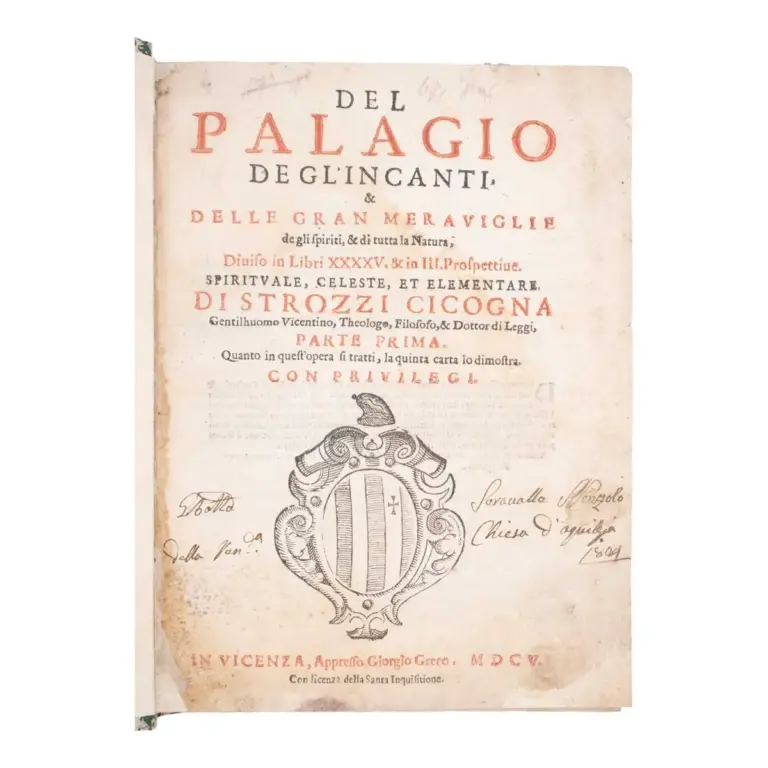
Del Palagio de gl’incanti, et delle gran Meraviglie de gli spiriti, et di tutta la Natura, diviso in Libri XXXXV…
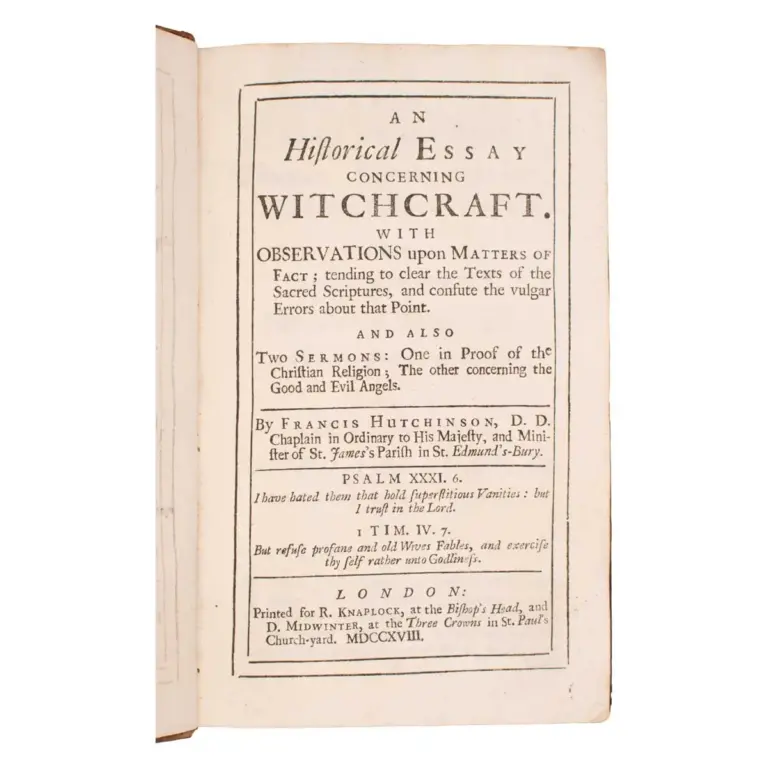
An Historical Essay Concerning Witchcraft. With Observations upon Matters of Fact; tending to clear the Texts of the Sacred Scriptures, and confute the vulgar Errors about that Point.
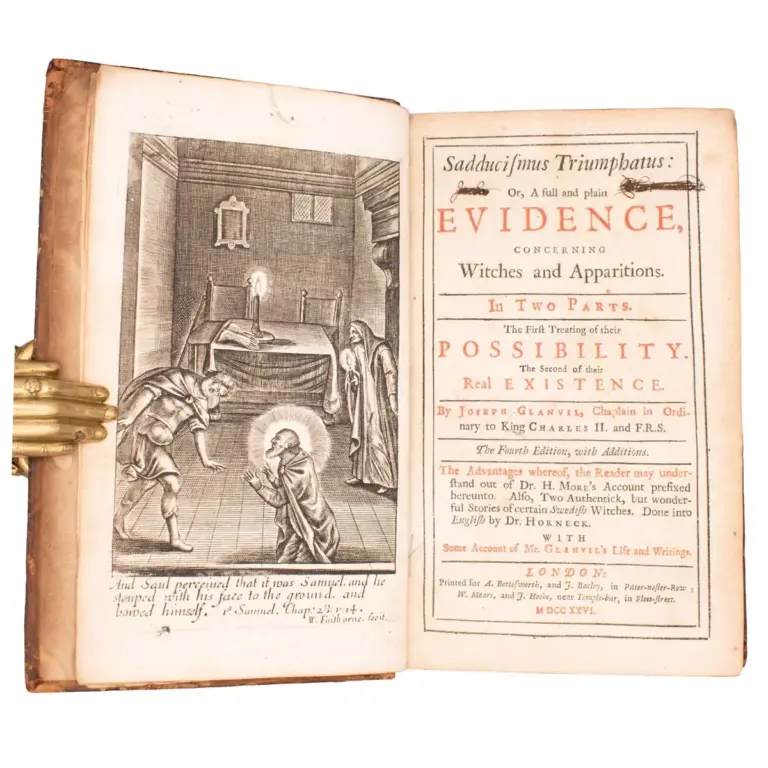
Saducismus Triumphatus: or, Full and Plain Evidence Concerning Witches and Apparitions.
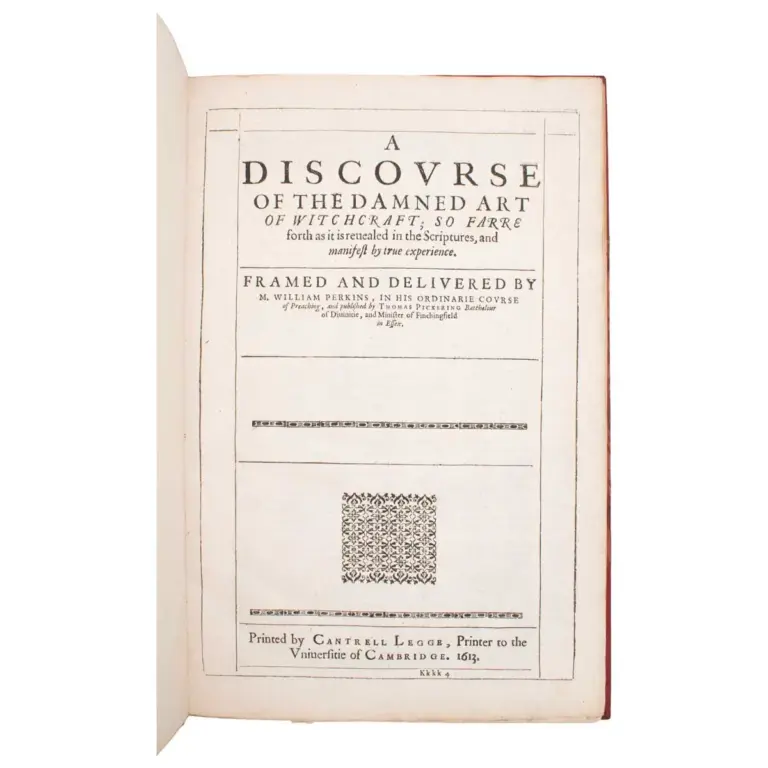
A Discourse of the Damned Art of Witchcraft, so farre forth as it is revealed in the Scriptures, and manifest by true experience