Marshall Rare Books
Saducismus Triumphatus: or, Full and Plain Evidence Concerning Witches and Apparitions.
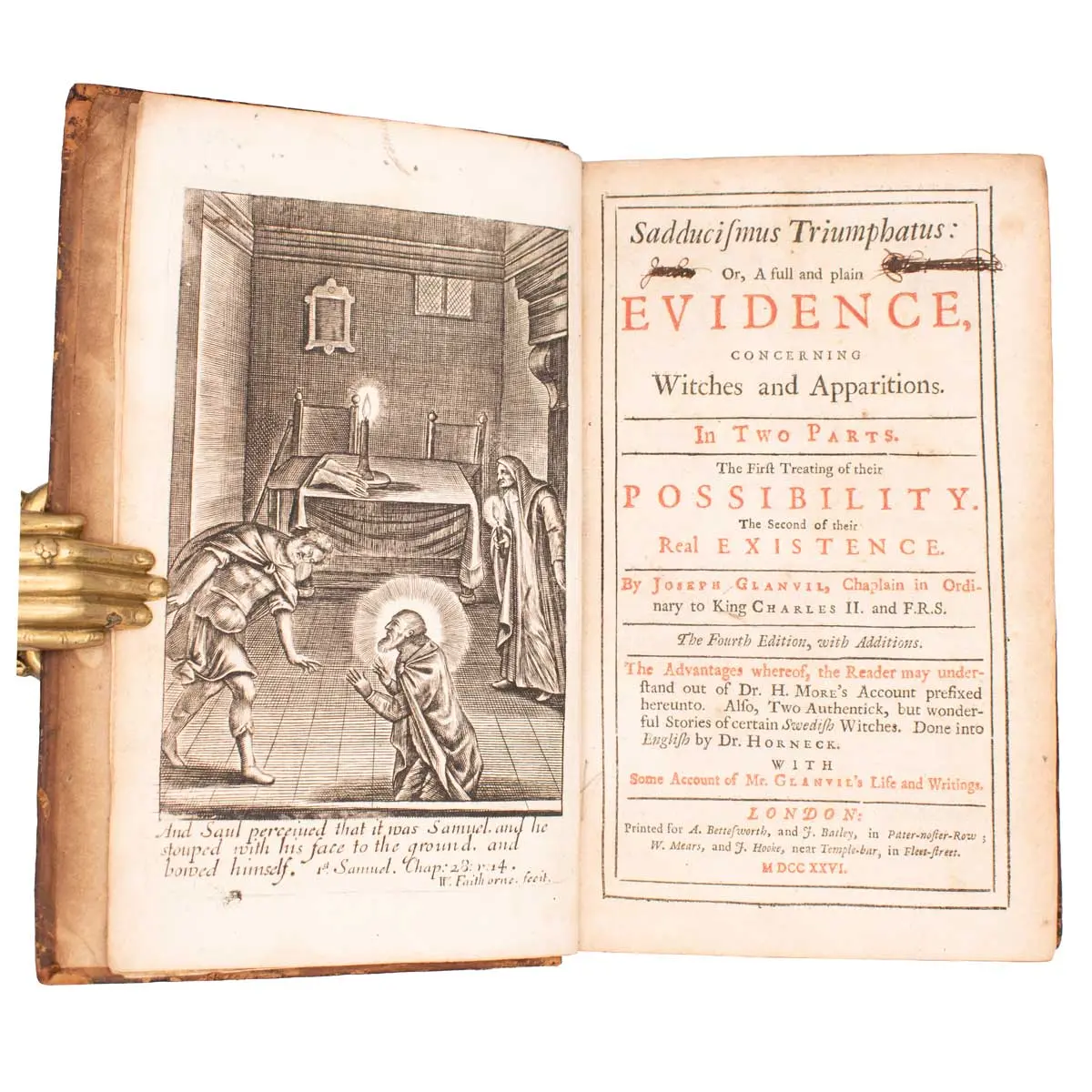
LATER EDITION OF THIS INFAMOUS ATTEMPT TO PROVE THE EXISTENCE OF WITCHES USING SCIENCE.
Fourth Enlarged Edition, two parts in one, (6), 35, (5), 104, (4), 112-161, (8), 223-498, (2)pp., first title in red and black, engraved frontispieces, text illustrations, 1 engraved plate depicting two stones mentioned in relation to the Swedish witches section, woodcut initials and head-and-tail pieces, censored ownership mark to first title, very occasional light staining, contemporary panelled calf, red morocco label to spine, spine a little rubbed, head and tail expertly repaired, bookplate to front pastedown, 8vo, London, A. Bettesworth, J. Batley, 1726.
The expanded edition of Glanvill’s magnum opus on witchcraft, first published posthumously in 1681. This edition includes topical material on witchcraft in Sweden, supplied by Anthony Horneck (from a Dutch pamphlet of 1670). It also contains an early tale on poltergeists and contains one of the earliest descriptions of a ‘witch-bottle’.
Saducismus Triumphatus was the final work published in the exchanges between Joseph Glanvill and John Webster. These works epitomised the exhaustive debate in Restoration England, between the supporters of the new ‘mechanical philosophy’ and their detractors concerning the existence of witchcraft.
Glanvill, with the support of his Cambridge colleague Henry More, sought to provide empirical evidence for the existence of spirits, poltergeists, apparitions and related stories about witchcraft in order to prove the existence of God. The work’s title refers to the Sudduccees, a Jewish sect which denied the existence of spirits and the immortality of the soul. Glanvill did not appear to be so much concerned about witchcraft being a serious threat to life and limb, especially after his careful investigations revealed rather feeble examples, but instead that a denial of the witch was a big step towards the denial of all religion. As Henry More put it: ‘No spirit, no God’. Crucially, such sentiments were also shared by the vast majority of Glanvills informants, mostly fellow clergy, who supplied Glavill and More with large numbers of instances of witchcraft and related phenomena for publication.
The bulk of Saducismus Triumphatus comes from Glanvills earlier “A Blow at Modern Sadducism” first published in 1666. In 1677 John Webster published his response “The Displaying of Supposed Witchcraft”, which attacked Glanvill in an effort to deflect from his own participation in “natural science”. Webster goes as far as suggesting that the bible has been mistranslated to support the belief in witches.
In response, Glanvill wrote a characteristically calm and reasoned refutation of Webster’s scriptural interpretations entitled “A Proof of the Existence of Apparitions, Spirits and Witches, out of Holy Scripture,” which remained unfinished at his death in 1680. Undaunted, More hastily assembled Glanvill’s unfinished work and added it, along with a chapter from his own ‘Enchiridion Ethicum’ and other materials, to “A Blow at Modern Sadducism”. The new collection, Saducismus Triumphatus, represented Henry More’s final effort to silence the ‘Hag-Advocates’.
The frontispiece of the second part shows six examples of evidence for witchcraft. Clockwise from the top left: the drummer of Tedworth; the Somerset witch Julian Cox; rendezvous of witches at Trister Gate; a celestial apparition in Amsterdam; the Scottish witch Margaret Jackson; and the levitation of Richard Jones at Shepton Mallet.
The work was well received, with a fifth edition appearing the same year as this copy. The book strongly influenced Cotton Mather in his Discourse on Witchcraft (1689) and the Salem witch trials held in 1692–3 in Salem, Massachusetts.
[Caillet 4562; Coument G38-10, Brian Levack, The Devil Within, 2013; Thomas Harmon Jobe, The Devil in Restoration Science: The Glanvill-Webster Witchcraft Debate, 1981; Peter Elmer, Witchcraft, Witch-Hunting, and Politics in Early Modern England, 2016]
Books you may also like
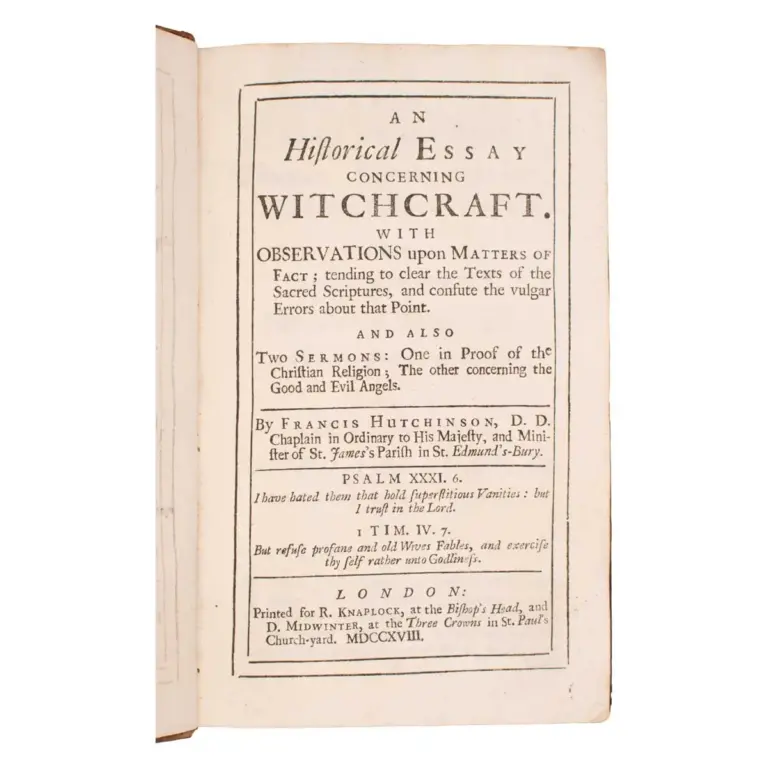
An Historical Essay Concerning Witchcraft. With Observations upon Matters of Fact; tending to clear the Texts of the Sacred Scriptures, and confute the vulgar Errors about that Point.
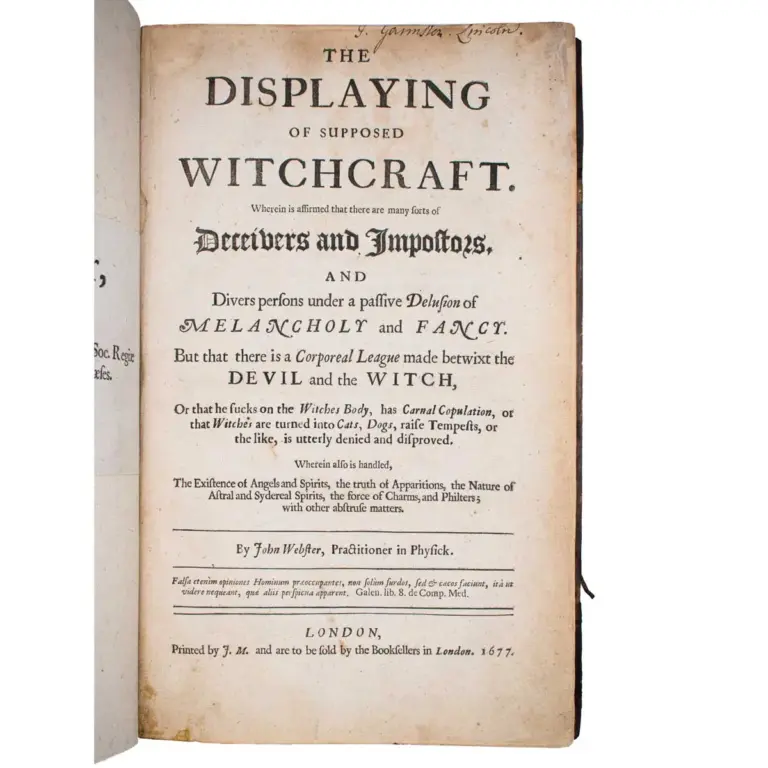
The Displaying of Supposed Witchcraft. Wherein is affirmed that there are many sorts of Deceivers and Imposters. And Divers persons under a passive Delusion of Melancholy and Fancy.
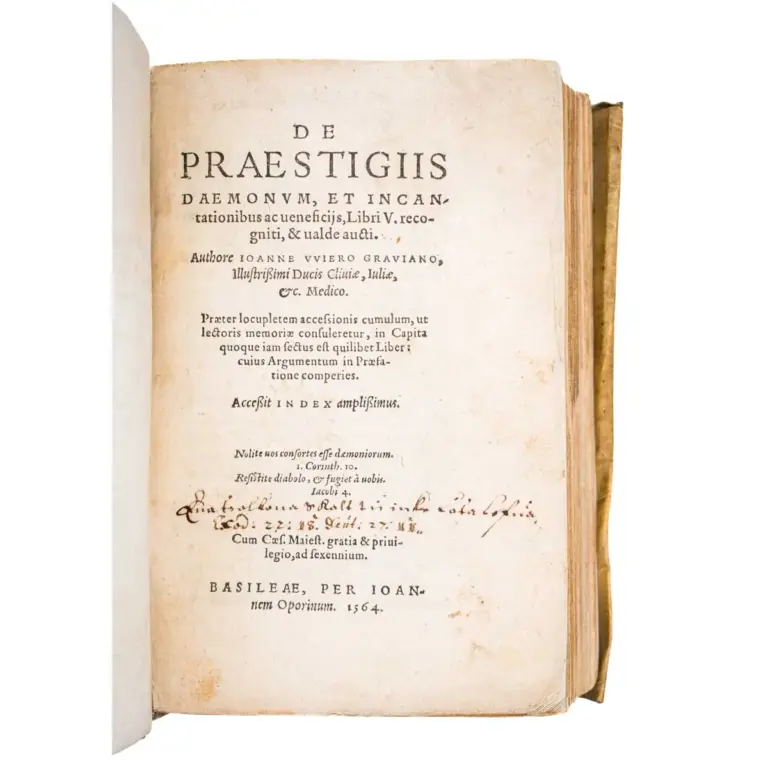
De Praestigiis Daemonum, Et Incantationibus ac ueneficiis, libri V. recogniti, & ualde aucti. Authore Ioanne Vviero Graviano, illustrißimi ducis Cliuiae, Iuliae, &c. medico.
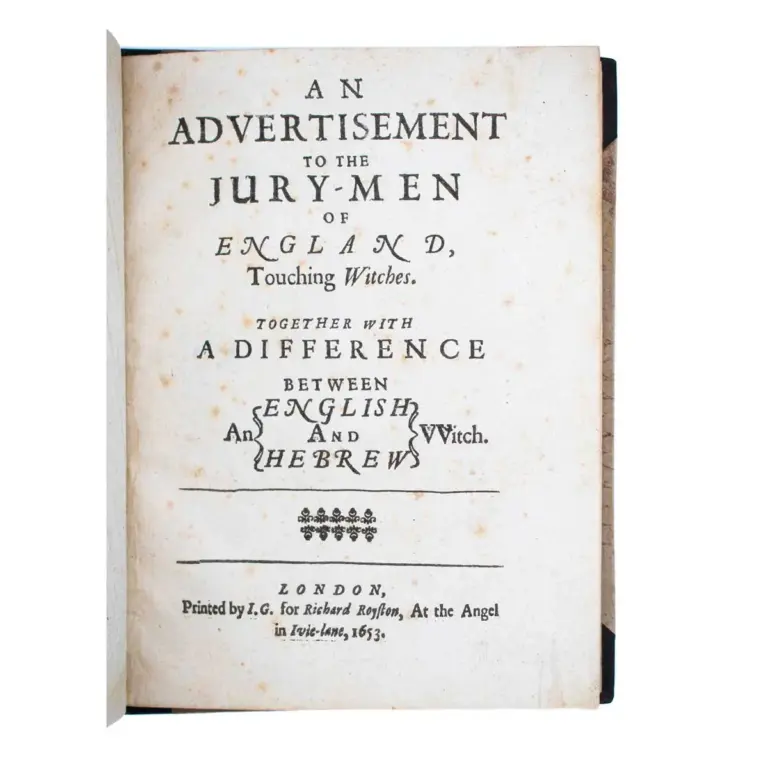
An Advertisement to the Jury-Men of England, Touching Witches. Together with a Difference between an English and Hebrew Witch.